Advances in Engineering Advances in Engineering features breaking research judged by Advances in Engineering advisory team to be of key importance in the Engineering field. Papers are selected from over 10,000 published each week from most peer reviewed journals.

Significance
Invar alloys can be defined as iron-nickel alloys having 30-40% by mass of nickel in their composition. Recent studies have shown that the coefficient of thermal expansion at room temperature for these type of alloys changes significantly depending on the alloy composition. To be precise, iron-nickel alloys with 36% mass of nickel exhibit the lowest coefficient of thermal expansion. This alloys can be fabricated through invar iron-nickel alloy electroforming process (KEEPNEX™). Unfortunately, the strength of the electrodeposited invar alloy films decreases during heat treatment at 600° C due to grain growth. The need to improve the mechanical properties of the electrodeposited invar alloy films after heat treatment has triggered further research. More so, their potential applicability as micro/nano-molds in micro-electromechanical systems is quite motivating owing to their low coefficient of thermal expansion. Surprisingly, most of the available literature on composite electroplating uses only nickel or nickel rich alloys, therefore, little has been done on composite plating using the Invar iron-nickel alloys as the metal matrix.
Kyoto Municipal Institute of Industrial Technology and Culture researchers, Tomio Nagayama and colleagues developed fabricating electrodeposited Invar iron–nickel alloy/Silicon carbide composite films where silicon carbide was used as the hardening fine particle. They hoped to investigate the properties of the electrodeposited composite films correlated to their microstructure, and elucidate on the role of the co-deposited particles and the heat treatment to obtain electrodeposited films of high hardness and low coefficient of thermal expansion. Their work is now published in the research journal, Surface & Coatings Technology.
Briefly, the team begun by adopting modified based Watt-type nickel plating bath to prepare the iron-nickel bath. They then applied the composite electroplating method to electrodeposit invar iron-nickel composite films. Eventually, the research team assessed the composite films and correlated them to their microstructure.
The authors were able to obtain Invar iron–35-37% by mass nickel alloy/Silicon carbide composite films with the silicon carbide contents up to 20.8% by volume. The team observed that the co-deposition of silicon carbide particles increased the hardness of the electrodeposited films and suppressed the decrease in hardness by the heat treatment at 600° C. To be precise, they noted that the hardness of the films with around 20% by volume of silicon carbide remained almost unchanged after the heat treatment, and was comparable to that of the as-deposited Invar alloys without silicon carbide and higher than that of pyrometallurgically produced Invar alloys.
Tomio Nagayama and colleagues have successfully fabricated electrodeposited invar iron-nickel alloy/Silicon carbide composite films and assessed the effects of heat treatment in a bid to improve the mechanical properties of the electrodeposited invar alloy films. It has been seen that the heat treatment reduces the coefficient of thermal expansion of the composite film as with the electrodeposited invar iron-nickel alloy. The results are positive and have shown that the composite films can be used in the fabrication of microelectromechanical systems elements which require high mechanical strength and high thermal dimensional stability.
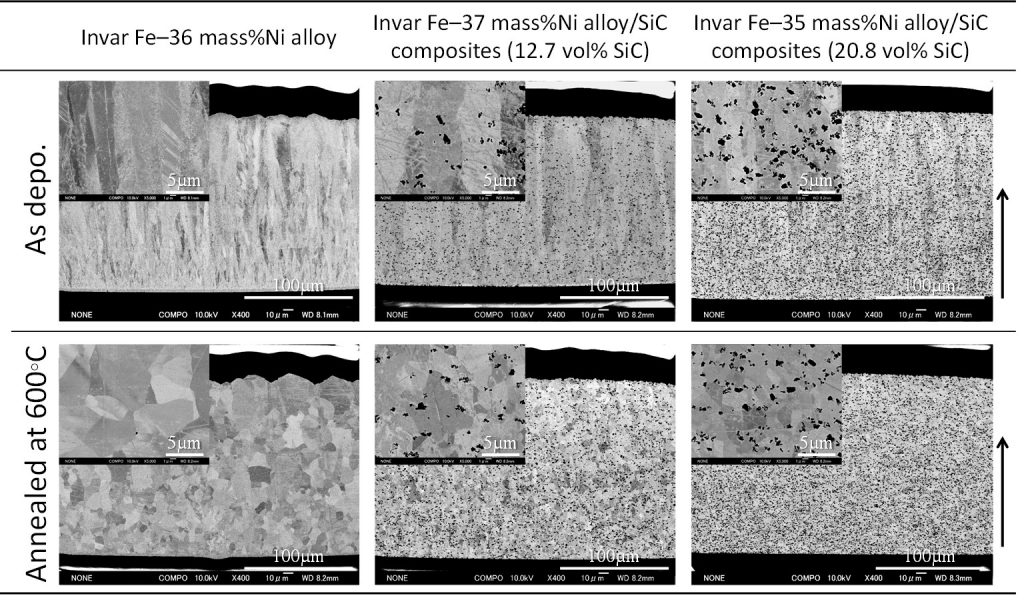
Figure legend: Backscattered electron images of the cross section of the electrodeposited Invar Fe–36 mass% Ni alloy films and the electrodeposited Invar Fe–35 mass% Ni alloy/SiC composites before and after heat treatment at 600°C. Arrows show film growth direction.



Reference
Tomio Nagayama, Takayo Yamamoto, Toshihiro Nakamura, Yutaka Fujiwara. Properties of electrodeposited invar Fe–Ni alloy/SiC composite film. Surface & Coatings Technology volume 322 (2017) pages 70–75.
Go To Surface & Coatings Technology