Advances in Engineering Advances in Engineering features breaking research judged by Advances in Engineering advisory team to be of key importance in the Engineering field. Papers are selected from over 10,000 published each week from most peer reviewed journals.

Significance
Semiclathrate hydrates is built from extended hydrogen-bonded water networks stabilized by bulky quaternary ammonium ions, they resemble ice in topology but behave in very differently in transport and electrochemical response which made them attractive in cold-energy storage and low-temperature electrochemical systems. Semiclathrate hydrates contain no obvious ionic sublattice designed for migration not like conventional solid electrolytes but instead, any electrical response must emerge from rearrangements inside a hydrogen-bonded framework that is only partially perturbed by guest ions. Earlier work on tetra-n-butylammonium halide semiclathrate hydrates established that protons act as the dominant charge carrier under low-temperature conditions, however, electrical conductivity varies widely among hydrates with different anions, even when their crystal structures appear closely related. Diffusion coefficients inferred from spectroscopic probes do not track these changes in conductivity in a straightforward way. This mismatch points to a missing variable, one that modulates charge transport without strongly affecting molecular mobility. Proton concentration inside the hydrate lattice presents itself as a plausible candidate, but it resists direct measurement. Protons in these systems are not free species; they exist as lattice defects, transiently localized within hydrogen-bond rearrangements that resemble Bjerrum defects in ice. Counting them experimentally inside a solid crystal remains beyond current techniques. As a result, prior discussions of proton concentration effects have relied on indirect arguments or comparisons across unrelated systems, leaving considerable uncertainty in how anion chemistry influences defect populations.
Carboxylate-based semiclathrate hydrates introduce an additional layer of complexity. Compared with halides, carboxylate anions engage the water framework through multiple oxygen atoms and, in many cases, carry alkyl substituents that intrude into hydrate cages otherwise vacant. These structural features are expected to influence hydrogen-bond geometry, local rigidity, and defect formation energies, yet systematic electrochemical data on single-crystalline carboxylate hydrates have been scarce. Most prior studies emphasized phase behavior or thermal properties rather than charge transport. A recent research paper published in ACS Applied Energy Materials and conducted by Ms. Riko Tsugaya, Dr. Jin Shimada, Professor Takeshi Sugahara, and Professor Takayuki Hirai from the University of Osaka, the researchers developed a comparative electrochemical framework for single-crystalline tetra-n-butylammonium carboxylate semiclathrate hydrates. They combined impedance spectroscopy, deuterium NMR, and solution acidity measurements to separate proton mobility from proton population effects. The work establishes defect concentration within hydrogen-bond networks as the dominant variable governing electrical conductivity in these systems.
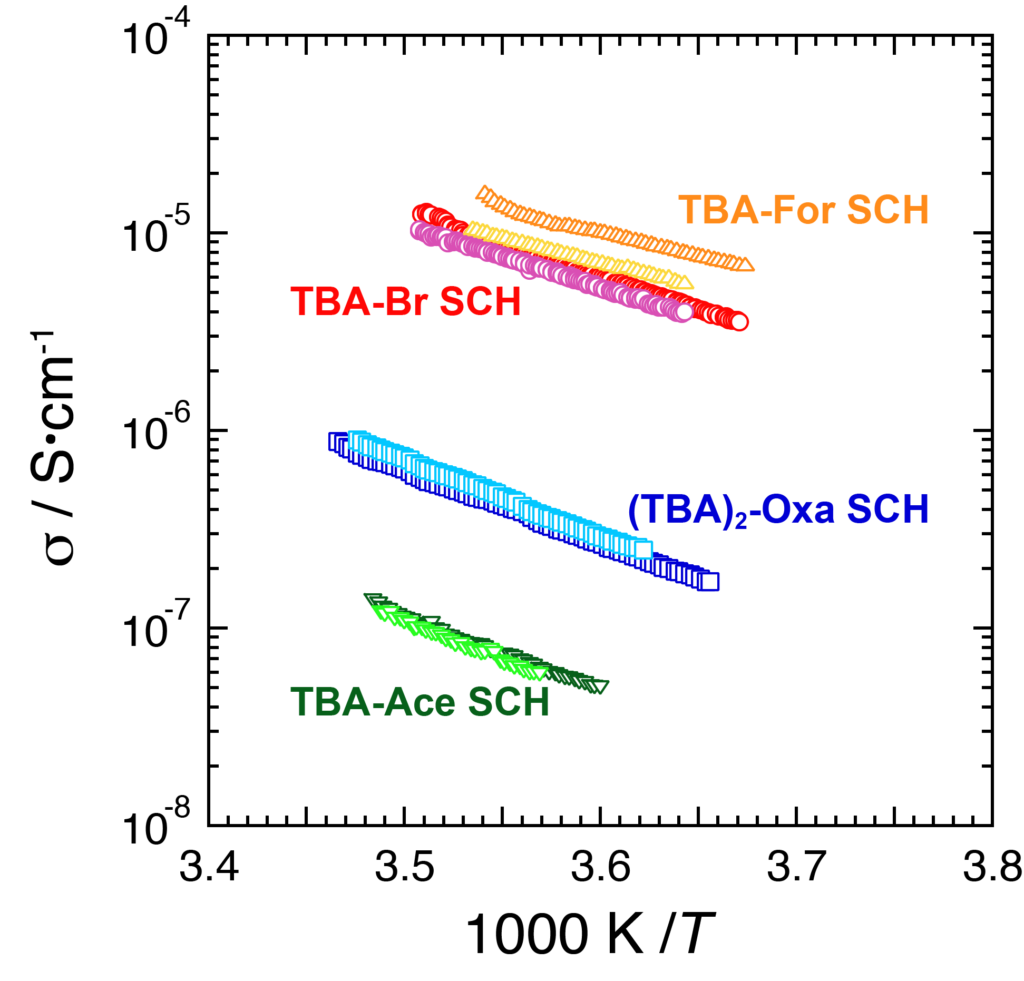
The research team prepared single-crystalline semiclathrate hydrates of tetra-n-butylammonium formate, acetate, and oxalate directly between platinum electrodes, ensuring that the measured response reflected bulk crystal properties rather than interfacial artifacts. They grew crystals slowly near equilibrium temperatures, to minimize cracking and excluded secondary phases, a practical decision that later proved decisive for reproducible impedance measurements. They used electrochemical impedance spectroscopy across a broad frequency range, to extract both electrical conductivity and relaxation times as functions of temperature. All three hydrates displayed thermally activated behavior consistent with Arrhenius-type conduction but the magnitude of the conductivity varied sharply among them. The researchers observed the highest conductivity in the formate hydrate, intermediate values in the oxalate system, and markedly lower conductivity in the acetate analogue and this ordering did not mirror simple expectations based on anion size or charge alone. They also reported that acetate and oxalate hydrates showed higher activation energies than the formate system. The authors linked electrochemical data to structural considerations. Carboxylate anions replace water molecules at the edges of hydrate cages, and alkyl-substituted carboxylates occupy cage regions that remain empty in halide hydrates. The researchers argued that such occupancy constrains rotational motion of oxygen atoms involved in hydrogen bonding, and raise the energetic cost of rearrangements that accompany proton transfer.
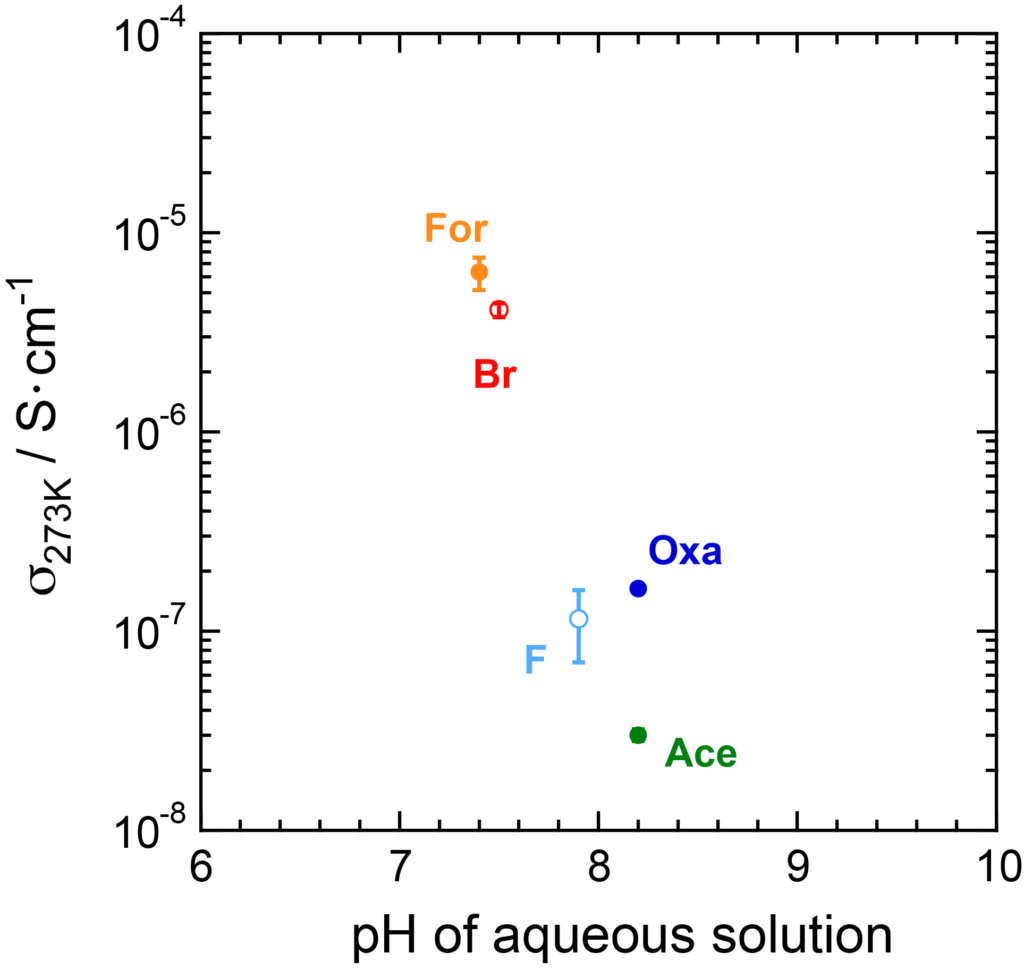
The investigators performed solid-state deuterium NMR measurements on deuterated formate and oxalate hydrates to test whether proton mobility itself controlled the observed trends. They found that spin–lattice relaxation times reflected water reorientation dynamics and the similarity of these relaxation times to those reported earlier for halide hydrates indicated that proton diffusion coefficients remained comparable across systems. The finding eliminated proton mobility as the dominant variable behind conductivity differences. Moreover, direct measurement inside the crystal remained impractical, so the researchers adopted an indirect strategy. They measured the pH of aqueous solutions obtained after dissociating the hydrates, treating solution acidity as a proxy for the number of protons incorporated into the solid lattice. When electrical conductivity values were plotted against these pH levels, a clear correlation emerged: hydrates associated with lower pH solutions exhibited higher conductivity.
There is also a practical payoff that engineers will appreciate. Low-temperature conductivity measurements are fragile, time-consuming, and unforgiving of experimental noise. The study shows that electrical conductivity tracks closely with the acidity of the solution from which the hydrate forms. That connection gives engineers a way to narrow down promising candidates using straightforward solution measurements, long before committing to crystal growth or impedance experiments. In a materials development workflow, that kind of shortcut can save months. The work of Professor Takeshi Sugahara and colleagues reshapes how proton-conducting solids at low temperature can be viewed. These hydrates move protons without relying on liquid water, polymer matrices, or heavily doped ceramic frameworks. Conductivity can be adjusted through chemistry while the material remains crystalline and rigid. For engineers dealing with sensing platforms, electronics exposed to cold environments, cryogenic electrochemical systems, or monitoring hardware in icy settings, this is not a small detail. It points to materials that remain functional where many established electrolytes either freeze, crack, or lose reliability.
This distinction has practical consequences. Efforts to tune electrochemical properties through lattice softening or dynamic disorder may yield limited returns if defect concentrations remain fixed. The present findings suggest that chemical design strategies should instead focus on how guest ions stabilize or destabilize defect states within the hydrogen-bond network. Small structural changes in anions, including the presence or absence of alkyl substituents, can shift defect energetics enough to alter conductivity by orders of magnitude. The work also sharpens the link between semiclathrate hydrates and ice-based proton conductors. While both rely on similar defect-mediated mechanisms, semiclathrate hydrates offer chemical handles unavailable in pure ice. Anion selection becomes a way to bias defect populations without drastically modifying the underlying framework. This opens a path toward rational tuning, provided the limits of structural stability and thermal robustness are respected.
Reference
Tsugaya, Riko & Shimada, Jin & Sugahara, Takeshi & Hirai, Takayuki. (2025). Electrical Conductivity in Tetra-n-butylammonium Formate, Acetate, and Oxalate Semiclathrate Hydrates. ACS Applied Energy Materials. 8. 10.1021/acsaem.5c02210.