Advances in Engineering Advances in Engineering features breaking research judged by Advances in Engineering advisory team to be of key importance in the Engineering field. Papers are selected from over 10,000 published each week from most peer reviewed journals.

Significance Statement
The use of molecular devices is of current interest in areas such as nanotechnology, advanced materials, electronics, sensors and drug delivery systems. Some are able to switch their structural states when external factors such as temperature, light or pH are applied. Certain molecules that are responsive to light involve photoisomerization of a double bond, producing a large change in molecular shape. The ability to turn photoisomerization on and off by means of a second external stimulus would be useful, and employing pH for this purpose is reported here.
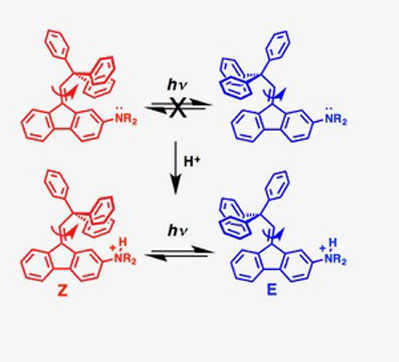
Researchers led by Dr. Udaya Jayasundara and Professor Thomas Bell at the University of Nevada published new research in the journal, ChemPhysChem, discussing the discovery of proton-gated photoisomerization of derivatives of 9-(2,2,2-triphenylethylidene)fluorene (TEF). The researchers capitulated on structural changes during the photoisomerization phenomenon, as the molecules contain a dibenofulvene chromophore, which acts as a rotor about the exocyclic C=C bond.
The authors investigated photoisomerization of two different 2-substituted 9-(2,2,2-triphenylethylidene)fluorene molecules, 2-amino-9-(2,2,2-triphenylethylidene)fluorene (ATEF) and 2-dimethylamino-9-(2,2,2-triphenylethylidene)fluorene (DTEF), with and without addition of trifluoroacetic or trifuoromethanesulfonic acid. In acetonitrile solution, both ATEF and DTEF have negligible photoisomerization efficiencies (quantum yields) in the free base form with the 2-position nitrogen atom unprotonated. Upon addition of acid, both compounds become photoactive and their E and Z isomers are interconverted rapidly.
The authors compared the protonation effect of trifluoromethanesulfonic acid with trifluoroacetic acid and triethylamine. It was discovered that trifuoromethanesulfonic acid produced higher quantum yields, resulting from full protonation, which wasn’t the case for other added substances. Likewise, fewer equivalents of trifuoromethanesulfonic acid were needed for full protonation and gave less photodecomposition than trifluoracetic acid.
The authors found a good correlation between the photoisomerization quantum yields and levels of protonation in acetonitrile solution and discovered that amine protonation increased efficiency by factors of 30-60 compared to unprotonated cases.
This work introduced four new polar substituents (NH2, NH3+, NMe2, and NMe2H+) at the 2-position of 9-(2,2,2-triphenylethylidene)fluorene, in addition to the previously reported four (tBu, NO2, CN and I). Listing them in order of increasing quantum yield shows that electron withdrawing groups generally increase photoisomerization efficiency, but the list does not exactly correlate with the order of substituent electronegativity. In the cases of ATEF and DTEF, protonation may turn on photoisomerization by eliminating intramolecular charge transfer, which hinders effective photoisomerization of these molecular devices.
According to the authors, “Such molecules could be used in light controlled actuators, storage registers and power sources, as well as in switching and sensing applications.”
The two derivatives of 9-(2,2,2-triphenylethylidene)fluorene investigated by the authors have excellent molecular sensing features which are of relevance to numerous fields, including nanotechnology and drug delivery systems.


Reference
Jayasundara, U.K., Kim, H.J., Sahteli, K.P., Cline, J.I., Bell, T.W. Proton-Gated Photoisomerization of Amino-Substituted Dibenzofulvene Rotors, ChemPhysChem 18 (2017) 59-63.
Go To ChemPhysChem