Advances in Engineering Advances in Engineering features breaking research judged by Advances in Engineering advisory team to be of key importance in the Engineering field. Papers are selected from over 10,000 published each week from most peer reviewed journals.

Significance
Radioactive wastes are extremely dangerous and require development of effective waste management strategies to minimize their impact to both human health and the environment. Generally, they exist in various forms, states, and concentrations requiring various treatment and management strategies. Presently, three main radioactive waste management techniques used include concentration and isolation, diluting to acceptance levels before discharging into the environment and storing the radioactive wastes to allow natural decay of their radioactivity properties.
Among the radionuclides present in radioactive wastes, highly radiotoxic uranium (U) has attracted significant research attention. Its naturally occurring isotopes decay mainly by emission of alpha particles, a form of highly ionizing corpuscular radiation. Therefore, to ensure safe storage and significantly minimal impact on the environment, development of new materials and processes for decontamination and reduction of uranium-containing wastes volume is highly desirable. The use of sorbents has increased over the past decades owing to their ability to remove specific contaminants from the solution. This is quite favorable for treatment of uranium-based radioactive aqueous wastes through volume reduction and separation of the radionuclide from the aqueous matrix. Alternatively, by-products from agricultural activities have been identified as a promising solution for wastewater treatment since it has the potential to enhance waste reduction, recovery, and reuse. In particular, biochars exhibit great potential as adsorbent materials for removing heavy metals from aqueous solutions, therefore ideal for low-cost wastewater treatment.
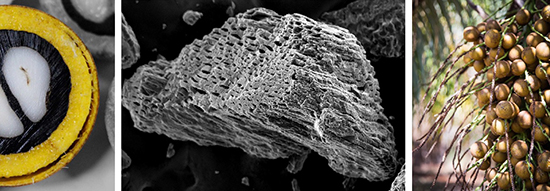
Biochar is generally produced from thermal degradation of carbon-rich biomass in an oxygen-deficient environment. Pyrolysis process allows heating of organic matter in the absence of oxygen to relatively higher temperatures for production of both liquid and solid products depending on the heating time and highest treatment temperature in the pyrolysis reactor. Besides, biochar has been produced from different feedstock types with varying composition and biomass yield. Specifically, the stiff nut shell, otherwise known as endocarp, from macauba tree has exhibited potential use for biochar production.
In the paper published in the journal, Biomass and Bioenergy, Brazilian scientist at the Nuclear and Energy Research Institute in Sao Paulo, Dr. Sabine Neusatz Guilhen together with Dr. Ondrej Masek from the University of Edinburgh investigated the effects of pyrolytic temperature on the biochar produced from the macauba endocarp. By subjecting the endocarp to six different pyrolytic temperatures in the range of 250 to 750°C, different biochars were produced and each of which had their capacities assessed for uranium adsorption. The main objective was to evaluate the feasibility of using macauba biochar in the removal of uranium by selecting favorable pyrolytic temperature to maximize the adsorbents’ removal capacities.
“Agribusiness represents a significant participation in the Brazilian economy. The diversity of biomasses and the availability of renewable resources enable strategic uses of wastes from the agro-industrial supply chain directed to the production of value-added materials. Said Dr. Sabine Neusatz Guilhen in a statement to Advances in Engineering. Then she added “Macaúba (Acrocomia aculeata) is a palm tree of high prevalence in drier areas such as semiarid biomes in the Americas, including the Brazilian’s savannah (called “Cerrado”), and one of the most promising natural and renewable sources of vegetable oil for cosmetics, food and biofuels. The endocarp, resulting from the processing of the macauba coconuts’ nut oil, can be transformed to biochar by pyrolysis. Its use as an adsorbent material reveals many sustainable opportunities for a wide range of applications.
Pyrolytic temperature exhibited a significant influence on the properties and the stability of the macauba biochar. For instance, an increase in the temperature resulted in a decrease in the biochar yield and a corresponding increase in the fixed carbon content. Highest adsorption capacities were obtained at lower temperatures, 250°C and 350°C, with removal efficiencies of 86% and 80% respectively. However, a balanced gravimetric yield, carbon content and adsorption capacities were obtained at temperatures ranging from 300 to 350°C. This qualified 350°C as the ideal working temperature for uranium removal from aqueous solutions. Even though characteristics of the macauba biochar influencing uranium removal were not fully elucidated, the study will pave way for the treatment of other radioactive contaminants thus leading to sustainable radioactive waste management strategies. “The custom design of biochars requires a primary understanding of the biomass properties, as well as a full comprehension of the effects involved in the pyrolysis process. This way, the properties can be engineered for the targeted use of the biochars.” Commented Dr. Sabine Neusatz Guilhen, first author on the paper.

Reference
Guilhen, S. N., Mašek, O., et al. (2019). Pyrolytic temperature evaluation of macauba biochar for uranium adsorption from aqueous solutions. Biomass and Bioenergy, 122, 381-390.
Go To Biomass and Bioenergy