Advances in Engineering Advances in Engineering features breaking research judged by Advances in Engineering advisory team to be of key importance in the Engineering field. Papers are selected from over 10,000 published each week from most peer reviewed journals.

Significance
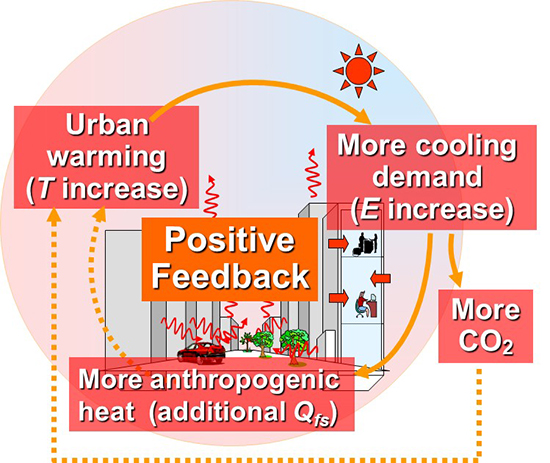
Urban communities are vulnerable to many risks associated with climate change, raising concerns due to rapid urbanization globally. Large urban agglomerations are experiencing an alarming increase in surface air warming attributed to urban heat island (UHI) and global warming. One of the main causes of UHI is the anthropogenic heat (Qf)-induced feedback, which defines the interaction between the building cooling energy demand (E) and the urban air temperature (T) to generate well-known positive feedback (PFB). PFB is governed by sensible anthropogenic heat (Qfs) and is referred to as Qfs–T–E PFB in this study. Although PFB has several adverse effects in urban climates, like inducing self-reinforced warming, its effects remain poorly understood primarily due to theoretical difficulties.
An increase in urbanization increases the urban demand for cooling energy, which could further enhance the adverse effects of PFB. Though Qfs–T–E PFB is among the interactional processes influencing urban climates, many studies have focused on quantifying the impacts of some of the involved elementary processes rather than its effects as a whole. In addition to the difficulties in isolating the effects of PFB, the energy balance issue is another limitation hindering the understanding of the Qfs–T–E PFB effects despite the remarkable attempts. Thus, overcoming these limitations is important and requires feasible and effective approaches.
Herein, Professor Yukihiro Kikegawaand Ms. Kazusa Nakajima from Meisei University in collaboration with Dr. Yuya Takane from National Institute of Advanced Industrial Science and Technology, Professor Yukitaka Ohashi from Okahyama University of Science, and Associate Professor Tomohiko Ihara from The University of Tokyo quantified the effects of Qfs–T–E PFB on urban energy-climate systems. Osaka, a beautiful Japanese city with a humid subtropical climate, was selected for this study. The main purpose was to analyze and clarify the Qfs–T–E PFB effects on Osaka City during cooling seasons. The work is published in the journal, Applied Energy.
In their approach, the authors first focused on the observable impacts of Qfs–T–E PFB on E caused by the increased consumption of urban energy from weekends to weekdays. The weekend-to-weekday increase and differences in ground-level T and their associated impacts were observed and analyzed for 15 districts in Osaka with the help of the proposed urban meteorological model, weather research and forecasting, urban canopy and building energy models (WRFCM-BEM). The model was validated for selected three districts (commercial buildings, apartment buildings and detached dwelling districts) and applied to quantify the self-reinforcement of the energy-climate systems of urban areas by estimating the impact of PFB on T.
The research team showed that the contrasts in energy consumption for the weekdays and weekends were induced by the Qfs–T–E PFB effects, resulting in a 10% feedback gain and 0.7 °C increase in T on weekdays. The observed PFB impact on T and E could be reproduced with a root mean square error of 1.5 °C for T and a normalized mean absolute error of 8.7 – 12.6% for electric energy consumption using the model. For the three districts, the observable estimates were comparable to those in the previously reported studies.
The validated model was also used to quantify the unobservable impact of Qfs–T-E PFB by considering the feedback gain as a percentage of T variation induced by PFB. The estimation of the feedback gain represented the sensitivity of Qfs to T and its inverse sensitivity with a and without the influence of Qfs–T–E PFB, respectively. Weekdays-run and holidays-run simulations were used to quantify the gain to circumvent the effects of the energy imbalance. The resulting feedback gain had a daytime average of 10% and 20% in the downtown commercial and leeward located resident areas, respectively, indicating the impact of the sea breeze heat advection on the feedback gain.
In summary, the authors reported the quantification of previously unquantified Qfs–T–E PFB effects on urban climates by also considering the effects of other feedbacks causing the variation in urban air humidity. The estimated impacts on E and T were realistic and comparable with those in previous studies that were not based on observable validations. Compared to the feedback impacts on global surface warming with a feedback gain of about 50%, the reported impact level was relatively less and non-negligible. In a statement to Advances in Engineering, Professor Kikegawa said their findings will advance our understanding of energy-climate systems in urban areas.




Reference
Kikegawa, Y., Nakajima, K., Takane, Y., Ohashi, Y., & Ihara, T. (2022). A quantification of classic but unquantified positive feedback effects in the urban-building-energy-climate system. Applied Energy, 307, 118227.