Advances in Engineering Advances in Engineering features breaking research judged by Advances in Engineering advisory team to be of key importance in the Engineering field. Papers are selected from over 10,000 published each week from most peer reviewed journals.

Significance
Resilient engineering and reliable engineering are both two sides of the same coin; i.e., reliable engineering seeks to provide a set of techniques to evaluate and maintain functional and operational capacity within a predictable environment, while as resilient engineering aims to provide an alternative set of tools to retain or recover such capacity under extreme conditions or events. In light of this, the resilience concept has been gaining popularity within the research community, particularly within the infrastructure system domain which is prone to increasing rate of disruptions attributable partially to climate change and partially to aging infrastructure. Typically, extreme events can have various degrees and scale of disruptive consequences depending on the characteristics of a city. As such, an in-depth understanding of disruptive forces and their interdependencies with a city’s particular characteristics can lead to effective management strategies. In fact, such comprehension could aid minimize the external and far-reaching impacts of disruptive events through effective education and awareness of the citizens of a city.
Indeed, resilience is a topic with a myriad of concepts and definitions, driven by the lack of consensus of what it actually consists of. In most cities, transportation systems are comprised of various elements including: pavements, drainages and sewer systems. The interdependency of these elements is critical to their overall efficacy; a great factor in determining suitability of habitability of the city. In general, a city’s transportation system ought to be both resilient and reliable. Therefore, to be in congruence with this, suitable evaluation techniques ought to be developed. On this account, Stevens Institute of Technology researchers: Raif Bucar (PhD candidate), and Professor Yeganeh M. Hayeri, developed a new quantitative method for evaluating the level of robustness of the surface transportation system of the city of Hoboken, New Jersey, by assessing traffic engineering metrics under specific rainfall scenarios. Their aim was to address the impacts of flood events on urban street networks. Their work is currently published in the research journal, Reliability Engineering and System Safety.
In their approach, macro-traffic simulation techniques were used on disrupted and undisrupted scenarios to assess the increase on the network’s mobility and accessibility. Local topographical aspects of the terrain were analyzed to identify portions of the network more prone to disruption. Flood maps were used to systematically remove links from the network, generating its disrupted state for different scenarios. The traffic assignment model generated routes using k-shortest path methods with link impedance penalty functions, selecting them based on user equilibrium assumption.
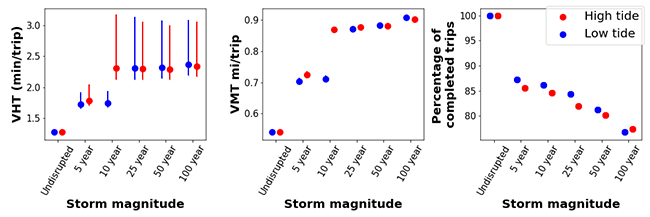
The authors reported that their results indicated the viability of the method to analyze the impacts of flood events of different severity and duration. More so, the successful validation of the presented technique indicated its viability as a tool for benefit cost analysis of urban improvement projects including resilience plans for high-risk cities. Remarkably, their analysis was validated using the City of Hoboken, New Jersey’s transportation network and flood models.
In summary, the Bucar-Hayeri study presented a framework to evaluate the effects of precipitation induced flood events in urban cities. Based on their approach, one can state that the estimated loss of performance for each scenario is a representation of an urban environment’s lack of robustness to these disruptive events. Exceptionally, the framework extends the body of knowledge of resilience engineering by providing a method to assess a system’s vulnerability to disruptive events based on both link-level and global performance metrics. In a statement to Advances in Engineering, Professor Yeganeh Hayeri explained that their novel approach supports the body of knowledge of reliability engineering by providing an alternative set of tools to evaluate system functionality under the effects of extreme events. She further added that the obtained results can be applied to cities with a high chance of flooding and should help authorities to effectively review their infrastructure strategic plans as well as their short and long-term urban mobility plans.



Reference
Raif C.B. Bucar, Yeganeh M. Hayeri. Quantitative assessment of the impacts of disruptive precipitation on surface transportation. Reliability Engineering and System Safety 203 (2020) 107105