Advances in Engineering Advances in Engineering features breaking research judged by Advances in Engineering advisory team to be of key importance in the Engineering field. Papers are selected from over 10,000 published each week from most peer reviewed journals.

The Effect of Guest–Host Interactions
Significance
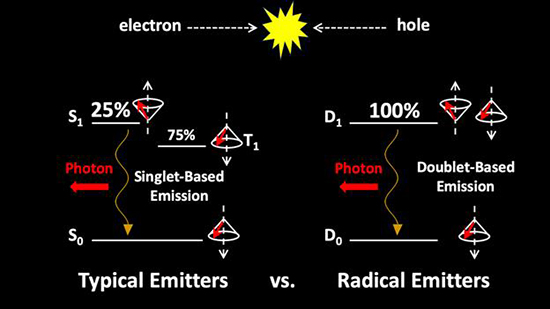
Organic Light Emitting Diodes (OLEDs) are solid-state devices composed of thin films of organic molecules that create light with the application of electricity. Their recent penetration into the high-end market of commercial electronic devices has been triggered by their outstanding properties: i.e. light weight, panel flexibility, low power consumption, high brightness, and high contrast. In purely organic emitters with a closed-shell electronic structure, according to spin statistics, the recombination of the electrons and holes injected at their respective electrodes generally produces singlet and triplet excitons in a ratio of 1:3. Since the lowest triplet electronic state (T1) is normally located below the lowest singlet state (S1) in fluorescent emitters, only 25% of generated excitons can be harvested. Thus, to avoid losing 75% of the input power, several strategies have been explored to harvest the triplet excitons. The most notable involve the use of heavy metal-based phosphors (which are at the heart of the light-emitting materials currently used in commercial OLEDs) or, over the past decade, of purely organic thermally activated delayed fluorescence (TADF) emitters. Very recently, in parallel to these efforts, a novel design paradigm has emerged based on neutral organic radical-carrying emitters with an open-shell electronic structure.
In general, despite the extensive efforts conducted to improve the luminescence efficiency of radical-based optoelectronic devices, the details of how the excited states form remain elusive, a consequence of the complexity of these systems. Also, there is a lack of in-depth investigations to unveil the effect that the host matrix can have on the radical excited-state radiative and nonradiative decay properties. Since these processes are critical in device operation, it appears highly desirable to gain a much greater understanding of their characteristics in order to guide the development of radical-based materials for OLEDs and other applications. On this account, scientists at the University of Arizona: Dr. Hadi Abroshan, Professor Veaceslav Coropceanu and Professor Jean-Luc Brédas used multi-scale simulations to describe the factors determining the optoelectronic properties of radical emitters in realistic solid-state morphologies. Their work is currently published in the research journal, Advanced Functional Materials.
In essence, the research team proposed to address the aforementioned challenges of emitter–host interactions from a theoretical perspective. Generally, by combining molecular dynamics simulations and density functional theory calculations, the impact of the host matrix on the optoelectronic performance of radical emitters was evaluated, taking as a representative example the (4-ncarbazolyl-2,6-dichlorophenyl)bis(2,4,6-trichlorophenyl)-methyl (TTM-3NCz) radical emitter dispersed in a 4,4-bis(carbazol-9-yl)biphenyl (CBP) host. Ideally, the team chose to rely on a multi-tiered computational approach to study the morphology and electronic properties of emissive layers containing radical emitters.
The morphological analysis showed that steric effects around the radical centers, carried by the TTM electron-poor moieties of the emitters, disfavored π–π interactions with the host molecules, which lead to random intermolecular orientations around the TTM moieties. Moreover, the authors reported that the 3NCz electron-rich moieties of the emitters, however, had much lesser spatial hindrance for intermolecular π–π stacking, which modulates the structural and electronic properties of the emitters in the host matrix. The results also underlined that the host–emitter interactions taking place in the solid state can reduce the dynamic disorder in the excited states of the radical emitters, a feature that can be used to tune the optoelectronic properties of radical-based OLEDs.
In a statement to Advances in Engineering, the authors highlighted that their work provided vital inputs in this field and future studies will determine the best ways to tune these interactions via a selection of the host materials that can promote stronger electroluminescence of the emissive layers. Importantly, applications of radical-based organic materials are not limited to OLEDs but can potentially extend to fields including spintronics, imaging, and quantum information technologies.



Reference
Hadi Abroshan, Veaceslav Coropceanu, Jean-Luc Brédas. Radiative and Nonradiative Recombinations in Organic Radical Emitters: The Effect of Guest–Host Interactions. Advanced Functional Materials 2020, volume 30, 2002916.