Advances in Engineering Advances in Engineering features breaking research judged by Advances in Engineering advisory team to be of key importance in the Engineering field. Papers are selected from over 10,000 published each week from most peer reviewed journals.

Significance
Fluid catalytic cracking has long occupied a central position in petroleum refining, not simply because of its economic role, but because of the unusual way it brings together transport phenomena and chemical transformation within a single circulating system. An FCC unit functions through the continuous movement of catalyst between two sharply contrasting environments. In the reactor, hydrocarbon cracking absorbs heat and progressively alters catalyst activity, while in the regenerator, coke combustion restores activity and releases substantial thermal energy. These opposing processes are inseparable in practice. Changes introduced in one part of the loop inevitably reshape conditions elsewhere, making the unit behave as a tightly coupled system rather than a collection of independent components. Even after decades of industrial operation, this coupling remains difficult to describe quantitatively at scale. Most computational studies to date have approached FCC modeling by isolating individual sections, most commonly the riser or the regenerator. This strategy has yielded useful insight into local flow structures and reaction trends, but it also imposes a fundamental limitation. By breaking the loop, such models cannot capture how disturbances in catalyst circulation, temperature, or coke loading propagate through the system. In operating units, modest shifts in residence time or regeneration severity can alter gas–solid distributions upstream and downstream, often in ways that are not intuitive. Addressing these interactions requires models that follow the catalyst continuously as it moves through the entire loop. The challenge, however, extends beyond assembling a large geometric domain. FCC units span several distinct flow regimes, from dense and turbulent beds to fast fluidized and dilute transport regions. Within these regimes, mesoscale features such as particle clusters and voids strongly influence momentum and heat exchange, yet they are often smeared out by traditional closures. At the same time, reaction models must accommodate the chemical diversity of cracked feedstocks without becoming computationally unwieldy. Balancing these competing demands remains one of the central difficulties in building realistic, predictive simulations of industrial FCC systems.
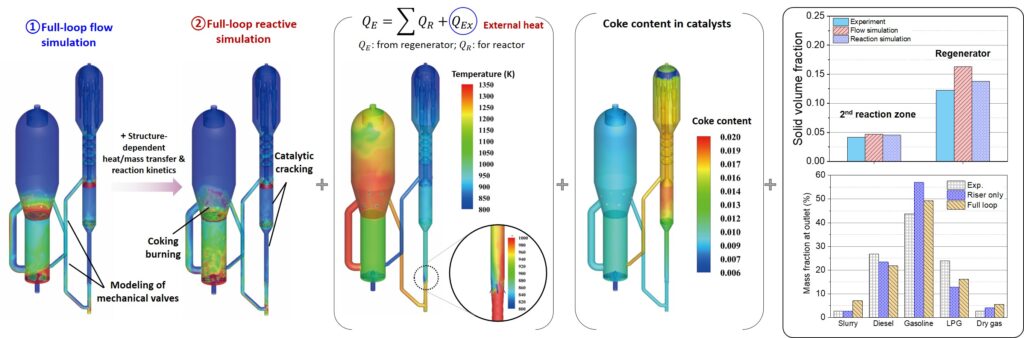
To this end, new research paper published in AIChE Journal and conducted by Dr. Yuting Wu, Dr. Shikun Zhong, Dr. Professor Bona Lu, Dr. Shanglin Liu, Dr. Wei Wang from the State Key Laboratory of Mesoscience and Engineering, Institute of Process Engineering at Chinese Academy of Sciences in collaboration with Dr. Youhao Xu from the State Key Laboratory of Petroleum Molecular and Process Engineering at the Sinopec Research Institute of Petroleum Processing, the researchers developed the first three-dimensional, transient reactive simulation of an industrial FCC reaction–regeneration full-loop system. Their model couples multiscale gas–solid hydrodynamics with twelve-lump catalytic cracking kinetics and coke combustion. This unified framework resolves how reactions, flow structures, and heat transfer interact across the entire circulation loop. The research team constructed a three-dimensional, transient simulation of a 1.2 Mt per year industrial FCC unit encompassing the reactor, disengager, regeneration system, cyclones, and connecting transfer lines. The team employed gas–solid Eulerian–Eulerian formulation, augmented by Energy Minimization Multiscale closures to account explicitly for heterogeneous flow structures across different operating regimes. Within this framework, they described catalytic cracking reactions in the reactor using a twelve-lump kinetic network that balances chemical fidelity with numerical tractability, while coke combustion in the regenerator followed a diffusion-controlled formulation consistent with experimental observations.
The authors showed in their simulation that chemical reactions exert a pronounced influence on hydrodynamic behavior, especially in regions close to feed injection. They found in the first reaction zone, rapid cracking of heavy hydrocarbons increased gas volume and reduced density, producing a gradual axial acceleration of the gas phase that was absent in non-reactive simulations. This effect propagated upward, altering solid holdup and modifying the driving forces for catalyst circulation. By contrast, the second reaction zone exhibited more stable hydrodynamics, reflecting the reduced intensity of cracking and the dominance of secondary reactions under cooler, denser conditions.
Temperature evolution along the circulation loop emerged as a central outcome of the reactive simulation. Coke combustion in the regenerator generated substantial thermal energy, raising catalyst temperatures to levels significantly higher than those observed in the reaction system. As regenerated catalyst re-entered the reactor, heat transfer to the incoming feedstock initiated intense endothermic cracking, leading to a sharp temperature drop in the first reaction zone. Beyond this region, temperature gradients diminished, which indicate that most cracking reactions had approached completion. Importantly, the simulation enabled a quantitative estimate of excess heat generated in the regenerator, providing a direct basis for sizing heat removal equipment.
Coke deposition patterns were similarly resolved. Coke content increased steadily along the reaction system, reaching values consistent with plant measurements at the reactor outlet, before declining during regeneration due to combustion. This spatial variation correlated closely with local temperature and residence time, reinforcing the connection between hydrodynamics and catalyst deactivation. Gas-phase composition in the regenerator showed a predominance of carbon dioxide over carbon monoxide, indicating largely complete coke combustion facilitated by extended catalyst residence times. Conversion profiles along the reactor height demonstrated that approximately four-fifths of feedstock conversion occurred within the first reaction zone, with the remaining conversion achieved through slower secondary processes downstream. Product distributions reflected this progression, with heavier fractions diminishing rapidly near the feed inlet and lighter products accumulating further along the reactor.
To sum up, the work by Professor Bona Lu and co-workers moves industrial FCC modeling closer to something that can be used predictively rather than diagnostically and by embedding reaction kinetics directly into a full-loop, multiscale hydrodynamic framework, the new study successfully demonstrates that chemistry actively reorganizes flow fields, thermal distributions, and catalyst circulation. Additionally, once reactions are allowed to influence transport, the FCC unit emerges as a dynamically evolving system whose behavior cannot be inferred from non-reactive simulations alone. One of the more practically significant aspects of the study is its treatment of temperature evolution along the catalyst pathway. Resolving temperature continuously from regeneration through reaction makes it possible to estimate excess heat generation using first-principles arguments rather than plant-specific tuning. In an operating environment increasingly shaped by energy efficiency targets and emissions constraints, this kind of predictive capability is difficult to overstate. It suggests a route toward evaluating heat removal strategies, operating windows, or design changes before they are tested at scale, reducing reliance on trial-and-error adjustments.
We also believe the analysis reinforces the value of spatial resolution in interpreting FCC chemistry. By distinguishing the intense primary cracking that dominates the first reaction zone from the slower secondary transformations that follow, the model explains why uniform kinetic assumptions often struggle to reproduce product slates observed in practice. This perspective naturally points toward more deliberate control strategies, whether through feed injection design, catalyst circulation tuning, or reactor internals that influence local residence time. Beyond FCC technology, the methodology of Professor Bona Lu and co-workers itself has wider implications and many circulating fluidized systems share the same tight coupling between transport, reaction, and heat release. The framework presented here offers a credible starting point for addressing such systems, while also making clear where further development is needed, especially in representing catalyst deactivation and heat extraction in a more explicit and physically resolved manner.


Reference
Wu, Yuting & Zhong, Shikun & Lu, Bona & Liu, Shanglin & Xu, Youhao & Wang, Wei. (2025). Reactive simulation of an industrial‐scale FCC reaction‐regeneration full loop system. AIChE Journal. 71. 10.1002/aic.18845.