Significance Statement
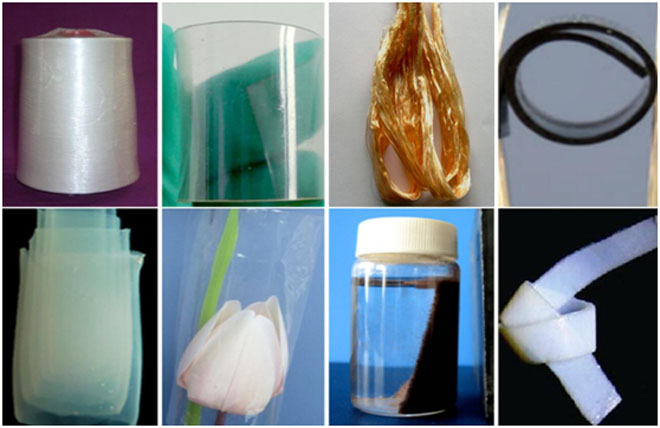
In the 21st century, the trend of science and technology is tending towards environmentally friendly materials, renewable resources and energy, as well as sustainable techniques and processes. Cellulose is the most abundant renewable organic material, however, the difficulties in dissolving cellulose in common organic solvents have hindered the research and development of the cellulose based materials. Recently, novel and non-polluting techniques for the construction of regenerated cellulose materials from its solutions in ionic liquids and/or NaOH/urea aqueous solution with cooling have been developed. This review has summarized the widely used non-derivatizing cellulose solvents, including their dissolution mechanisms. The concept of regeneration through a physical process is illustrated, and a number of novel regenerated cellulose materials are introduced for wide applications in textiles, packaging, biomedicine, water treatment, optical/electrical devices, agriculture and food, etc. The methodology of material processing and the resultant properties and functions are also covered in this review, with emphasis on the neat regenerated cellulose materials and the composite materials. It is worth noting that from the cellulose solution in NaOH/urea aqueous system, the regenerated materials and functional products have been directly converted through “green” techniques including filaments, films/membranes, microspheres/beads, hydrogels/aerogels and bioplastics, etc. (see Figure), and their correlation between the structure and properties have been revealed, showing the potential applications in biomedical, bioimaging, separation and adsorption, electrochemical, energy storage and biodegradable fields.

About the author
Prof. Lina Zhang is an academician of Chinese Academy of Sciences, and distinguished professor at the college of chemistry and molecular sciences in Wuhan University. She has established the Natural Polymers and Polymer Physics group since 1993. She pioneered the development of low temperature technologies to dissolve cellulose and chitin in water-based solvents, and has created new pathways for producing various functional materials and hybrid composites from cellulose and/or chitin solutions. 6 books and 510 papers in the international journals have been published, with over 10 000 cited times. She became the first Chinese scientist received Anselme Payen Award of American Chemical Society in 2011.

About the author
Dr. Ang Lu is currently an associate professor in the college of chemistry and molecular sciences at Wuhan University. He received his Ph.D. in 2009 under Prof. Lina Zhang from Wuhan University, with a focus on cellulose dissolution in NaOH/ thiourea and the solution properties. He began his independent academic career as an associate professor at Wuhan University in 2013, after his post-doctoral experiences in University of California, Davis, and University of Alberta, and he is interested in the dissolution of natural polymers in aqueous solvents as well as the regenerated materials.

About the author
Mr. Sen Wang received his Bachelor of Science degree in Chemistry from Shandong University in 2012. He is currently a Ph. D. student supervised by Professor Lina Zhang in Wuhan University. His research interests include biopolymer solution properties, dissolution mechanism at low temperature, developing new solvents of cellulose, as well as computational modeling of natural polymer structure.

Journal Reference
Progress in Polymer Science, 5 August 2015.
Sen Wang, Ang Lu, Lina Zhang
College of Chemistry and Molecular Sciences, Wuhan University, Wuhan 430072, China
Abstract
The dual threats of the depletion of nonrenewable energy and environmental pollution caused by petroleum-based polymers motivate utilization of naturally occurring polymers to create new materials. Cellulose, as the most abundant natural polymer on earth, has attracted attention due to its renewability, wide availability, low-cost, biocompatibility and biodegradability, etc. Regenerated cellulose may be constructed simply via physical dissolution and regeneration, an environmentally friendly process avoiding the consuming of chemicals since most of the reagents (solvents, coagulant, etc.) may be recycled and reused. “Green” solvents and techniques for the preparation of the environmentally friendly regenerated cellulose materials have been developed successfully, showing great potentials in the fields of polymer science and technology.
In this article, the widely used non-derivatizing cellulose solvents are summarized, including their dissolution mechanisms. Regenerated cellulose materials with different functions and properties have been designed and fabricated in different forms, such as filaments, films/membranes, microspheres/beads, hydrogels/aerogels and bioplastics,etc., to meet various demands. The concept of regeneration through a physical process is illustrated, and a number of novel regenerated cellulose materials are introduced for wide applications in textiles, packaging, biomedicine, water treatment, optical/electrical devices, agriculture and food, etc. The methodology of material processing and the resultant properties and functions are also covered in this review, with emphasis on the neat regenerated cellulose materials and the composite materials. The 277 references cited concerning the direct preparation of cellulose materials via physical dissolution and regeneration are representative of the wide impact and benefits of the regenerated cellulose materials to society.
Go To Progress in Polymer Science
 Advances in Engineering Advances in Engineering features breaking research judged by Advances in Engineering advisory team to be of key importance in the Engineering field. Papers are selected from over 10,000 published each week from most peer reviewed journals.