Advances in Engineering Advances in Engineering features breaking research judged by Advances in Engineering advisory team to be of key importance in the Engineering field. Papers are selected from over 10,000 published each week from most peer reviewed journals.

Significance
Earthquakes often result in extensive and fatal damage, especially in urban areas. It is well-known that buildings with different structures and heights exhibit different natural periods and shaking behaviors during earthquakes, depending on the seismic motion. During earthquakes, neighboring buildings with insufficient clearance between them have a high risk of colliding. Such collisions often result in impact force, whose characteristics differ from that of vibrations caused by seismic excitations. In most circumstances, even if the seismic resistance is guaranteed, such seismic pounding could cause severe damage to the structural and nonstructural components as well as the collapse of the building.
Installing shock-absorbing materials on the building walls is a promising strategy for reducing the damage to the buildings and mitigating disasters during seismic pounding. Among the available shock-absorbing materials, highly comprehensible materials like expanded polystyrene (EPS), which can be designed in different sizes and rigidities, have attracted considerable research attention lately. Nevertheless, despite the numerous applications of EPS materials in building and construction components, they are rarely utilized as shock absorbers attached to walls between neighboring buildings. This has been mainly attributed to the high costs of practical experiments required to verify its reduction effects on impact, which are yet to be verified.
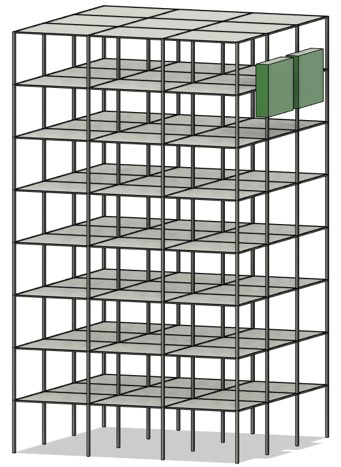
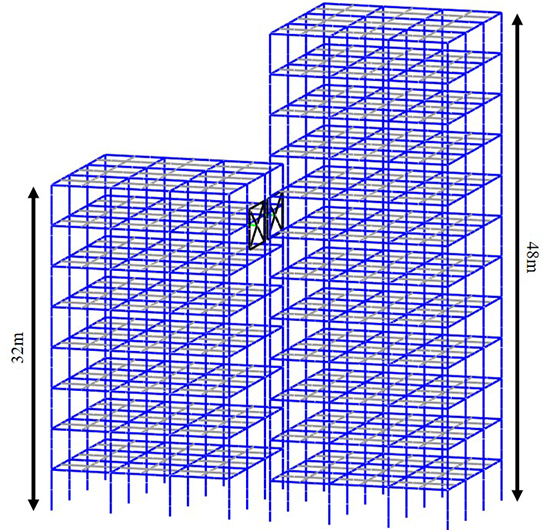
To this note, Professor Daigoro Isobe and Mr. Tomohiro Shibuya from the University of Tsukuba conducted an elegant study on the damage reduction effects of EPS-based shock-absorbers installed between two neighboring buildings. A single case comprising two neighboring steel-framed buildings with different heights subjected to a single seismic wave was used for the preliminary simulation. Considering that EPS and metallic materials have significantly different nonlinear properties, a databased algorithm was devised and integrated into the numerical code to numerically reproduce the properties. Their work is currently published in the journal, Engineering Structures.
Briefly, the research team commenced their experimental work by independently exciting the buildings and comparing the damage results to that of the neighboring buildings. Next, EPS blocks were installed on the sidewall of one of the buildings, and their damage reduction effects were quantitively evaluated via finite element analysis based on the adaptively shifted integration-Gauss technique. Furthermore, appropriate parameter values like the block thickness and foaming variation were also evaluated.
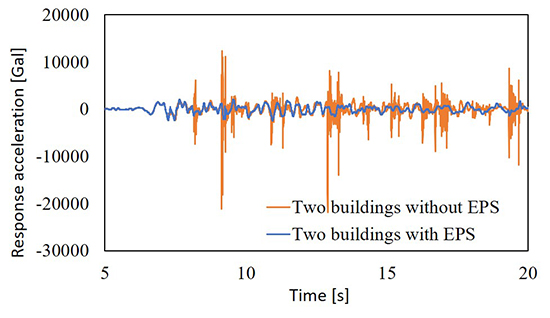
The authors revealed that installing the EPS blocks resulted in a significant reduction in the ratio of the yielded members to all structural members as well as the acceleration peak at the collision time in both buildings. The effectiveness of the EPS blocks with any foaming thickness or ratio in reducing the damage during seismic pounding was comparable to that of shock absorbers installed between the buildings. Due to the limited shock-absorbing effect of the plateau region of the EPS material, it was recommendable to utilize the materials as an elastic damper to avoid potential permanent deformations and frequent repairs associated with reaching the plateau region.
EPS blocks with lower foaming ratios, which mostly function as elastic dampers, were considered appropriate for practical use. From the results, 33 was the most appropriate ratio. Additionally, thicker EPS blocks were considered inappropriate for practical use because they may induce unnecessary collisions between the buildings. Furthermore, it was worth noting that determining the possible maximum comprehensive stress for a given clearance between the buildings under seismic excitation was enough consideration for designing the sectional area of the EPS blocks.
In a nutshell, the Isobe and Shibuya study resulted in the numerical verification of the damage reduction effects of EPS blocks installed between two neighboring buildings subjected to seismic excitation. By reducing the response acceleration by about 90%, the EPS blocks reduced the damage to both structural components of the buildings and nonstructural ones within them, like furniture. In a statement to Advances in Engineering, Professor Daigoro Isobe stated that their findings would pave the way for advanced studies to verify the practical feasibility of EPS materials in reducing seismic pounding damage.


Reference
Isobe, D., & Shibuya, T. (2022). Preliminary numerical study on the reduction of seismic pounding damage to buildings with expanded polystyrene blocks. Engineering Structures, 252, 113723.