Advances in Engineering Advances in Engineering features breaking research judged by Advances in Engineering advisory team to be of key importance in the Engineering field. Papers are selected from over 10,000 published each week from most peer reviewed journals.

Significance
Perovskite-type materials exhibit varying physical properties owing to their variety of composition thus explaining their potential applications related to solar energy conversion. Specifically, oxynitrides having narrower bandgaps have been widely studied. Their physical properties depend on the structural ordering of anions. However, they involve numerous possible anion orderings that makes it difficult to use quantum chemistry calculation method to predict their physical properties due to high optimization cost involved. Machine learning, suitable for predicting realistic physical properties for randomly selected structures, was recently proposed to reduce the high cost. This technique has been, therefore, extended to predict the thermodynamic phase stability of perovskite-type oxides and bandgap energies.
Dr. Masanori Kaneko, Dr. Mikiya Fujii, Professor Koichi Yamashita and Dr. Kazunari Domen from the University of Tokyo together with Dr. Takashi Hisatomi from Shinshu University explored the use of machine learning based on density functional theory calculations involving small supercells to predict stable anion ordering of perovskite-type oxynitrides. A model for predicting the total energy was generated through machine learning while the Metropolis method was used to predict stable anion ordering. The supercells structure obtained through the Metropolis method was validated by comparing to density functional theory calculations results. The work is published in Journal of Energy Chemistry.
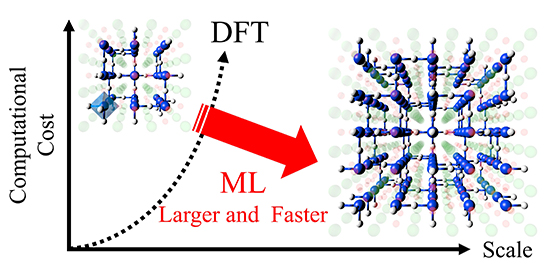
Just like cluster expansion methods, machine learning can handle large systems. Additionally, it can effectively take into consideration the long-range effects in any crystal structure regardless of the symmetry in question. Therefore, it was possible to correctly predict anion ordering in large-scale supercells within perovskite-type oxynitrides. Consequently, the total energy of perovskite-type oxynitrides was directly determined from randomly selected initial atomic placements at less structural optimization cost. For instance, machine learning significantly reduced the computation cost by more than 99.99% thus more economically viable.
A regression model based on density functional theory calculations was successfully established by machine learning. The accuracy of the total energy prediction was observed to be influenced by the explanatory variables reflecting the local anion ordering and associated with long-range interactions and chemical bonds. Ridge regression produced the most accurate model for the reproduction of the local anion ordering with well-coordinated stable supercells. With optimized anion ordering, it was possible to rapidly obtain stable anion orders through a combination of this predictive model and Metropolis method without the need for most stable supercell input.
Among the supercells used for machine learning, those predicted by the Metropolis method followed by predictive exhibited superior stability with total energy close to that calculated by density functional theory. The results indicated that the developed predictive model enhanced the accuracy of exploring stable anion ordering. This approach could also be extended in predicting electronic properties such as the bandgap energy.
In summary, the study demonstrated a method for predicting the properties of functional materials with complex compositions based on machine learning at reasonable computational costs. Considering that the approach is based on the most realistic elemental arrangements together with reasonable computational loads, Dr. Kaneko the first author told Advances in Engineering that their study will advance stabilization of energies associated with anion ordering in perovskite-type oxynitrides.
Reference
Kaneko, M., Fujii, M., Hisatomi, T., Yamashita, K., & Domen, K. (2019). Regression model for stabilization energies associated with anion ordering in perovskite-type oxynitrides. Journal of Energy Chemistry, 36, 7-14.