Advances in Engineering Advances in Engineering features breaking research judged by Advances in Engineering advisory team to be of key importance in the Engineering field. Papers are selected from over 10,000 published each week from most peer reviewed journals.

Significance Statement
Geopolymer concretes are appearing as environmentally friendly construction materials as compared to the conventional cement-based concretes. The production of geopolymers is not as capital and energy intensive as ordinary cement manufacturing processes and if their manufacture is controlled, geopolymers can curtail carbon-dioxide emission.
Foam concrete or cellular concrete is a lightweight concrete with air voids trapped in its matrix making it light and sustainable by reducing its embodied energy. Cellular concretes come with a number of benefits such as, reduced construction cost, and improving thermal and acoustic insulation. They have also been applied as nonstructural elements such as in-situ or precast walls, facades, insulation screeds and slabs. Geopolymers and alkali-activated binders have also been applied in making foam concretes in a bid to offer environmentally construction materials compared to the Portland cement-based concretes.
Mechanical as well as chemical foaming has been identified to introduce air voids within the concrete matrix. However, chemical foaming seems to give better results with regards to dropping density. The two methods can however be combined to bring together their benefits. Aluminum metal powder has been applied widely in lightweight concrete as a foaming agent. Targeting low densities in geopolymer concretes, higher percentages of aluminum powder has been used raising environmental concerns.
It is therefore necessary to explore efficient methods towards geopolymer formulation with appreciable porosity and low densities without extensive aluminum powder use. Australian researchers Ailar Hajimohammadi, Tuan Ngo, and Priyan Mendis at University of Melbourne and in collaboration with Jay Sanjayan at Swinburne University of Technology synthesized geoploymer foams with varying porosities with the same amount of aluminum foaming agent. They also implemented manipulated amounts of alkaline activators well known as accelerators and inhibitors of the aluminum reaction. Their research work is now published in Materials and Design.
The authors prepared two alkali-activating solutions by dissolving sodium metasilicate and sodium hydroxide in water. To prepare the geopolymer foams, they activated fly ash by alkali solution with varying ratios of the alkali activators. The geopolymer mixture was mixed and a similar amount of aluminum powder added as a foaming agent.
The foamed pastes were poured into cubic molds and cured at 60 °C for 24h. The cured samples were then removed and kept at room temperature ready for testing.
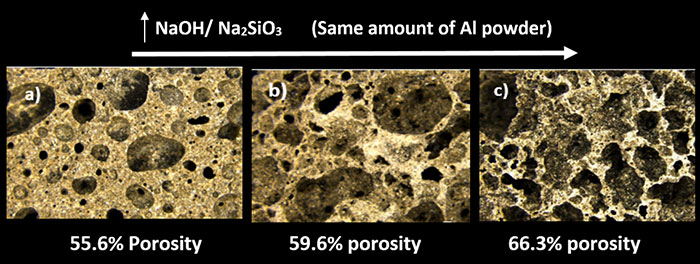
Sodium silicate and sodium hydroxide solutions were alkali activators and acted as an inhibitor and a catalyst, respectively. Therefore, by manipulating the ratios of the two alkali activators, the authors were able to regulate foaming extent. They realized that the total porosity was increased without adding extra amount of aluminum powder. High aluminum oxidation led to formation of larger voids in the matrix.
Reduced circularity of the voids was observed by increasing porosity. Wider size pore distribution was observed in samples with higher aluminum reaction. Formation of more fine voids was responsible for density reduction in the samples. Increasing sodium hydroxide to sodium silicate solution ratio affected the nanostructure of the binding skeleton. The amount of unreacted fly ash was noted to reduce in the sample with a higher ratio.
“Aluminium metal powder which is widely used in the lightweight concrete industry as an aerating agent has very high embodied energy, and its extensive usage in foamed geopolymers will diminish the environmental benefits of geopolymeric materials” Dr. Hajimohammadi said “The developed method can successfully increase the porosity of geopolymers and drop their density without adding more aluminium powder to the mix design. This has significant impact on commercial applications of foamed geopolymers and remarkably improves the energy rating of the products.”




Reference
Ailar Hajimohammadi1, Tuan Ngo1, Priyan Mendis1, Jay Sanjayan2. Regulating the chemical foaming reaction to control the porosity of geopolymer foams. Materials and Design 120 (2017) 255–265.
[expand title=”Show Affiliations”]1 Department of Infrastructure Engineering, University of Melbourne, Victoria 3010, Australia.
2 Faculty of Science, Engineering and Technology, Swinburne University of Technology, Victoria 3122, Australia. [/expand]
Go To Materials and Design