Advances in Engineering Advances in Engineering features breaking research judged by Advances in Engineering advisory team to be of key importance in the Engineering field. Papers are selected from over 10,000 published each week from most peer reviewed journals.

Significance
Recent technological advances have led to the development of two-dimensional materials such as graphene and metal dichalcogenides and has also paved way for nano-scale electronics development. Specifically, semiconductor transition metal dichalcogenides of the MX2 family have attracted much attention due to their tunable electronic properties which are dependent upon a number of layers in the material. This has enabled the fabrication of devices such as photodetectors, field-effect transistors, chemical sensors and solar cells. Even better, new devices combining transition metal dichalcogenides with ferroelectrics have emerged as novel hotspot for promising applications in electronics and optoelectronics. So far, little regarding the combination of ferroelectrics and transition metal dichalcogenides for resistive random access memories has been published.
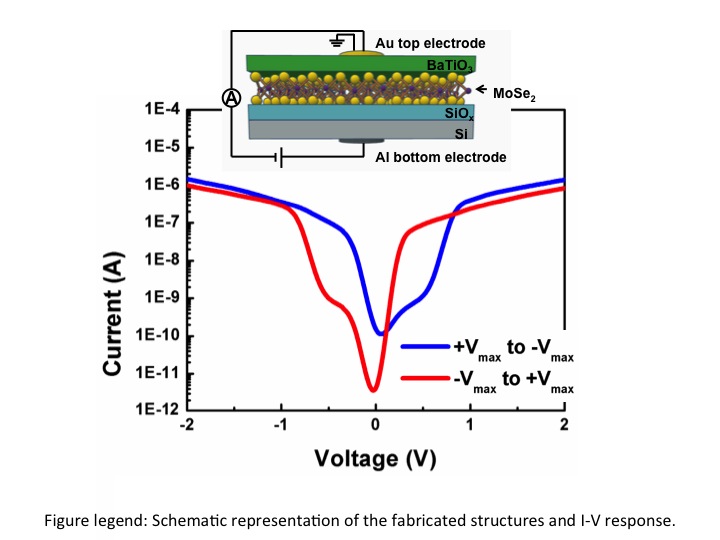
Researchers led by professor Olinda Conde at University of Lisbon in Portugal proposed to investigate the resistive switching effect that emerges when ferroelectric barium titanate and few-layer molybdenum diselenide are combined in a single structure. They hoped to elucidate the relation between the ferroelectric polarization and the resistive switching effect, and the mechanism underlying the former. Their work is now published in Journal of Materials Chemistry C and was funded by the Portuguese Foundation for Science and Technology (contracts UID/CTM/04540/2013 and UID/FIS/04650/2013).
The research team commenced their experiments by growing three samples, one of barium titanate, the other of molybdenum diselenide and eventually that of molybdenum diselenide/barium titanate hybrid structures on top of silicon/silicon oxide substrates by chemical vapor deposition and ion-beam sputtering deposition techniques. The surface morphology of the samples was then analyzed by field emission scanning electron microscopy and atomic force microscopy in tapping mode. The researchers then measured capacitance–voltage characteristics using a precision Inductance-Capacitance-Resistance (LCR) meter at an alternating current voltage of 50 mV and frequency of 10 kHz.
Generally, the authors of this paper observed that the capacitance-voltage loops revealed the ferroelectric nature of both Al/Si/SiOx/BTO/Au and Al/Si/SiOx/MoSe2/BTO/Au structures and the high quality of the SiOx/MoSe2 interface in the Al/Si/SiOx/MoSe2/Au structure. Moreover, Al/Si/SiOx/MoSe2/BTO/Au hybrid structures were seen to show electroforming free resistive switching that was explained on the basis of the modulation of the potential distribution at the molybdenum diselenide/barium titanate interface via ferroelectric polarization flipping. The research team also noted that both low resistance state and high resistance state were stable in time when evaluating for potential applications in memory devices and therefore, the hybrid structures displayed a reliable resistive switching behavior.
The study has demonstrated the switchable diode effect of molybdenum diselenide/barium titanate hybrid structures. It has been seen that the origin of the switchable diode effect can be attributed to charge coupling at the molybdenum diselenide/barium titanate interface, which therefore might be related to the ferroelectric polarization reversal process. More so, the coexistence of capacitance–voltage hysteresis and resistive switching characteristics and the equivalence of the coercive field and switching field has confirmed the coupling between ferroelectric polarization reversal and the resistive switching effect. In conclusion, their results indicate that the molybdenum diselenide/barium titanate hybrid structures are promising candidates for non-volatile ferroelectric resistive memories.



Reference
J. P. B. Silva, C. Almeida Marques, J. Agostinho Moreira, O. Conde. Resistive switching in MoSe2/BaTiO3 hybrid structures. J. Mater. Chem. C, 2017, volume 5, 10353.
Go To Journal of Materials Chemistry C