Advances in Engineering Advances in Engineering features breaking research judged by Advances in Engineering advisory team to be of key importance in the Engineering field. Papers are selected from over 10,000 published each week from most peer reviewed journals.

Significance
Carbon nanotubes, particularly single-walled variants (SWNTs), are renowned for their unique properties including high tensile strength, electrical conductivity, and thermal stability. These cylindrical nanostructures are composed of a single layer of graphene rolled into a tube, with their properties heavily dependent on their specific atomic structure. The electronic behavior of SWNTs, whether metallic or semiconducting, is determined by their chirality, which describes the angle and diameter of the graphene sheet roll-up. Traditional approaches to modulate the electronic properties of these materials have typically involved chemical doping or covalent modifications, which can disrupt the inherent stability and conductivity of the carbon lattice. However, A new study published in Proceeding of the National Academy of Science and conducted by Duke University researchers led by Professor Michael Therien introduces a method to alter these properties through non-covalent means, specifically by wrapping m-SWNTs with rigid, conjugated polymers. The research team synthesized and utilized binaphthalene-based, aryleneethynylene polymers that can wrap around m-SWNTs, maintaining a fixed helical periodicity. This wrapping induces a symmetry breaking in the SWNTs, effectively converting them from metallic to semiconducting without altering the carbon-carbon covalent bonds. The polymers were designed to attach to the nanotube exterior via weak, reversible bonds, which can be controlled by the electronic structure of the polymer itself.
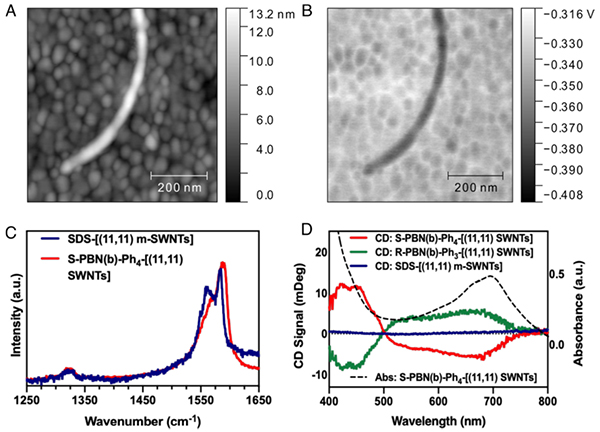
Key to their methodology was the use of optical and electronic characterization techniques such as Fourier-transform infrared (FT-IR) spectroscopy, cyclic voltammetry, and Raman spectroscopy to study the band gap openings induced by the polymer wrappings. These methods confirmed that the non-covalent interactions between the polymer and the SWNT surface were sufficient to alter the electronic properties of the nanotubes. The authors demonstrated that the non-covalent wrapping of m-SWNTs with different polymers could reliably adjust the electronic characteristics of the nanotubes, reflected in changes to their band gaps. Specifically, they observed that the polymers could induce a low-energy band gap in the m-SWNTs, which is critical for applications in semiconducting devices. Additionally, the reversible nature of the polymer wrapping allows for the dynamic tuning of the nanotube properties, a feature that has significant implications for the design of adaptive or responsive electronic materials. This could lead to advancements in fields such as flexible electronics, sensors, and advanced coatings, where materials require changeable properties based on environmental or operational conditions. This research opens up new pathways for the design of one-dimensional materials with customizable electronic structures. By providing a method to control the electronic properties of carbon nanotubes through external, non-invasive, and reversible means, it paves the way for more sustainable and versatile materials science solutions.
The significance of the study conducted by Professor Michael Therien and his team at Duke University lies in the development of a novel method to manipulate the electronic properties of metallic carbon nanotubes (m-SWNTs) through non-covalent interactions, specifically via the wrapping of these nanotubes with rigid polymers. This research marks a significant shift from traditional methods that typically involve altering the covalent structure of materials, offering several key advancements and implications. Firstly, unlike conventional methods that modify the electronic properties of materials through covalent bonding alterations, this technique utilizes non-covalent polymer wrapping. This approach preserves the integrity of the carbon nanotubes’ covalent structure, potentially maintaining their inherent mechanical, thermal, and conductive properties while modifying their electronic characteristics. Moreover, the polymer wrapping is reversible, allowing for the dynamic tuning of the nanotubes’ electronic properties. This adaptability is crucial for applications where environmental responsiveness or reconfigurability is desired, such as in smart sensors and adaptive electronics. Furthermore, by adjusting the type of polymer and the conditions of wrapping, researchers can finely tune the band gap of m-SWNTs. This control is essential for the design of semiconductors, which play critical roles in various electronic and optoelectronic devices. Additionally, the ability to convert m-SWNTs into semiconducting materials via a non-destructive method opens up new possibilities for their use in electronics, photonics, and energy devices. Applications could include field-effect transistors, solar cells, and LEDs, where specific band gap properties are necessary for efficient function. The non-covalent approach is potentially more sustainable and less damaging to the material’s structure compared to covalent modifications, which often involve harsh chemicals and conditions that can degrade material properties.
The research work could impact photonics, energy storage, and conversion technologies, and even biomedical applications where SWNTs can be used as delivery vehicles or sensors. Future research could explore the broader applicability of this technique to other nanomaterials and potentially the integration of these advanced materials into existing and novel technologies. In summary, the study by Professor Therien and colleagues marks a significant advance in the manipulation of nanoscale materials through non-covalent modifications, highlighting the potential for new classes of smart materials and the next generation of electronic devices. This research not only extends our fundamental understanding of material properties at the nanoscale but also illustrates the potential for innovative approaches to material design and application.


Reference
Mastrocinque F, Bullard G, Alatis JA, Albro JA, Nayak A, Williams NX, Kumbhar A, Meikle H, Widel ZXW, Bai Y, Harvey AK, Atkin JM, Waldeck DH, Franklin AD, Therien MJ. Band gap opening of metallic single-walled carbon nanotubes via noncovalent symmetry breaking. Proc Natl Acad Sci U S A. 2024;121(12):e2317078121. doi: 10.1073/pnas.2317078121.