Advances in Engineering Advances in Engineering features breaking research judged by Advances in Engineering advisory team to be of key importance in the Engineering field. Papers are selected from over 10,000 published each week from most peer reviewed journals.

Significance
Recently, aerospace technology has undergone rapid development to meet new demands in the sector such as increasing the engine operating temperature. Therefore, researchers have been looking for new materials suitable for such functions and have identified nickel aluminide as a promising solution owing to its excellent properties including low density, high melting point and good thermal conductivity. Unfortunately, nickel aluminide exhibits poor ductility and low fracture toughness at room temperature. This makes it inappropriate to use nickel aluminide material for heavy structural applications.
Generally, several methods are available for nickel aluminide production. For instance, powder metallurgy techniques are used to reduce the problems associated with intermetallic machining. Thus, it can effectively be used for alloying of nickel aluminide with the addition of ternary components such as rhenium. In a recently published literature, rhenium results in significant mechanical properties improvement by dissolving fully in e.g. a chromium matrix of chromium-alumina composite obtained by pressure sintering. This is a key consideration in subsequent research works when using the powder metallurgy technique to manufacture such materials.
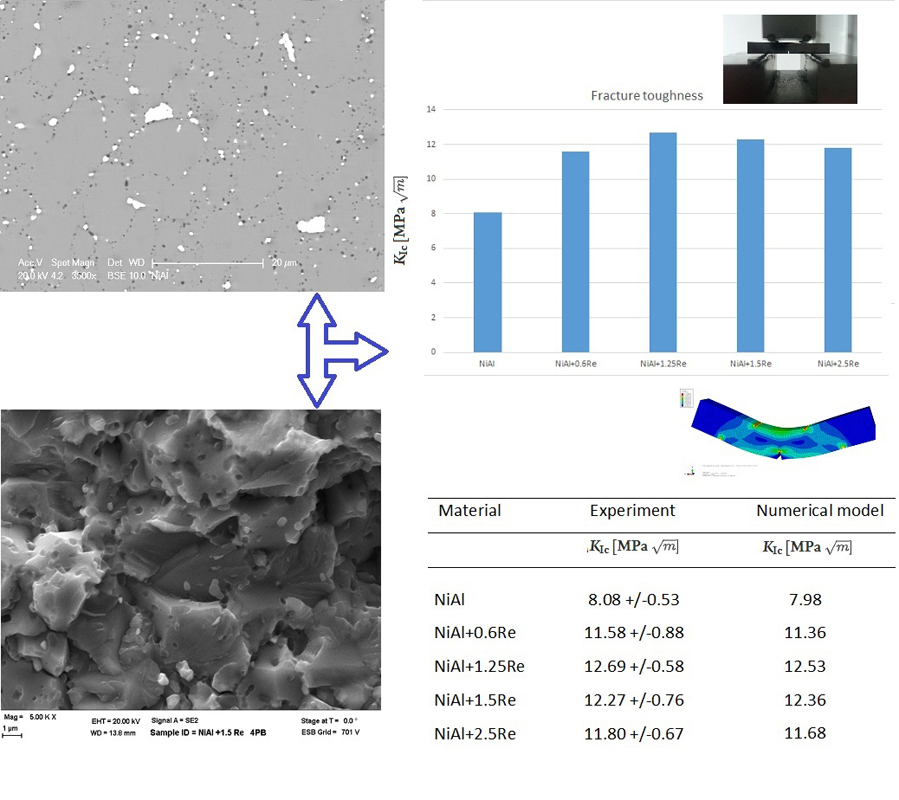
Researchers at Polish Academy of Sciences Mr. Kamil Bochenek, Dr. Witold Węglewski, Professor Jerzy Morgiel and Professor Michał Basista proposed the addition of rhenium to nickel aluminide to improve its mechanical properties without compromising the oxidation resistance. The authors utilized two powder metallurgy techniques including spark plasma sintering and hot pressing to obtain the sinters. The enhancement of the oxidation behavior and fracture toughness were investigated based on microscopic observations. Furthermore, a numerical model was developed to verify the hypothesis of the fracture toughness enhancement mechanism of the resulting material at different amounts of added rhenium. Their work is published in the research journal, Materials Science and Engineering.
From the experimental research, the authors observed that rhenium particles at the boundaries of nickel aluminide grains resulted in significant improvement of the fracture toughness and the flexural strength of the nickel aluminide by addition of only small amounts of rhenium. Moreover, very low mass changes were noted during oxidation at temperatures 900 °C, 1100 °C and 1300 °C due to the degradation of the protective aluminum oxide layer formed initially on the surface. Among the tested materials, eutectic composition sintered by hot pressing proved to be the best for enhancing fracture toughness, whereas beyond the eutectic concentration, a decrease was observed. Furthermore, finite element method simulations showed that the strengthening of nickel aluminide grain boundaries by rhenium was the main mechanism responsible for the enhanced fracture toughness.
The study by Polish Academy of Sciences scientists successfully used powder metallurgy method to enhance the fracture toughness of nickel aluminide by adding rhenium. Even though the solubilities of the rhenium were merely approximated based on earlier research works, the results can still be adopted and improved. Therefore, it will provide good replacements for nickel-based superalloys and thus advance the aerospace technology.




Reference
Bochenek, K., Węglewski, W., Morgiel, J., & Basista, M. (2018). Influence of rhenium addition on microstructure, mechanical properties and oxidation resistance of NiAl obtained by powder metallurgy. Materials Science and Engineering: A, 735, 121-130.
Go To Materials Science and Engineering: A