Advances in Engineering Advances in Engineering features breaking research judged by Advances in Engineering advisory team to be of key importance in the Engineering field. Papers are selected from over 10,000 published each week from most peer reviewed journals.

Significance
In addition to steel and concrete-reinforced beams, concrete-filled U-shaped steel (CFUS) beams are a promising composite material owing to their advantages, including enhanced fire and buckling resistance. They have been used in practical engineering applications, especially long-span and heavy-loaded structures. On the other hand, square concrete-filled steel tubular (CFST) columns exhibit favorable structural properties such as high strength and good ductility alongside other economic benefits. To this end, composite frames consisting of CFUS beams and square CFST columns are anticipated to possess superior performance, though suitable connecting details are still lacking.
Although composite joints have been extensively studied in the past, most studies focused on either steel-concrete composite or CFST column to steel beam joints. The most prominent connecting details identified in these cases are interior, exterior and through diaphragms and endplates. Nevertheless, there are limited studies on the CFUS beams to CFST columns connecting joints. Moreover, various stiffeners like endplates are needed to transfer force from steel beams, while scaffolds are used to position CFUS beams during field installation, making the construction complex. This complexity can be circumvented by adopting facile and robust joint details.
Herein, a team of researchers leading by Professor Xuhong Zhou and Professor Dan Gan at Chongqing University developed a through-beam composite joint system for connecting square CFST columns and CFUS beams. The joint system consisted of channel-shaped and circular holes in the square steel tube for direct beam load transfer. Larger diameter flexural rebars were used to minimize the concrete damage. Their work is currently published in the Journal of Structural Engineering (ASCE), one of the oldest and most respected periodicals in the field.
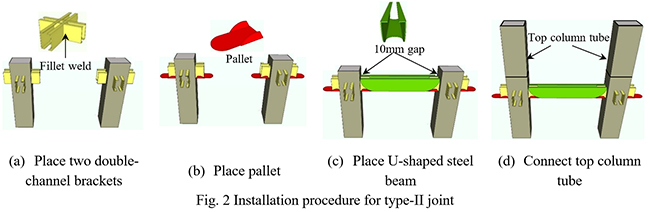
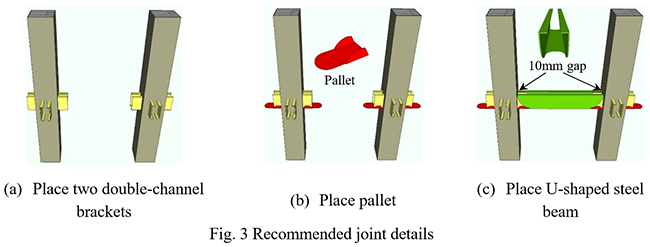
In their approach, two procedures representing two joint details, Type-1 and Type-II, were adopted to facilitate the field construction of the joints. Six cruciform joints were analyzed under uniform cyclic lateral loading and axial compression. The critical test parameters included axial load ratio, constriction procedure, loading procedure and additional flexural rebars. The test results were evaluated per the ACI (2005) acceptance criteria. Finally, appropriate design considerations were proposed.
The research team observed two distinct ductile failure modes. All Type-I beam specimens attained flexural beam capacities characterized by the fracture of both the reduced section of the bracket and the fillet welds of the beam end. Similarly, Type-II samples attained beam flexural capacities characterized by fracture of the brackets at the heated zones at the beam ends. However, all the specimens failed the ductility test.
In addition to reducing energy dissipation and stiffness and strength degradation under equal axial load ratio, the double-channel bracket in Type-I samples decreased the ultimate story drift ratio and ductility coefficient by 41.3% and 36.7%, respectively, compared to Type-II samples. While an axial load ratio of at least 0.3 improved the peak load by restraining the slippage in Type-I samples, higher axial load ratios affected the peak load of Type-II specimens. Other effects of higher axial load ratio included a reduction in the ductility coefficients and ultimate story drift ratios and increased strength and stiffness degradation.
Compared to samples subjected to cyclic loading, those subjected to combined cyclic and monotonic loading exhibited a 9.5% lower ductility coefficient, accelerated stiffness and strength degradation, 20% higher load capacity and 11.2% lower ultimate story drift ratio. Type-I and Type-II specimens had ductility coefficients exceeding 3.2 and 2.2, respectively. All the specimen satisfied the ACI 374.1-05 criteria, suggesting that they possessed remarkable hysteretic performance.
In summary, the authors reported installing square CFST columns to CFUS beam joints using simplified connecting details. The flexural rebar continuity ensured the construction of a more integrated joint. The Type-I and type-II procedures simplified the joint details to facilitate field construction by avoiding the complexities induced by scaffolds and stiffeners. In a statement to Advances in Engineering, Professor Dan Gan explained that their findings would contribute to the design of advanced CFST columns to CFUS connecting joins for various practical applications.




Reference
Gan, D., Yan, F., Yang, Z., Zhou, Z., & Cheng, R. (2022). Behavior of CFST Column to Concrete-Filled U-Shaped Steel Beam Joints with Slabs under Cyclic Loading. Journal of Structural Engineering, 148(3).