Advances in Engineering Advances in Engineering features breaking research judged by Advances in Engineering advisory team to be of key importance in the Engineering field. Papers are selected from over 10,000 published each week from most peer reviewed journals.

Significance Statement
Carbon nanofibers have been generally tipped as a suitable anode material for lithium secondary batteries. However, incorporation of transition metal oxides such as ruthenium oxide RuO2 is of interest as certain unwanted features such as low charge capacity and low retention rates which often occurs in carbon anode materials is less likely to occur.
In a recent article published in Applied Surface Science, ruthenium oxide coated with carbon nanofibers acted as an anode material for lithium secondary batteries, in view of getting an increased efficiency and workability of electrodes by negating undesirable reactions which may occur in electrolytes.
Researchers led by Professor Chang-Seop Lee from Keimyung University in Republic of Korea synthesized carbon nanofibers on nickel foams via chemical vapor deposition method before coating ruthenium oxide on the carbon nanofibers/nickel (RuO2/CNFs/Ni) foams.
Using scanning electron microscopy the authors showed nickel foam to act as a catalyst for synthesis of carbon nanofibers as well as growth confirmation of ruthenium oxide coatings on the carbon nanofibers/nickel foam. Without presence of carbon nanofibers, a cracked surface became observed during coating of ruthenium oxide on the nickel foam. Energy dispersive spectroscopy measurements also indicated a high presence of carbon nanofiber growth on nickel foam. Moreover, the authors confirmed a high crystalline deposition of carbon nanofibers on the synthesized ruthenium oxide-coated carbon nanofibers/nickel foams using x-ray diffraction.
Cyclic voltammetry measurements while considering ruthenium oxide-coated nickel foams, ruthenium oxide-coated carbon nanofibers/nickel foams, carbon nanofibers on nickel foams and graphite as anode showed that the ruthenium oxide-coated carbon nanofibers/nickel foams had the largest cyclic voltammetry area and highest efficiency when compared with each capacity per cycle.
The charge-discharge cycling measurements with LiClO4 used as an electrolyte when dissolved in an equal mixture of propylene carbonate and ethylene carbonate (1:1) indicated that the ruthenium oxide-coated carbon nanofiber/nickel foam when used as anode active material had the highest retention rate of 47.4% after 30 cycles compared to other anode active materials used in the research.
This study enhanced efficiency and extended life span of lithium secondary batteries due to the coating of ruthenium oxide on carbon nanofibers.
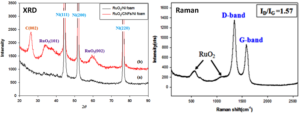 Figure XRD patterns and Raman spectra of synthesized RuO2/CNFs/Ni foam.


Journal Reference
Hyun, Y.1, Choi, J.1, Park, H.2, Lee, C.1 Synthesis and electrochemical performance of ruthenium oxide-coated carbon nanofibers as anode materials for lithium secondary batteries, Applied Surface Science 388 (2016) 274–280.
[expand title=”Show Affiliations”]- Department of Chemistry, Keimyung University, Republic of Korea
- Department of Chemical Engineering, Keimyung University, Republic of Korea
Go To Applied Surface Science