Advances in Engineering Advances in Engineering features breaking research judged by Advances in Engineering advisory team to be of key importance in the Engineering field. Papers are selected from over 10,000 published each week from most peer reviewed journals.

Significance
Composite materials combine two or more components, each with distinct properties and functions, into one material so as to takes advantages of the synergy among the components. Developing novel components for critical applications such as catalysis and energy science are in high demand in industry. When different properties and function of constituent components interact synergistically, , the composite can show entirely new functions and application opportunities, which could not have been possible with the individual components separately. This is representative of the Nanochemistry approach to novel materials, especially in this case where graphene oxide and periodic mesoporous silica with distinct properties have been chemically integrated to form a new kind of composite.
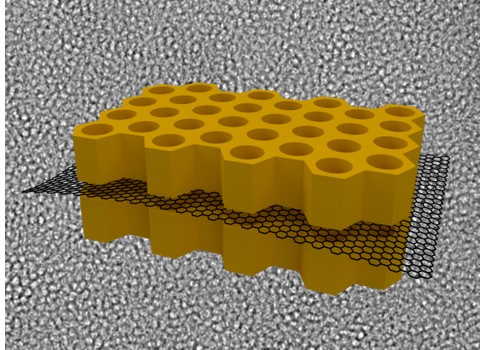
Researchers led by Dr. Zheng-Ming Wang at National Institute of Advanced Industrial Science and Technology in Japan in collaboration with researchers at University of Toronto led by Professor Geoffrey Ozin investigated nanocomposites formed from graphene oxide and periodic mesoporous silica. The study seeks to uncover the benefits that could be obtained from vertically aligned mesochannels in the formation of the nanocomposites. At a step towards understanding the synergistic interaction between graphene oxide and periodic mesoporous silica, the present study focuses on examining the formation and effects of pore depth and sizes of the materials. This part of the research has been recently published in the journal Advanced Functional Materials.
The researchers were able to obtain the unexpected vertical channel growth through surfactants and the graphene as templates. The focus of the work was the means of controlling the depth of the aligned mesochannels and the pore sizes due to their importance in determining the properties of the resulting nanocomposite. Hydrolysis of the silica precursor tetraethyl orthosilicate proved to be the key in the control of the depth of mesochannels, for periodic mesoporous silica. By using a combination of X-ray scattering and synchrotron characterization methods, the authors for the first time show that the vertical growth of the microchannels are initiated on graphene oxide substrate in the presence of surfactant in solutions.
The research team also found out that this type of nanocomposite can be built more easily and quickly by tuning the synthesis conditions as well as alkyl chain lengths of the surfactants. The templating function of the surfactant solution used in the process are affected by various factors, such as the reaction temperature and concentration of the surfactant. Judicious choices of these critical reaction parameters are important in successful synthesis of good sandwich structures of graphene oxide-periodic mesoporous silica.
The study by Zheng-Ming Wang and colleagues has therefore successfully presented a means of building a sandwich nanocomposite comprising of graphene oxide and periodic mesoporous silica with vertically aligned mesochannels. Next phase of the study will seek to use this type of materials in molecular sieving sensors, filtrations, drug delivery system, and so forth.


Reference
Wang, Z., Peng, W., Takenaka, Y., Yoshizawa, N., Kosuge, K., Wang, W., & Ozin, G. (2017). Sandwich-Type Nanocomposite of Reduced Graphene Oxide and Periodic Mesoporous Silica with Vertically Aligned Mesochannels of Tunable Pore Depth and Size. Advanced Functional Materials, 27(47), 1704066
Go To Advanced Functional Materials