 Advances in Engineering Advances in Engineering features breaking research judged by Advances in Engineering advisory team to be of key importance in the Engineering field. Papers are selected from over 10,000 published each week from most peer reviewed journals.

Significance
Buoyancy-driven flows have been a topic of interest in fluid dynamics for decades due to their presence in numerous industrial configurations such as passive cooling processes. Since the early work of Batchelor in the mid-twentieth century, buoyancy-driven flows, especially in heated cavities, have remained a challenging research area. Over the years, three distinct flow regimes were identified: steady laminar, unsteady laminar and fully turbulent. Most of the computational and experimental research work has been focused on the mapping of transitions between these flow regimes as a function of aspect ratio, Rayleigh number and Prandtl number. However, efficient characterization of the turbulent flow regime at high Rayleigh number, which is the most relevant case for industrial applications, has remained a great challenge due to the inappropriate computational resources.
Taking advantage of the growth in the computing technology, some simulations of turbulent flows in differentially heated cavities at increasingly higher Rayleigh numbers have been recently published. However, high order statistical data that could help the turbulence modeling community remain scarce.
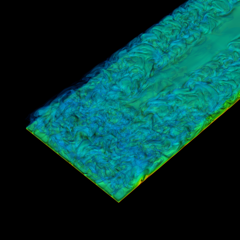
To this note, Imperial College London scientists: Dr. Frederic Sebilleau, Professor Raad Issa and Dr. Simon Walker together with Dr. Sylvain Lardeau at CD-Adapco carried out direct numerical simulations on a heated square cavity. Specifically, a square cavity was chosen considering the fact that its configuration was well known for producing the largest degree of discrepancy between turbulence models. The numerical simulation involved using a Prandtl number of 0.71 and Rayleigh number ranging between 108 – 1011. In order to provide insightful data for the turbulence modelling community, they presented the full budgets i.e. Reynold stresses, temperature variances, and turbulent heat fluxes budgets for all the Rayleigh number covered during the experiment. Their work is currently published in International Journal of Heat and Mass Transfer.
The authors observed that the budgets were influenced by the displacement of the temperature variance towards the inner boundary layer. Consequently, a negative production region that increased with the increase in the Rayleigh number was initiated in the budget due to the behavioral difference between the velocity and thermal boundary layers.
In summary, the research team was the first to perform a direct numerical simulation of a differentially heated square cavity at higher Rayleigh number with statistical data that can help understanding the limitations of current turbulence models to simulate buoyancy driven flows. It also gives reference data that will be useful to assess the performance of new turbulence models. The database associated to their paper has been made available to the scientific community on the ERCOFTAC classic database and was chosen as the benchmark case of the 16th SIG15 ERCOFTAC workshop, gathering most of the academic and industrial turbulence modelling research groups in Europe, held in October 2019 in Slovenia. This database will be used again at the next SIG15 ERCOFTAC workshop in France in 2021.




Reference
Sebilleau, F., Issa, R., Lardeau, S., & Walker, S. (2018). Direct Numerical Simulation of an air-filled differentially heated square cavity with Rayleigh numbers up to 1011. International Journal of Heat and Mass Transfer, 123, 297-319.