Advances in Engineering Advances in Engineering features breaking research judged by Advances in Engineering advisory team to be of key importance in the Engineering field. Papers are selected from over 10,000 published each week from most peer reviewed journals.

Significance
Electrochromic devices generally require low voltages to reach full contrast since the use of high voltage results in degradation. Therefore, designing low-power devices that can be switched over with relatively low voltages, probably less than 1V, is highly desirable. Among the available electrochromic materials, conjugated polymers have been intensively investigated for use in electrochromic applications owing to the ease in customizing their physical properties such as color control. A good example is the ECP-Magenta which exhibits high color contrast. Unfortunately, great challenges have been experienced in the attempts to construct solid and flexible systems based on conjugated polymers to facilitate the development of electrochromic applications. This requires enhancement of their rheologic properties suitable for different coating techniques such as screen-printing.
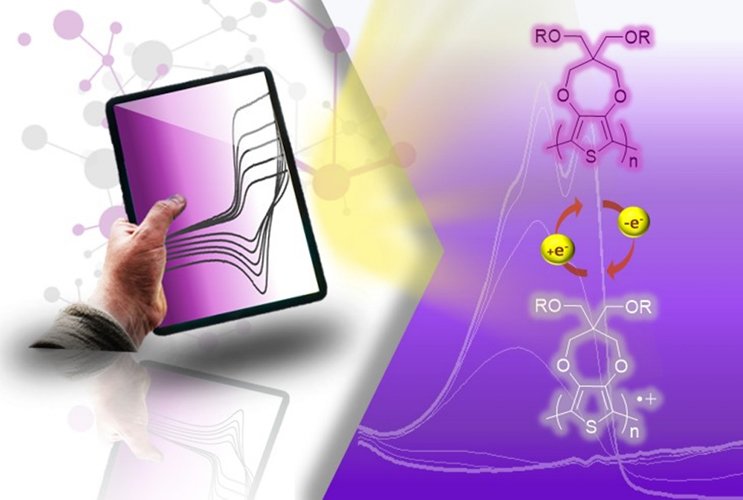
In a recent paper published in the journal, Electroanalysis, Sara Santiago, Miguel Aller, Professor Javier del Campo and Professor Gonzalo Guirado from the Universitat Autonoma de Barcelona (Autonomous University of Barcelona) and the Microelectronics Institute of Barcelona (IMB-CNM-CSIC), developed a new strategy for formulating screen-printable electrochromic inks. This approach incorporated electrochromic polymer the poly(3,4-propylenedioxythiophene) (ECP-Magenta), antimony-doped tin oxide for facilitating the electron transport, a P(VDF-co-HFP) binder, and an electrolyte. Specifically, polymeric gel electrolytes preferably ion gels were utilized to provide ions for charge-balancing and current transportation. These ion gels synthesized based on P(VDF-co-HFP) are advantages in terms of low-cost, non-volatility and high chemical stability.
As a concept of proof, the feasibility of this approach was demonstrated by constructing a fully screen-printed and flexible electrochromic device. The new ECP-Magenta ink films exhibited significant color change at low potentials up to 0.3V, higher optical values and higher coloration efficiency in comparison with other ink formulations. Consequently, the authors noted that the response time for bleaching and coloring could be improved by optimizing the film thickness. Furthermore, the formulation of electrochemical ink was observed to be compatible with the use of flexible electrolytes with minimal impact on the environment.
Ion gels comprising of the P(VDF-co-HFP) and room temperature ionic liquids showed good ionic conductivity, elasticity, flexibility, and environmental friendliness thus a promising gel electrolyte for similar applications. By analyzing the electrochemical features of different ion gels as a function of ionic liquids, new ion gels formulations were developed and incorporated in the electrochromic device. Screen-printing can be used to design and integrate the components of the electrochromic device at relatively low-cost and thus can be adapted for a wide variety of substrates for various other electrochemical devices.
This approach is scalable and can be applied to different fields. As such, this inexpensive and rapid fabrication route will open numerous doors for the preparation of similar electrochromic inks based on other polymeric compounds. In a statement to Advances in Engineering community, Professor Gonzalo Guirado, the corresponding author observed that the developed electrochromic inks and electrolyte materials will particularly facilitate the mass production of flexible electrochromic displays as well as other optoelectronic devices through screen printing.




Reference
Santiago, S., Aller, M., Campo, F., & Guirado, G. (2019). Screen-printable Electrochromic Polymer Inks and Ion Gel Electrolytes for the Design of Low-power, Flexible Electrochromic Devices. Electroanalysis, 31(9), 1664-1671.