Screening halogenated environmental contaminants in biota based on isotopic pattern and mass defect provided by high resolution mass spectrometry profiling

Significance Statement

The combination of chromatographic mass spectrometry and high resolution mass spectrometry filters have been used in characterization of environmental contamination. However, due to necessity in knowing less-regarded chemical substances that serve as potential environmental hazards, the improved chromatography and high resolution mass spectrometry faces daunting challenges in terms of effective filtering of signals of interest.

The two criteria used in supplying records for an effective study includes; the mass defect which comprises of heavy atoms compared to major atoms from organic compound and the second criterion which is mainly meant for both chlorinated and brominated compounds.

Researchers from “Laboratoire d’Etude des Residus et Contaminants dans les Aliments” (LABERCA) in France provided new approach capable of detecting a vast variety of organohalogenated compounds in any kind of matrix extract. The research work is published in the peer-review journal, Analytica Chimica Acta.

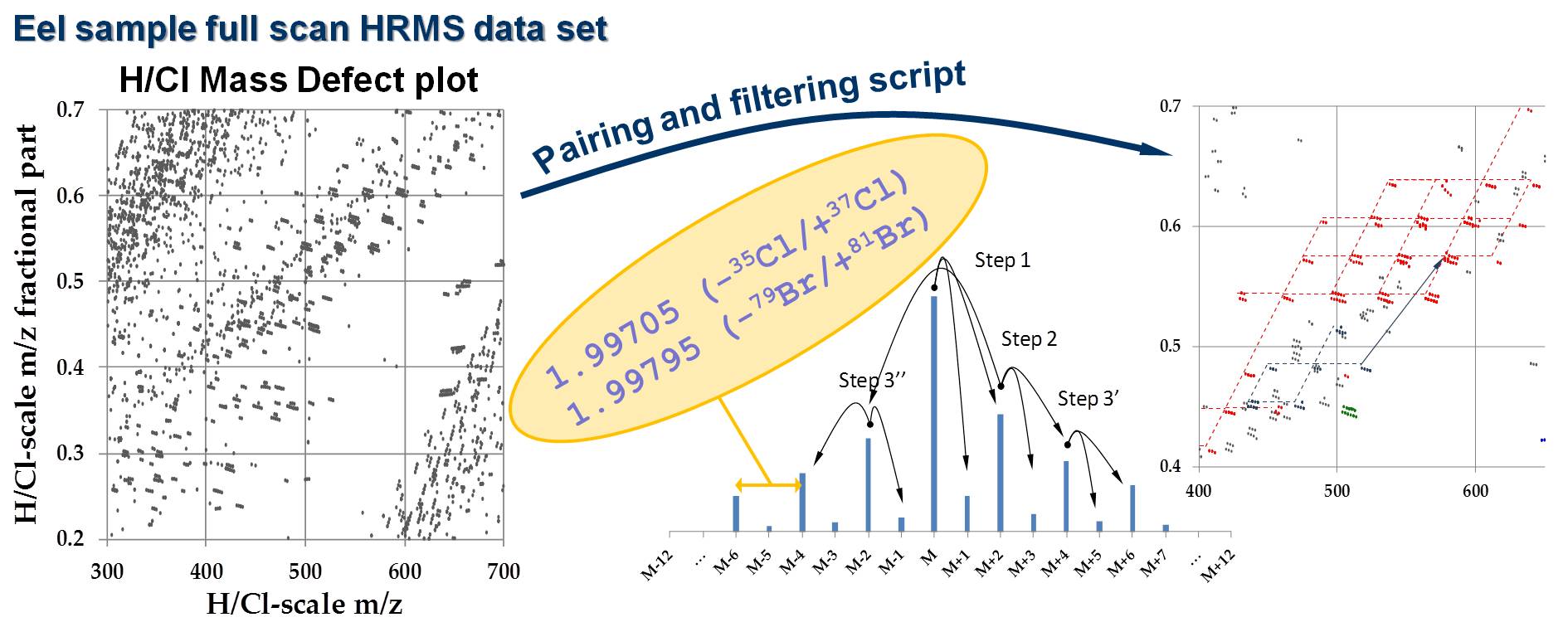
A purified extract was obtained from an eel muscle sample before being analyzed by liquid chromatography coupled to high resolution mass spectrometry in full scan mode. Automatic peak integration was performed, leading to a list of features characterized by exact mass m/z, retention time and signal intensity. Pairing of features into halogenated isotopic clusters became completed by using a data treatment tool based on mass defect, more precisely the exact mass difference between natural Cl and Br halogen isotopes, the script being developed  in Visual Basic for Application language.

After global peak picking step was achieved, the authors eventually obtained 9789 features in the eel sample extract. The filtering script whilst using the visual basics for application macro tool brought about a discounted variety of 1994 features which were paired in 579 potentially halogenated clusters for additional investigation.

When investigating clusters associated with hexabromocyclododecane (HBCDD), 10 clusters which showed the largest spans were found and were all attributed to HBCDD isomers as native form, internal standards 13C12, external standard 2H18 or related adducts. For the three isomers (α, β, γ) of HBCDD. This result supplied an estimate of native forms of three isomers of HBCDD concentration which implies that the approach used by the authors is very effective in detecting contaminants at trace levels in complicated organic matrices.

The authors also identified chlorinated paraffin on the eel sample extract which were grouped as short chain, medium chain and long chain. Rough estimation of the short chain and medium chain chlorine paraffin were in orders of 5 and 50 ng-1, respectively. Various other halogenated compounds were additionally detected showing high efficiency of this method.

The method used by the authors show an improved overall performance of detecting extensive range of organohalogenated compounds in any form of matrix extract.  
Screening halogenated environmental contaminants in biota based on isotopic pattern and mass defect provided by high resolution mass spectrometry profiling. Advances in Engineering

About the author

Elsa OMER graduated from Nantes University with a Master degree in analytical chemistry in 2014. She joined the “LABoratoire d’Etude des Résidus et Contaminants dans les Aliments” (LABERCA) in 2015 on a project aiming at preventing the contamination of livestock animals by hexabromocyclododecane, a brominated flame retardant. In 2016, she began a PhD related to the “identification of substances migrating from polyester based varnishes intended for food contact” in collaboration between Ardagh Group, the LABERCA and the laboratory “Interdisciplinary chemistry: synthesis, Analysis, Modelling” (CEISAM) based in Nantes University. 

About the author

Dr. Gaud Dervilly-Pinel obtained her PhD in Food Science in 2001. Since 2002 she is working as a researcher at LABERCA (French National Reference Laboratory for growth promoters and environmental chemical contaminants in food); her research activity is devoted to Chemical Food Safety issues. She acts as Scientific Advisor in the laboratory and is responsible for the management of research projects related to the modeling of contaminants transfer along the food chain and the evaluation of consumer’s chemical exposure.

She has contributed to significant advances in the detection of chemical residues of forbidden compounds in food related matrices, as well as to the establishment of criteria to distinguish between situations of frauds and natural occurrence of certain substances (natural steroid hormones …); she received in 2012 the EuroResidue Award for her contribution to this field.

In 2009, she obtained a second PhD in Analytical Chemistry dedicated to Food Safety issues. Her competences have then enlarged to environmental contaminants and from targeted mass spectrometric approaches to more global and untargeted strategies, such as metabolomics, to study the effects of chemical exposure and related biomarkers discovery, in a risk assessment perspective. She is author or co-author of more than 70 peer reviewed papers in the field (h-index 18, RG Score : 36,89 and more than 50 oral communications.

She also teaches at the academic level at Nantes University (France) and is regular lecturer at SARAF (School for Advanced Residue Analysis) and VLAG (Wageningen University, NL). 

About the author

Dr. Ronan Cariou graduated from an agricultural engineers school (ENSAR, Rennes, France) in 2001, with a specialisation in food process. He joined the “LABoratoire d’Etude des Résidus et Contaminants dans les Aliments” (LABERCA) within the Nantes-Atlantic National College of Veterinary Medicine, Food Science and Engineering (Oniris, Nantes, France) in 2002 during his Master degree. He graduated a PhD degree from Nantes University in Analytical Chemistry in 2006 for his work related to the “Evaluation of the fetus and newborn exposure to brominated flame retardant type endocrine disruptors”. He remained at the LABERCA as postdoctoral fellow, participating to the evaluation of a bioanalytical approach for the detection of dioxin and dioxin-like compounds in foodstuffs using a DNA-based in vitro test with quantitative PCR measurement.

He is currently in charge of a research axe dedicated to the fate of chemical hazards along the food chain in order to contribute to human dietary exposure assessments in a food safety context.

His expertise in analytical chemistry mainly focuses on environmental contaminants and migrants from food contact materials in foodstuffs and human matrices (e.g.: dioxins/furans, polychlorinated biphenyls, bromine-, chlorine- and phosphorus-containing flame retardants, organochlorine pesticides, bisphenol A, phthalates, non-intentionally added substances).

He teaches within SARAF, an international education school specialized in Advanced Residue Analysis in Food, and joined its organising committee in 2010. He is the author or co-author of 23 peer-reviewed scientific papers (h-index 12) and more than 50 oral communications. 

About the author

Alexis LÉON graduated his MSc degree in Analytical Chemistry from Orléans University, France, in 2015. He joined the “LABoratoire d’Etude des Résidus et Contaminants dans les Aliments” (LABERCA, Nantes, France) during his MSc internship in 2015 and started a PhD in 2016 on a similar subject, in collaboration with the French Research Institute for Exploitation of the Sea (IFREMER), then working in the fields of Food Safety and Marine Environment.

His subject involves developing an innovative strategy to discover and inventory new polyhalogenated compounds based on sample preparation, high resolution mass spectrometric fingerprints and automated home-made bioinformatics tool for data treatment.

About the author

 Bruno le Bizec, Professor, PhD, HDR graduated from Nantes University as a Doctor in Analytical Chemistry (PhD, 1995). He obtained in 2001 his HDR, the highest Academic Diploma in France authorizing the leadership of Research Projects.

He is Professor since 2005 in food safety at the National Veterinary College of Nantes, Oniris. Professor Le Bizec is at this time the Head of the French National Reference Laboratory LABERCA in charge of forbidden growth promoters in farm animals and a wide of persistent organic pollutants in food. He was appointed Vice-Chair of the Contaminant panel of the French Agency for Food Safety (ANSES) from 2006 to 2012, Professor Le Bizec is also serving as a member on a FAO/WHO expert committee on food additives (JECFA) since 2008 and in IARC (PCB/PBB monographies, 2013). He has been repeatedly invited as a national expert for FVO (Food and Veterinary Offices, EU DG SANCO) inspection in member states and third countries. His activities include membership in several scientific councils both at institutional levels (ENVN, ENITIAA, Oniris, PONAN…) and at international scientific events [Euroresidue (NL), VDRA (B), RAFA (CZ), International SaskVal Workshop (CA)…).

He developed and teaches food safety, risk analysis as well as analytical chemistry. He is coordinating the actions of SARAF, an international education school specialized in Advanced Residue Analysis in Food.

He is the author or co-author of more than 250 peer-reviewed scientific papers (h-index 38), 12 book chapters, 200 oral communications. Bruno Le Bizec received several awards amongst which the Euroresidue Award in 2004 for its research career on steroid hormones analysis. He was bestowed Knight of the Order of Academic Palms in 2015 by the French Government for distinguished services.  

Journal Reference

Cariou R1, Omer E2, Léon A2, Dervilly-Pinel G2, Le Bizec B2Screening halogenated environmental contaminants in biota based on isotopic pattern and mass defect provided by high resolution mass spectrometry profiling, Analytica Chimica Acta 936 (2016) 130-138.

 [expand title=”Show Affiliations”]

  1. LUNAM Université, ONIRIS, Laboratoire d’Etude des Résidus et Contaminants dans les Aliments (LABERCA), Nantes, F-44307, France. Electronic address: [email protected].
  2. LUNAM Université, ONIRIS, Laboratoire d’Etude des Résidus et Contaminants dans les Aliments (LABERCA), Nantes, F-44307, France.
[/expand]


Go To Anal Chim Acta

Check Also

Bridged charge transfer in Mn-doped CdS nanorods with noble-metal-free metal hydroxide co-catalysts

Significance  Reference MacSwain, Walker & Hu, Xia & Wu, Rongzhen & Li, Zhi-Jun & Vanshika, …