Advances in Engineering Advances in Engineering features breaking research judged by Advances in Engineering advisory team to be of key importance in the Engineering field. Papers are selected from over 10,000 published each week from most peer reviewed journals.

Significance
Art represents a range of human activities that the respective authors use to express their imaginative, conceptual or technical abilities either visually, auditory or through performance. The resulting artwork currently encompasses some of the most delicate yet highly valued objects in human history that demand constant control over the situation they are in, and effective actions to preserve and deliver them safely to subsequent generations. According to art conservation practices, a proficient approach necessitates the identification of defects at an early stage, especially for fragile paint artworks being panel or wall paintings.
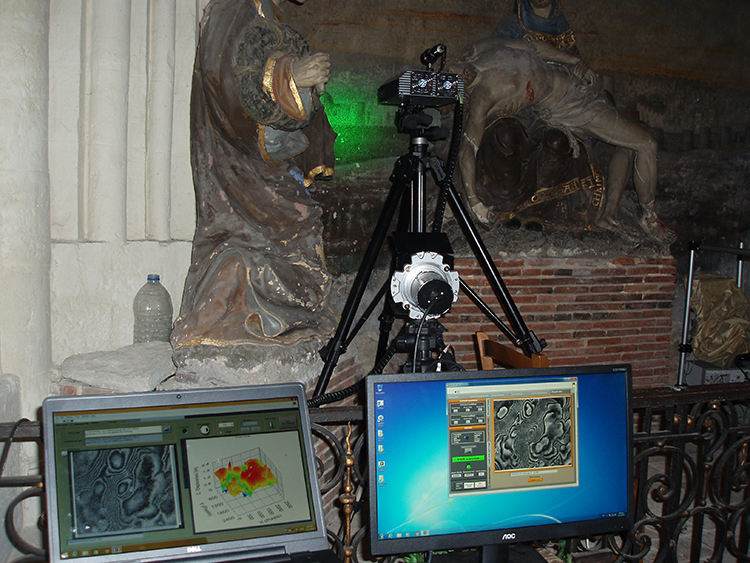
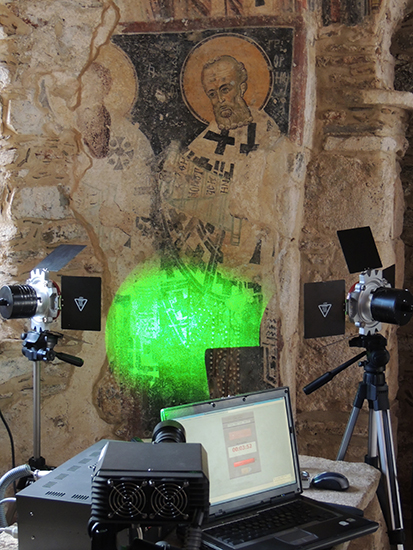
To date, interferometry has proven to be a successful method for measuring fields of refractive index and displacement in paintings. As such, holographic interferometry has been presented as a non-destructive full-field optical method for the remote detection of non-visible anomalies by recording the surface response in one instance for all surface points and integrating the response time in a temporal measurement of optical surface displacement at once. So far, a thorough review on this and other techniques reveals that there lacks a portable non-destructive or minimally destructive diagnosis system that would help acknowledge various invisible defects and their morphology; an information that would allow timely recognition and correct maintenance to ensure better preservation. In a recent publication, Professor Vivi Tornari from the Institute of Electronic Structure and Laser at the Foundation for Research and Technology Hellas designed a new Digital Holographic Speckle Pattern Interferometry (DHSPI) portable system with the main focus being to resolve existing shortcoming in existing techniques in art conservation field. The presented system implements the properties of holographic interferometry with the phase shifted speckle interferometry. Consequently, various types of cultural heritage objects can be studied using the DHSPI portable system. Her work is currently published in the research journal, Strain,
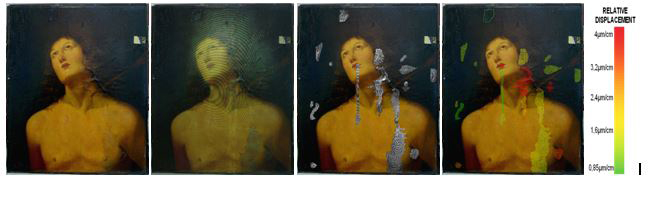
Professor Vivi Tornari technique was based on overlaying on a digital medium the backscattered laser light from the surface of the object under consideration with a twin beam—derived from splitting same laser beam—of fixed optical pathway called reference beam. With specific algorithms, the digital hologram of the object is calculated. Altogether, the interferogram collected from this intricate approach is analyzed with specially developed post-processing tools and various deductions concerning invisible defects size, shape, 3D map and the risk imposed to the precious surface completing documentation of structural condition are made.
The author reported that the device allowed for micro projections of the invisible defects on the surface of the object to be detected with system’s minimum sensitivity equal to half the wavelength of the laser used. Additionally, she highlighted that the special tailor-made software allows for full control of the system and setting of experimental parameters, processing of the data, post-processing and extraction of anomalies. Additionally performing automatic measurements for long period of time to assess environmental impact without the presence of operator is made possible.
In summary, the DHSPI portable system is developed as a result of many years of research to cover demands for out of laboratory non- destructive structural diagnosis investigation especially in the field of cultural heritage. Professor Vivi Tornari mentioned that her approach provided the possibility for full-field high resolution interferometry and non-destructive analysis of works of art on site via remote acquisition and recording to detect structural alterations in works of cultural heritage. Remarkably, the hardware and software used were optimized as user-friendly. Overall, the new system also allows observation of the object’s response to environmental and microclimate changes in order to predict the impact of RH/T conditions and formation of alterations or the evolution of existing ones providing the only known direct tool for exploring the mechanisms of deterioration and impact allowing scheduling of maintenance and preservation strategies.

Reference
Vivi Tornari. On development of portable digital holographic speckle pattern interferometry system for remote-access monitoring and documentation in art conservation. Strain. 2019; volume 55: page12288.
Go To Strain