Advances in Engineering Advances in Engineering features breaking research judged by Advances in Engineering advisory team to be of key importance in the Engineering field. Papers are selected from over 10,000 published each week from most peer reviewed journals.

Significance
The use of imines for the synthesis of fine chemicals, for pharmaceutical applications, have rapidly increased owing to the presence of reactive C=N bonds. These bonds undergo three typical transformations: reductions, addition, and cyclizations. Apart from Schiff coupling approaches, new synthetic approaches based on one-pot oxidative methods operating with starting materials and oxidant (air) have been developed. These methods include the cross-coupling of alcohols with amines, the use of secondary amines, and the self-coupling of the primary amines. With the emergence of the catalytic systems based on metals, metal-free, and photocatalysis, the oxidative approaches have been extensively investigated. In fact, their development in aerobic oxidation of alcohols and amines to imines have been achieved.
Among the available metal-based catalysts, Ru has been studied for potential applications in the imine formation. Unfortunately, oxidation in the Ru catalyst produced low yields thus unfavorable for large-scale applications. Consequently, under anaerobic conditions, over oxidation of imines leading to the formation of nitriles is a great possibility due to the presence of oxygen. As such, effective catalytic systems are desirably for anaerobic oxidation.
To address these challenges, University of Pardubice researchers: Michal Aman (PhD student), Jakub Tremmel, Dr. Libor Dostal, Dr. Milan Erben, Dr. Jiří Tydlitát and led by Professor Roman Jambor together with Dr. Josef Jansa from the Research Institute for Organic Synthesis evaluated highly active and selective Ru-PNH catalyst in aerobic oxidation of primary amines. The application of the germylene LGeCl as a ligand in preparing germylene analogous was investigated by the team. Additionally, the effect of different charges of the Ru atom on the efficiency of the oxidants was analyzed. Their work is published in the journal, Chemcatchem.
Their results showed that the activities of the catalysts depended on the charge of the Ru atom influenced by the character X and donation of the R ligands. The Ru/P catalysts that exhibited the least negative charge on the Ru atom were identified as the most effective catalyst. Among the prepared Ru/P catalysts, the typical Ru/P catalyst 3 was observed to be the most effective since it produced no detectable over oxidation of the tested benzyl amines. To this end, it was used as a homogenous catalyst in 0.1 mol% loading with relatively high selectivity. The high catalytic activity of 3 was attributed to the least negative charge especially on the central Ru atom as compared to its counterparts.
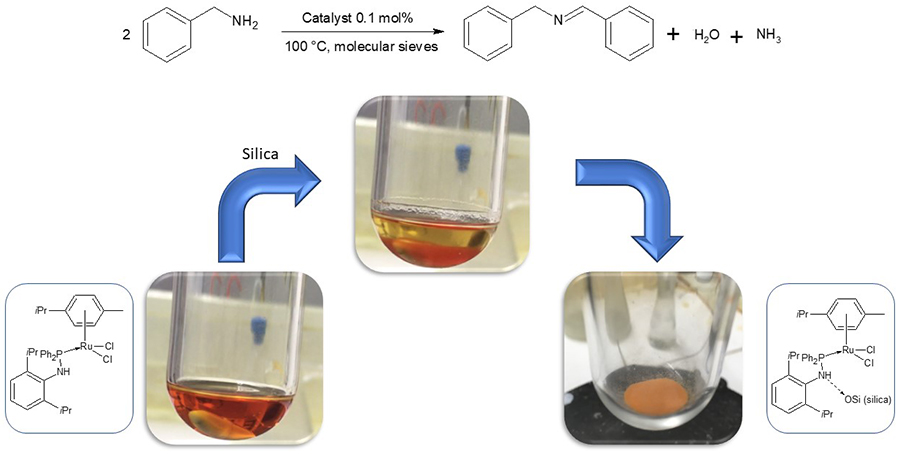
To have a proof of concept, the research team designed a phosphine ligand L2 containing amino-phosphine PNH moiety and demonstrated the efficient anchoring of the complex 3 to silica gel via NH hydrogen bonding. This enabled the synthesis of highly active and selective heterogenous catalyst 3-silica that was successfully tested for aerobic oxidation in primary amines. Based on the results, the study has been selected by Advances in Engineering as a key scientific article for the future development of effective catalysts for aerobic oxidation of benzyl amines.


Reference
Aman, M., Tremmel, J., Dostál, L., Erben, M., Tydlitát, J., Jansa, J., & Jambor, R. (2019). Highly Active and Selective Ru-PN H Catalyst in Aerobic Oxidation of Benzyl Amines. Chemcatchem, 11(18), 4624-4630.