Advances in Engineering Advances in Engineering features breaking research judged by Advances in Engineering advisory team to be of key importance in the Engineering field. Papers are selected from over 10,000 published each week from most peer reviewed journals.

Significance
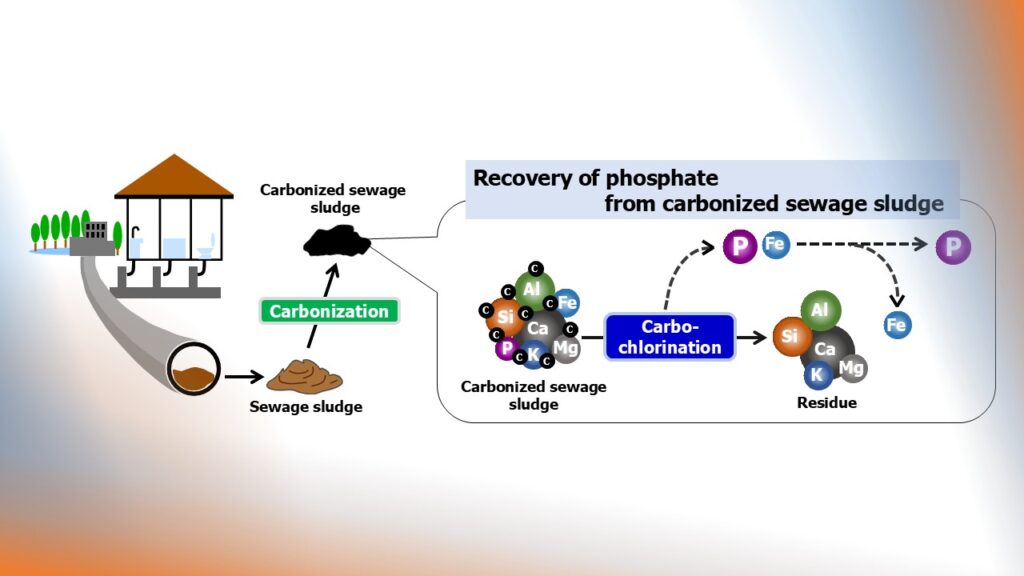
Chlorination has attracted attention for that reason. Earlier studies showed that, under specific conditions, phosphorus in various solids can be chlorinated into volatile species while other elements remain comparatively immobile. That opens the door to a separation approach based on controlled volatilization rather than dissolution. The question is whether this idea holds up when the starting material is carbonized sewage sludge. Here, phosphorus does not appear as a typical phosphate mineral; it is present mainly as Fe₂P, a reduced compound whose response to chlorination is much less predictable. Establishing whether that form can be volatilized selectively is therefore not just a technical detail—it is the central uncertainty that motivates this line of work. To this end, new research paper published in Biomass and Bioenergy and led by Assistant Professor Yuuki Mochizuki and Associate Professor Naoto Tsubouchi from the Faculty of Engineering at Hokkaido University, the researchers developed two conceptual process models for phosphorus recovery. The first is a temperature-controlled volatilization model, demonstrating that Fe₂P within carbonized sewage sludge can be converted into gaseous Fe- and P-chlorides at 773 K while suppressing volatilization of Si, Al, K, Mg, and Ca. The second is a gas-phase separation model, where FeCl₃ condenses preferentially along the reactor’s cooling walls while PCl₃ remains mobile enough to be captured downstream in a water trap.
The research team prepared the carbonized sewage sludge (SSC) under controlled pyrolysis at 1173 K, a temperature chosen after thermogravimetric analysis showed that devolatilization of organics stabilizes near that point. Once pyrolyzed, the material displayed a markedly different mineral fingerprint: XRD patterns revealed the disappearance of species common in untreated sludge and confirmed that phosphorus was present almost entirely as Fe₂P. This point is important because Fe₂P behaves differently from phosphate minerals such as hydroxyapatite; its volatilization requires conversion into gaseous chlorides rather than simple thermal decomposition.
They performed chlorination experiments in a quartz fixed-bed reactor where small SSC samples were exposed to flowing Cl₂ while temperature was ramped from 573 to 1273 K. The yield curve behaved in a way that reflected competing reactions. Up to about 773 K, the mass increased because chlorine was retained within the carbon matrix and ash. Beyond that temperature, desorption began to dominate, accompanied by volatilization of metal chlorides. Additionally, the authors found iron and phosphorus both began volatilizing near 573 K, and their release exceeded 90% between 973 and 1273 K. In contrast, silicon and aluminum remained relatively immobile until temperatures surpassed 873 K, and even then, their volatilization rates lagged behind those of Fe and P. Calcium proved the most resistant—essentially nonvolatile across the entire temperature span. The team then performed kinetic analysis, and they fitting volatilization data to Arrhenius-type expressions. For phosphorus, the activation energy was around 50 kJ/mol, which differed markedly from values previously reported for apatite and MAP. That divergence supports the conclusion that phosphorus in SSC behaves according to the chemistry of Fe₂P, not phosphate minerals. Iron volatilization required a two-step kinetic model, consistent with the fact that Fe transitions between Fe₂Cl₆ and FeCl₃ depending on temperature. These findings aligned well with thermodynamic calculations predicting PCl₃, Fe₂Cl₆, and FeCl₃ as the dominant gas-phase species. Moreover, the authors found at 773 K, approximately 70% of Fe and P volatilized within 40 minutes, while Si, Al, K, Mg, and Ca remained largely in the solid phase. Holding at 873 K increased volatility but at the cost of dragging other elements into the gas stream. Thus, 773 K emerged as the sweet spot for selective volatilization. Finally, the team addressed whether volatilized Fe and P could be separated physically. Cooling gradients inside the reactor caused Fe chlorides to condense preferentially on the inner wall, whereas phosphorus species divided between wall deposits and the downstream water trap. Roughly half the volatilized P was captured as dissolved chloride species in the trap, while Fe was overwhelmingly retained near the reactor outlet. This demonstrated, at least in principle, a pathway for downstream separation based purely on differences in condensation behavior.
In conclusion, Assistant Professor Yuuki Mochizuki and Associate Professor Naoto Tsubouchi designed new models that introduce a single-step thermochemical pathway which enables selective release and physical separation of Fe and P without wet chemical processing. What stands out in this work is the authors’ ability to carve out a narrow but highly effective thermochemical window for phosphorus recovery from a material that typically defies selective processing. Carbonized sewage sludge is not an easy feedstock. It contains a dense mixture of minerals, trace metals, and residual carbon, and its phosphorus often sits in a coordination environment that resists extraction. Yet by combining controlled chlorination with an understanding of volatilization kinetics, the researchers were able to demonstrate that Fe and P can be lifted out of the solid matrix without triggering broad volatilization of the surrounding mineral phases.
Many countries face a growing dependence on imported phosphate rock, and geopolitical stresses have made the supply of this non-renewable resource precarious. Waste streams containing phosphorus—sludge, ash, manure, and industrial residues—represent a dispersed but international reservoir of secondary phosphorus. The challenge has always been how to release that phosphorus without generating new waste or incurring prohibitive processing costs. What the present study suggests is that thermochemical separation, when tuned properly, may provide a relatively clean and compact way to convert what is now a waste liability into a recoverable commodity. There are practical considerations that will shape the next stage of development. The process generates phosphorus chlorides rather than phosphates, and although these compounds can be converted into useful forms, doing so requires additional reaction steps. Likewise, the purity of recovered phosphorus will depend on how efficiently downstream condensation and trapping can be controlled. But the fact that Fe and P volatilize together and then separate naturally during cooling offers a distinct operational advantage; it externalizes the separation step into the temperature gradient of the reactor rather than requiring chemicals or membranes. Another element worth noting is the new method proposed by Assistant Professor Mochizuki and Associate Professor Tsubouchi and its potential scalability. Pyrolysis systems already exist at municipal levels, and chlorination reactors are well understood in industrial practice. Integrating the approach into existing waste-to-resource infrastructures seems within reach. Moreover, because the process can run as a single thermal step, it avoids the multi-stage acid–base cycles that plague conventional wet extraction, particularly when metals co-leach and require expensive purification.