 Advances in Engineering Advances in Engineering features breaking research judged by Advances in Engineering advisory team to be of key importance in the Engineering field. Papers are selected from over 10,000 published each week from most peer reviewed journals.

Significance Statement
Nanoporous/nanotubular titanium oxide is popular for energy storage applications as electrodes of rechargeable batteries and electrochemical capacitors. Honeycomb structures are considered to possess high stiffness, excellent capacity to absorb impact energy, and superior structural stability. A honeycomb morphology offers high surface area and enhanced porosity. These two characteristics, when combined with branched structures and low density, leads to the formation of heterojunctions. For this reason, honeycomb structures as semiconducting elements may lead to superior thermal, dielectric, and electronic attributes.
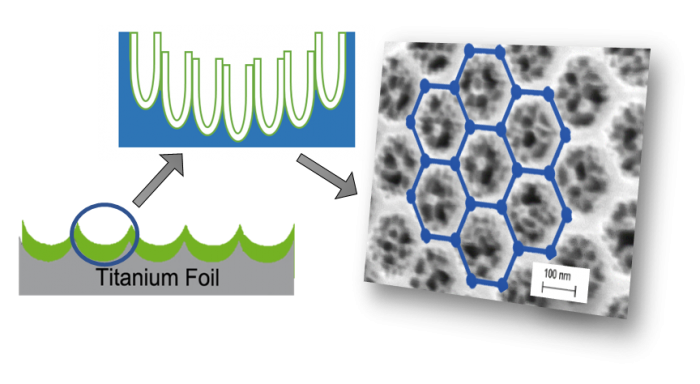
Steven Sitler and colleagues at the University of Idaho and the University of Nevada, Reno investigated the energy storage attributes of titanium oxide nanotubes with honeycomb morphology. They prepared the honeycomb structured titanium oxide samples implementing a two-step anodization approach. They used an organic solvent in the first anodization process and an aqueous acidic solution in the second anodization process. The selected concentration of titanium ions was needed to generate the honeycomb structure in the second anodization process. The authors then compared the energy storage capacity as well as the stability of the honeycomb structured titanium oxide specimens with the regular titanium oxide nanotubes synthesized through a single anodization step. Their work is published in Applied Surface Science.
The authors carried out galvanostatic charge-discharge and cyclic voltammetry tests on specimens in annealed and anodized conditions in lithium chloride and sodium hydroxide electrolytes. They used a three-electrode configuration with a platinum spiral counter electrode, silver-silver chloride in saturated potassium chloride as reference electrode and the test piece as the working electrode with 2 cm2 surface area.
The authors carried out the galvanostatic charge-discharge tests implementing a three-electrode configuration with spiral platinum counter electrode at varying current densities in the range of 0.1-10 mAcm-2. They also analyzed the stability of the specimens in sodium hydroxide. Electrochemical impedance spectroscopy measurements were also carried out to illuminate the degradation mechanism of the samples.
The new morphology consisted of small diameter nanotubes placed inside of every honeycomb like hemisphere. The honeycomb like hemispheres were observed to have diameters of 160-200 nm with 20-50 nm inter-wall thicknesses grown onto a planar barrier layer. The total thickness of the dual-layered honeycomb oxide was approximately 350-500 nm and had very high surface area.
The results of the cyclic voltammetry as well as galvanostatic charge-discharge tests done on the oxide samples in as-anodized and annealed conditions using sodium hydroxide and lithium chloride electrolytes. The researchers observed that the honeycomb arrays had an areal capacitance of 56 mFcm-2 at a 100 mVs-1 scan rate. The arrays also showed an areal capacitance of 0.75 mFcm-2 at a current density of 0.1 mAcm-2.
The observed areal capacitance for the honeycomb structured specimens was approximately 60% more than that of typical titanium oxide nanotubes. The honeycomb structured specimens also exhibited over 33% higher capacitance retention even after 10,000 cycles as opposed to typical titanium oxide nanotubes. This high capacitance retention reported can be attributed to the improved structural stability of the honeycomb structures.

Reference
S.J. Sitler, K.S. Raja, Z. Karmiol, D. Chidambaram. Self-ordering dual-layered honeycomb nanotubular titania: Enhanced structural stability and energy storage capacity. Applied Surface Science, volume 401 (2017), pages 127–141.
Go To Applied Surface Science