Advances in Engineering Advances in Engineering features breaking research judged by Advances in Engineering advisory team to be of key importance in the Engineering field. Papers are selected from over 10,000 published each week from most peer reviewed journals.

Experimental and Numerical Study
Significance
Steel-concrete composite girders exhibit stiffer and higher flexural resistance properties than steel beams or reinforced concrete beams. Among the many steel-concrete composite girders, U-shaped composite girders have drawn significant research attention owing to their ability to withstand bending moments, making them potential candidates for various practical applications. Generally, U-shaped composite girders comprise two main elements: a U-shaped steel beam and a reinforced concrete slab. Since most applications involving U-shaped composite girders require shear transfer at the interface of these components, a wide range of shear connectors such as steel trusses, steel angles and headed studs have been proposed to achieve the same. Most of these connectors are capable of transferring longitudinal shear in composite girders.
Recently, angle connectors have been developed as a promising alternative for specifically U-shaped composite girders. They are easy, convenient and inexpensive to install. Additionally, they have a clear load path, improve the stability of the structure, and their two legs work together to resist the uplifting of the reinforced slab and ensure efficient longitudinal shear transfer. Despite the extensive studies on the angle connectors, reliable design model and analysis of their effectiveness and practicability is still lacking. This has continued to limit their widespread acceptance and applications. Previous findings established that properly designed angle connectors could provide the girders with desired composite action as well as stiffness and flexural strength properties required in most applications. Thus, a robust design of angle connectors for high-performance U-shaped composite girders is urgent.
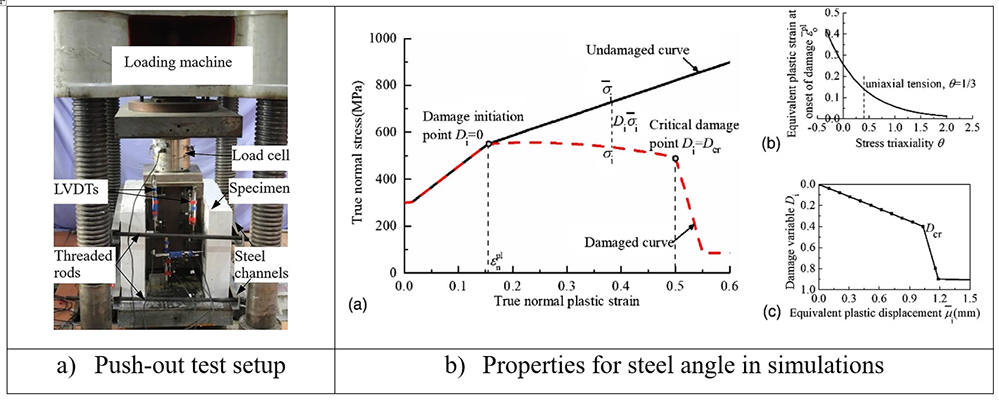
On this account, Professor Yong Liu from Hefei University of Technology, Professor Lanhui Guo from Harbin Institute of Technology and Professor Bing Qu from California Polytechnic State University conducted a numerical and experimental study to investigate the shear resistance of steel angle connectors in U-shaped composite girders. In the first part, a series of push-out tests were performed to study their nonlinear load-slip responses considering three key test parameters: comprehensive strength of the concrete, angle thickness and the influence of the foam blocks attached at the end of the connectors. Finite element models were developed in the second part to investigate the nonlinear behaviors of the connectors. After validating the models against the experimental results, a parametric analysis was conducted to determine the influence of various parameters on the shear resistance. Finally, an accurate empirical model for predicting the shear resistance was proposed and validated. The work is currently published in the Journal of Structural Engineering.
From the results, the slip capacities of the angle connectors were greater than 6mm, suggesting that the connectors were of the ductile shear type. The angle connectors exhibited two failure modes relative to the strengths of the angle connector and the concrete: rapture at the vertical legs and cracking of the concrete around the connector. Additionally, the foam blocks increased the slip angles of the angle connectors, reducing their shear resistance. In contrast, shear resistance could be improved by increasing the comprehensive strength of the concrete, steel yield strength and the cross-section angle dimensions. Among the investigated parameters, the shear resistance was mostly affected by the angle thickness and least affected by the comprehensive concrete strength.
In summary, the research team studied carefully the shear resistance of angle connectors in U-shaped composite girders experimentally and numerically. The numerical results agreed well with the experimental results. The proposed empirical design model provided acceptable shear predictions, suggesting the model’s feasibility and potential practical applicability. Moreover, the angle connectors did not compromise the overall performance of composite girders. In a statement to Advances in Engineering, the authors explained the study findings will advance the application of angle connectors in U-shaped composite girders.



Reference
Liu, Y., Guo, L., & Qu, B. (2021). Shear Transfer Capacity of Angle Connectors in U-Shaped Composite Girder: Experimental and Numerical Study. Journal of Structural Engineering, 147(5), 04021046.