 Advances in Engineering Advances in Engineering features breaking research judged by Advances in Engineering advisory team to be of key importance in the Engineering field. Papers are selected from over 10,000 published each week from most peer reviewed journals.

Significance
Raman spectroscopy refers to the famed spectroscopic technique that is used for making vibrational, thermal, optical, magnetic, rotational and other low-frequency modes observations of a system. Over the years, it has become indispensable particularly during the characterization of solid, liquid and vapor phases of materials, owing to the ease of sample preparation and facile mode of operation associated with it. Thus, it has been widely used in research and industrial setups. This technique is particularly useful in studying properties of epitaxially grown materials. For such applications, useful information regarding impurities, doping, stress, strain, degree of crystallinity or micro-crystalline size in amorphous samples and nano-structural characteristics can be obtained. The principle mode of action here involves exploring changes in the Raman spectra of specific materials compared to what is expected for a single crystalline sample. Furthermore, the polarization dependent characteristics of Raman scattering are dependent on single crystalline quality and crystallographic orientation of the substrate.
Recently, Professor Uma Ramabadran at Kettering University and Professor Bahram Roughani at Loyola University Maryland joined forces and undertook in-depth analysis of the Raman intensity profiles generated when an alternative approach is used to obtain polarized Raman spectra from single crystalline Silicon samples to that commonly used for this purpose. Specifically, they determined the specific theoretical profiles of Raman scattered signal from samples of the well-known diamond cubic crystalline Silicon cut off axis. Their work is currently published in the research journal, Materials Science & Engineering B.
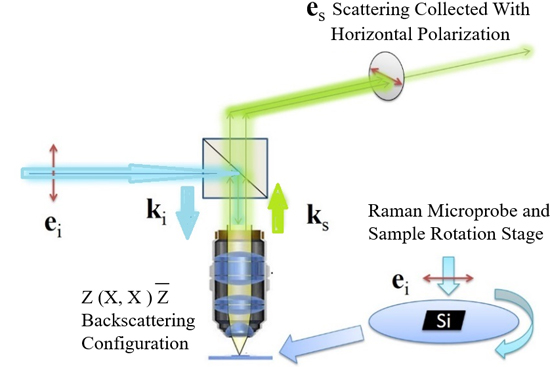
In brief, the research method employed involved making a comparison of experimental intensity profiles of polarized Raman spectra to those determined by calculation in order to determine the sample cut. The orientation of the crystal was then defined by two angles, one defined between the (0 0 1) crystal axis and the lab z-axis and the other as the angle of rotation of the crystallographic x-y plane about the crystal’s z-axes. Theoretical Raman intensity profiles were then generated by rotating wafers of different geometry about the lab z-axis in the backscattered configuration. Lastly, the impact of the off-axis Silicon on the Raman intensity profile was investigated to identified specific signatures in the Raman spectra.
The authors observed that application of a polarizer and analyzer maintained at the horizontal polarization configuration allowed for determination of the ratio of maximum to minimum intensity which correlated with the sample geometry. Additionally, they noted that without the analyzer, the Raman intensity profile was the sum of horizontal and vertical polarization profiles.
In summary, Uma Ramabadran-Bahram Roughani study demonstrated that polarized backscattered Raman spectroscopy could be used for identifying the crystallographic orientation of silicon cut off axis. In general, they saw that the overall polarized Raman intensity signature varied systematically and characteristically in accordance with the sample cut variance. Altogether, the model and the computational approach presented by professors Ramabadran & Roughani could potentially be used to get good idea of the Raman intensity profiles for other crystallographic structures.


Reference
Uma Ramabadran and Bahram Roughani. Intensity analysis of polarized Raman spectra for off axis single crystal silicon.Materials Science & Engineering B, volume 230 (2018) page 31–42.
Go To Materials Science & Engineering B