Advances in Engineering Advances in Engineering features breaking research judged by Advances in Engineering advisory team to be of key importance in the Engineering field. Papers are selected from over 10,000 published each week from most peer reviewed journals.

Significance
Lightweight alloys of aluminum-silicon series have excellent physical and mechanical properties, which are desirable for a number of industrial products. However, even for pure aluminum materials, silicon is still present in solid solutions and Intermetallics. Silicon as well as other elements like copper, iron, and magnesium are normally introduced as alloy elements in order to improve the mechanical integrity of the soft aluminum. Low density along with high tensile strength gives aluminum alloys a high specific strength.
During the processing of Al alloys (casting, extruding, rolling), heat directly affects elements diffusion like silicon, iron, and magnesium. Approximately 10at% silicon and magnesium enrichment can be found on the surface layer, and while magnesium can be removed easily by chemical etching, silicon often remains on the surface. As a result, surface properties such as reactivity and oxidation will be different in the presence of silicon. Without other elements, silicon is added to aluminum to yield elemental silicon particles as well as an aluminum-rich solid-solution phase.
Anodic oxidation is a surface treatment method that is widely applied in the aluminum industry to functionalize the material surface often as porous oxide. This process also finds applications as a cost-effective and an easy-to-use process in membrane technology as well as microelectronics for the production of ordered nanoscale structures. Surface protective oxide films for corrosion resistance applications, are very desirable in aggressive environments for materials employed in transportation combined with the light weight to cut down on energy consumption. In the field of large scale components, research along with development are primarily focused on tailoring the process to a desired surface morphology and pore size subsequently sealed. The anodizing process of these multicomponent alloys can encounter growth process problems due to the presence of secondary phases and surface segregation that affect surface reactivity during anodic oxidation.
Claudia Cancellieri and colleagues at Empa, the Swiss Federal Laboratories for Materials Science and Technology, Switzerland, investigated the effect of silicon incorporation into aluminum layers on the growth, oxide defect formation and the ability to generate high dielectric barrier oxides. Investigation of the barrier properties of the Al oxide is relevant for high dielectric components in microelectronics as well as in the initial stages of thicker porous oxide growth. Al-Si alloys model systems opportunely prepared as metallic layers by magnetron sputtering with different Si content of 0, 4, 7, and 10 at%, are investigated before and after the anodic oxide growth. Their research work is published in peer-reviewed journal, Materials Science & Engineering B (Ref.1).
In their study, combining different experimental techniques (XRD, SEM, XPS, RBS, AFM/SKPFM, EIS,), they derived the morphology as well as in-depth microstructure of the oxides for the varying silicon contents as well as different high anodizing voltages.
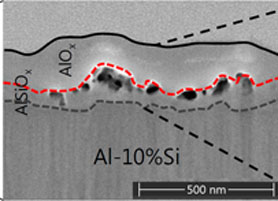
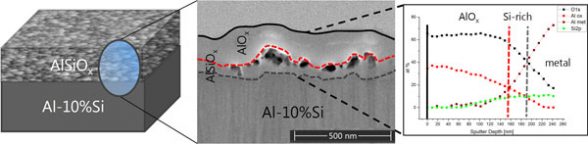
The authors observed that the presence of silicon had a significant effect on the electronic features and on the morphology/structure of the anodic oxide growing on metallic aluminum layer. They found that silicon amount as less as 4at% was sufficient to completely change the orientation of the deposited metallic aluminum layer from the preferential [111] to a polycrystalline and more disordered structure. Anodic oxidation was observed to yield a barrier, low defect, dense and homogeneous oxide only in pure aluminum layer. In the presence of a few percent’s silicon, formation of voids within the oxide layer and high roughness of the anodized surface were observed with increase in the silicon content. Important Si accumulation close to the oxide/metal interface is observed preventing the formation of a sharp interface only observed for Si-free samples. The resulting thin SiOx interface layer reactivity is further thought to be responsible for the water splitting and the formation of the voids as a result of gas evolution.
These findings of Empa researchers are important for technological advancement of the anodizing process for aluminum alloys where an in-depth understanding of the oxide microstructure/defects and particularly the influence of the modified metallic surface is the primary step in getting total control of the anodic layer growth as well as for anodizing process development on industrial aluminum alloys. This last point represents one of the key competence and main research activity of the authors at Empa (see also refs. 2 and 3).
References
[1] C. Cancellieri, F. Evangelisti, T. Geldmacher, V. Araullo-Peters, N. Ott, M. Chiodi, M. Döbeli, P. Schmutz. The role of Si incorporation on the anodic growth of barrier-type Al oxide. Materials Science & Engineering B, pages 226 (2017), pages 120–131.
[2] M. González-Castaño, M. Döbeli, V. Araullo-Peters, L. P.H. Jeurgens, P. Schmutz, C. Cancellieri. Substrate Purity Effect on the Defect Formation and Properties of Amorphous Anodic Barrier Al2O3. J. Electrochem. Soc. (2018) volume 165, issue 7, C422-C431
[3] NCCR Marvel
Go To Materials Science & Engineering B