Advances in Engineering Advances in Engineering features breaking research judged by Advances in Engineering advisory team to be of key importance in the Engineering field. Papers are selected from over 10,000 published each week from most peer reviewed journals.

Significance
Turning natural gas into something that can be stored or moved without massive infrastructure has become an unavoidable task in modern energy research. Among the many ideas proposed, methane hydrate still draws attention. It’s an odd material—part ice, part gas—where methane molecules sit locked inside tiny water cages. In theory, it offers a simple way to store large volumes of gas safely and compactly. But in practice, the process is stubborn. Hydrates form unpredictably, sometimes in minutes, sometimes after hours, and the growth rate can be painfully slow. This unpredictability has kept industrial adoption out of reach. The main tension lies in achieving fast formation while maintaining a high storage density, all within a light, reusable system that doesn’t collapse or expand. Previous research tested various porous materials such as silica, activated carbon, zeolites to provide extra surfaces for gas–liquid interaction. These fixed beds help but bring their own issues: they’re heavy and tend to swell as hydrates accumulate. Graphene aerogels seemed to offer a breakthrough. They’re incredibly light and chemically versatile, almost tailor-made for such work. However, in their pure form, they’re strangely passive. The structure is excellent, but the nucleation activity remains weak—like a stage set waiting for the reaction to begin. To overcome this limitation, the integration of metal nanoparticles onto porous matrices has been proposed as a means to stimulate nucleation and enhance mass transfer. Silver nanoparticles, in particular, exhibit a strong affinity for methane molecules and have been reported to facilitate heterogeneous nucleation through their high surface energy and electron density. However, the synergistic interplay between silver nanoparticles and graphene aerogels in controlling both the kinetics and the storage efficiency of methane hydrate formation had not been fully elucidated. To this account, new research paper published in Energy & Fuels and conducted by Dr. Wenhui Ma, Dr. Li Li, Dr. Yan Lin, and led by Professor Fei Wang from the College of Electromechanical Engineering at Qingdao University of Science and Technology, the researchers designed two integrated models describing methane hydrate formation kinetics and storage efficiency in silver-modified graphene aerogels. The first model correlates nanoparticle-induced nucleation with microstructural parameters, while the second links promoter concentration and mass transfer behavior to overall gas uptake capacity.
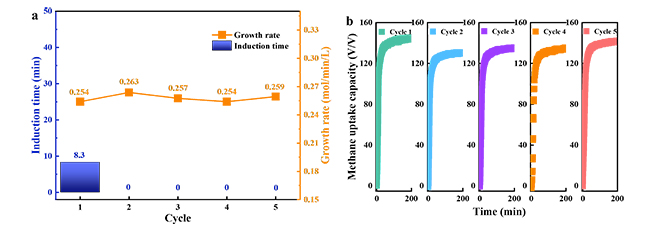
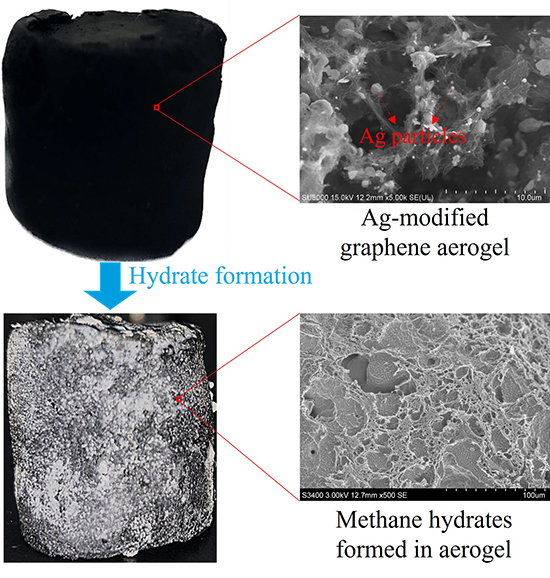
The researchers synthesized the Ag@GA composite through electrostatic adsorption of Ag⁺ ions onto graphene oxide, followed by in situ reduction with ascorbic acid and structural modification using sulfonated polystyrene nanospheres to improve hydrophilicity. They found the resulting aerogel to have a porous, interconnected network with reduced specific surface area but larger average pore diameter compared with pure graphene aerogel. They conducted scanning electron microscopy which confirmed uniform dispersion of silver nanoparticles within the matrix, while X-ray diffraction identified distinct peaks corresponding to the (111), (200), (220), and (311) crystal planes of metallic silver. These structural characteristics indicated successful nanoparticle incorporation without compromising the integrity of the aerogel framework. The authors performed afterward methane hydrate formation experiments in a 100 mL high-pressure stainless-steel reactor under varying conditions of temperature, pressure, and promoter concentration. They observed introducing Ag nanoparticles is important in reducing the induction time for hydrate nucleation—from more than 12 hours in the pristine aerogel to as little as zero to fifteen minutes in the Ag@GA system. At a volume ratio of 0.4 between the liquid and the solid bed, hydrate growth was most efficient, reaching rates near 0.25 mol min⁻¹ L⁻¹. Higher ratios increased induction speed but reduced storage density due to excessive liquid retention in the pores. Increasing the initial methane pressure from 5 to 8 MPa enhanced nucleation kinetics, though beyond 7 MPa, the rate improvement plateaued, indicating kinetic saturation. It is noteworthy to mention that within the temperature range of 273.15–276.15 K, both hydrate growth rate and storage efficiency remained nearly constant, confirming that Ag@GA mitigates the typical sensitivity of hydrate formation to temperature fluctuations. The role of L-methionine concentration was more intricate: at low concentrations (1 g L⁻¹), hydrates grew rapidly within the inner pores, whereas at higher levels (3–4 g L⁻¹), growth occurred on the outer surfaces as compact blocks, which reflect changes in wettability and diffusion pathways. Cryogenic SEM revealed that hydrates indeed occupied the aerogel pores, with the framework remaining intact after dissociation, ensuring reusability. When the team conducted cyclic tests, Ag@GA demonstrated remarkable durability and consistency across five formation–dissociation cycles and the induction time remained close to zero after the first run, evidencing a persistent “memory effect” facilitated by the porous network. The hydrate growth rate (≈ 0.26 mol min⁻¹ L⁻¹) and methane storage capacity (135–145 V V⁻¹) were maintained throughout, which indicate minimal structural degradation.
In conclusion, the work by Professor Fei Wang and his team clearly demonstrates that Ag@GA functions as both a highly active nucleation catalyst and a durable structural framework for methane hydrate formation. It can achieve the balance between rapid formation kinetics and sustained storage performance and the material behaves as a lightweight, reusable fixed bed—one that combines speed, efficiency, and long-term stability in a way that few systems have managed before. Indeed, the study effectively marks a turning point in the design of gas hydrate materials and the researchers brought together two distinct properties that rarely coexist: the catalytic activity of metallic nanoparticles and the exceptional permeability of graphene’s porous network by embedding silver nanoparticles within an ultralight graphene aerogel. Moreover, the resulting hybrid provides a large number of accessible sites while maintaining the porosity needed for consistent gas diffusion and this delicate balance finally addresses the long-standing compromise between kinetic acceleration and storage capacity that has restricted hydrate-based storage technologies. Additionally, Wenhui Ma et al. findings advance our understanding of hydrate formation itself. The observed shift in growth morphology with changes in L-methionine concentration illustrates how surface chemistry and wettability can reshape the nucleation pathway. Likewise, the negligible sensitivity of Ag@GA to temperature variations implies that microscopic conditions within the aerogel play a stronger role in directing hydrate growth than bulk thermodynamics. This kind of localized stability is highly attractive for industrial settings, where precise temperature control can be costly or impractical. The repeatable “memory effect” seen in successive formation–dissociation cycles adds yet another dimension. It suggests that the aerogel’s nanoscale structure preserves molecular ordering and enabled hydrates to reform more readily. Looking ahead, the implications of this research extend well beyond methane. Materials like Ag@GA could underpin modular reactors for distributed energy storage, offshore natural gas capture, or even carbon sequestration, where mechanical strength and weight efficiency are both critical. In essence, the study points toward a materials-driven route for advancing clean energy logistics and achieving sustainability through smarter design.


Reference
Ma, Wenhui & Li, Li & Lin, Yan & Wang, Fei. (2025). Management of Formation Kinetics and Energy Storage Capacity of Methane Hydrates via Ag-Modified Graphene Aerogel. Energy & Fuels. 39. 10.1021/acs.energyfuels.5c00762.