 Advances in Engineering Advances in Engineering features breaking research judged by Advances in Engineering advisory team to be of key importance in the Engineering field. Papers are selected from over 10,000 published each week from most peer reviewed journals.

Significance
Structural systems used in different fields such as mechanical, aerospace and civil are susceptible to various failures, which may occur from either known or unknown causes. In an approach to eliminate or minimize such failures which many times result in accidents, various methods have been put in place to help in monitoring the functionality and conditions of such structures. Through these methods, it is possible to detect defects and damages in structures before their failures.
Guided-waves is a technique for structural health monitoring system that has been widely used over the times in several fields. They have high sensitivity and can propagate long distances as well as thick walls. They have helped in detection and localization of the defects within structures.
Although numerous array systems can be used in structural health monitoring systems depending on the nature of the structure and type of information required, most of them require additional studies to improve their reliability while the cost and complexity reduced for commercialization. For example, phased arrays which employ the principle of radar systems depends on a real beam for scrutinizing the structural surfaces for damages from the outputs of all the transducers used. Although it has several advantages over other conventional systems such as short inspection time duration and much higher signal to noise ratio, there is still need to further improve the system and eliminate some of the expensive electronic devices necessary for its operation.
For instance, the structural defects localization has been continuously improved over the past years, as demanded by the continuing growth of more complex structural components due to technological advancements. As a result, various array configuration requires different analysis algorithms for reliable and accurate monitoring of structural components whether complex or simple. In most cases, such configuration requires the use of many sensors and actuators.
Professor Ibrahim Tansel and his research group at Florida International University: Ph.D. students Amin Baghalian, Shervin Tashakori and Dr. Dwayne McDaniel together with Dr. Volkan Senyurek who letter moved to University of Alabama proposed a simplified, compact phased array method for localization of multiple defects in structural components. Their work is published in the journal, Journal of Sound and Vibration.
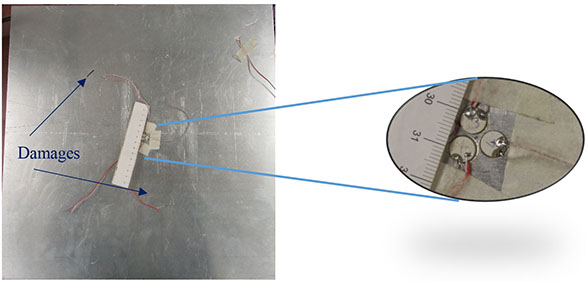
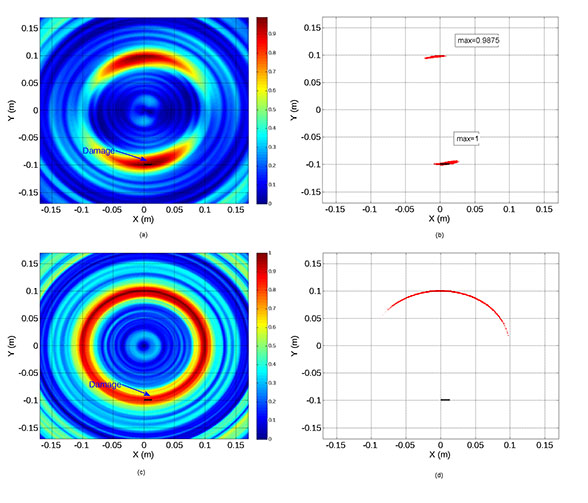
The proposed technique uses only three piezoelectric elements. Two of them works as exciters while the third one monitors the reflected surface waves. The data collection is completed with three tests in each a different piezoelectric element is used as sensor. At each test 60˚degrees in the front and 60˚degrees at the back are scanned. The received information is processed by using the modified total focusing method (TFM) and interface information for identification of the exact location of the cracks.
From the results obtained by the authors, it was observed that their proposal is viable for locating both single and multiple defects in structural components with high accuracy and precision.
Compact phased array approach is far much better than other methods due to their simplified nature. Proposed approach only requires three piezoelectric elements working together hence eliminate the need for several devices such as multiplexers and pulses as compared to its counterparts. Furthermore, it does not require high voltage supply for maintaining and running of its components because it creates beams in the selected directions only. It also requires short time for processing the collected data. The authors are optimistic that this approach can be implemented in the aerospace applications.
It is worth noticing that the research team just recently developed first structural health monitoring system which doesn’t use any sensors, computers or user interface to detect cracks and loose bolts. The Sensorless Structural Health monitoring (SSHM) systems excite the structure with such custom designed signals that a noise or verbal message will be created if there is a nonlinear damage such as crack or loose bolt. This innovative approach may be implemented to the commercial products below $10 cost and let the masses to use the SSHM in many daily products from washers to toys.







References
Senyurek, V., Baghalian, A., Tashakori, S., McDaniel, D., & Tansel, I. (2018). Localization of multiple defects using the compact phased array (CPA) method. Journal of Sound And Vibration, 413, 383-394.
Amin Baghalian, Shervin Tashakori, Volkan Y. Senyurek, Muhammet Unal and Ibrahim N. Tansel. Novel Approaches for Loose Bolt Detection With and Without Sensors Using Heterodyning Effect. IWSHM 2017.
Sensorless Talkative Structural Health Monitoring, (watch movie)
Go To Journal of Sound And Vibration