Advances in Engineering Advances in Engineering features breaking research judged by Advances in Engineering advisory team to be of key importance in the Engineering field. Papers are selected from over 10,000 published each week from most peer reviewed journals.

Significance Statement
Solid Oxide Fuel Cell (SOFC) finds its application in power generation operating at high temperature (over 1000k). The high operating temperature of SOFC has to be lowered since it deteriorates performance and causes adverse effects such as structural failure due to thermal stress. An attempt to reduce the temperature can lead to a reduction in power output and efficiency. Lowering the operating temperature without compromising its high efficiency and lower emission is highly important. Hence Dr. Lin Liu and his student Taufiq Abdullah from the University of Kansas studied electrochemical behavior in anode-supported SOFC’s.
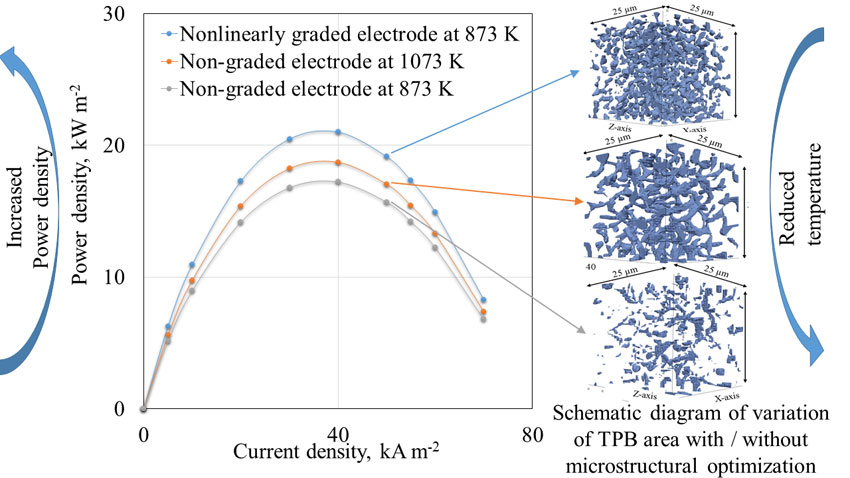
To determine the electrochemical behavior of Solid Oxide Fuel Cell one of its microstructural feature, Triple Phase Boundary (TPB) is considered. TPB area in the electrodes is the area among three phases such as the ion conducting, electron conducting and gas conducting phases which is in direct relation to the output power. In order to maximize the output power, this TPB area within the electrode has to be optimized. Correlating the electrochemical performance with TPB requires structural characterization of TPB. Hence various techniques such as Focus Ion Beam and Atomic Force Microscopy have been employed in exploring microstructure of TPB. By adopting Focus Ion Beam technique, the three-dimensional reconstruction of TPB and other parameters like phase volume fractions, tortuosity can be determined. The electrochemical functionality of TPB can be obtained using Atomic Force Microscopy. Comparing to experimental studies, the authors have carried out meso-scale phase-field modeling of SOFC microstructure as well as TPB evolution during long-term operation (over 1000 operation hours).
In this study, a cell level model was developed considering both micro-scale and macro-scale characteristics of SOFC electrode. Features such as particle size, coordination number, TPB area and pore diameter constitute micro-scale characteristics to find effective resistivity and conductivity of SOFC electrode. The macro-scale modeling constitutes three types of voltage losses namely Activation loss, Ohmic loss and Concentration loss. The effects of porosity change and tortuosity ratios are investigated in macro-scale modeling to optimize TPB area. The effective diffusion and effective conductivity obtained via micro modeling is then used by the authors in macro-model approach to calculate losses. Finally, they obtained a cell level model of SOFC by integrating micro and macro models.
The cell model was adopted using two electrodes namely Nickel/Yttria-Stabilized Zirconia and Lanthanum Strontium Manganite/Yttria-Stabilized Zirconia as anode and cathode respectively, and Yttria-Stabilized Zirconia is used as electrolyte. Based on certain conditions, this model was validated for both graded and non-graded SOFCs. Then they were compared in terms of different particle size and porosity grading profile for both anode and cathode. In addition to that, the voltage loss in both anode and cathode were also compared at different current densities. The voltage loss can be decreased by reducing the thickness of Anode. Different grading applied to both electrodes increases power density of SOFC. It is inferred that the Effective increase in power density of SOFC can be achieved by grading electrodes with reduced voltage loss.
This study showed that cell level-model increases output power by simultaneously applying particle-size and porosity-grading of both electrodes with reduced operating temperature. Thus optimizing nonlinearly graded SOFC electrodes increases power output and reduces voltage loss ensuring low operating temperature and good performance at high temperature.

Journal Reference
Taufiq Abdullah, Lin Liu. Simulation-based microstructural optimization of Solid Oxide Fuel Cell (SOFC) for low temperature operation, International Journal of Hydrogen Energy, Volume 41, 2016, Pages 13632-13643.
Department of Mechanical Engineering, The University of Kansas, Lawrence, KS 66045, United States
Go To International Journal of Hydrogen Energy