 Advances in Engineering Advances in Engineering features breaking research judged by Advances in Engineering advisory team to be of key importance in the Engineering field. Papers are selected from over 10,000 published each week from most peer reviewed journals.

Significance Statement
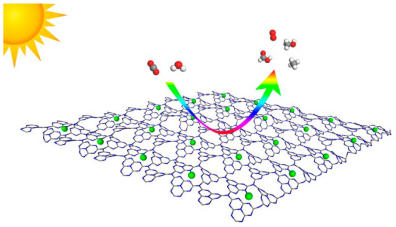
Reducing carbon dioxide (CO2) to hydrocarbon fuel with solar energy is significant for high-density solar energy storage and carbon balance. As CO2 is an extremely stable and unreactive molecule, the conversion of CO2 to fuels is a scientifically challenging problem that requires appropriate catalysts and high energy input. Using density functional theory calculations, the work [published in J. Amer. Chem. Soc. 138 (2016) 6292] by Aijun Du from Queensland University of Technology in Australia for the first time reported that single atoms of palladium and platinum supported on g-C3N4, i.e. Pd/g-C3N4 and Pt/g-C3N4, respectively, can act as efficient photocatalysts for CO2 reduction.
The supported individual metal atoms function as the active sites, while g-C3N4 provides the source of hydrogen (H*) from the hydrogen evolution reaction. The complete, as-designed photocatalysts exhibit excellent activity in CO2 reduction. HCOOH is the preferred product of CO2 reduction on the Pd/g-C3N4 catalyst with a rate-determining barrier of 0.66 eV, while the Pt/g-C3N4 catalyst prefers to reduce CO2 to CH4 with a rate-determining barrier of 1.16 eV. In addition, deposition of atom catalysts on g-C3N4 also significantly enhances the visible-light absorption, rendering them ideal for visible-light reduction of CO2.
The use of single atom supported on a stable substrate not only minimizes materials usage but also demonstrate fascinating catalytic activity due to their high ratio of low-coordinated metal atoms. This finding opens a new avenue of CO2 reduction for renewable energy supply.


Journal Reference
Am. Chem. Soc.,2016,138 (19), pp 6292–6297.
Guoping Gao1, Yan Jiao2, Eric R. Waclawik1, Aijun Du1
[expand title=”Show Affiliations”]- School of Chemistry, Physics and Mechanical Engineering,Queensland University of Technology, Garden Point Campus, Brisbane, QLD 4001, Australia
- School of Chemical Engineering,University of Adelaide, Adelaide, SA 5005, Australia
Abstract
Reducing carbon dioxide to hydrocarbon fuel with solar energy is significant for high-density solar energy storage and carbon balance. In this work, single atoms of palladium and platinum supported on graphitic carbon nitride (g-C3N4), i.e., Pd/g-C3N4 and Pt/g-C3N4, respectively, acting as photocatalysts for CO2 reduction were investigated by density functional theory calculations for the first time. During CO2 reduction, the individual metal atoms function as the active sites, while g-C3N4 provides the source of hydrogen (H*) from the hydrogen evolution reaction. The complete, as-designed photocatalysts exhibit excellent activity in CO2 reduction. HCOOH is the preferred product of CO2 reduction on the Pd/g-C3N4 catalyst with a rate-determining barrier of 0.66 eV, while the Pt/g-C3N4 catalyst prefers to reduce CO2 to CH4 with a rate-determining barrier of 1.16 eV. In addition, deposition of atom catalysts on g-C3N4 significantly enhances the visible-light absorption, rendering them ideal for visible-light reduction of CO2. Our findings open a new avenue of CO2 reduction for renewable energy supply.
Copyright © 2016 American Chemical Society
Go To J. Am. Chem. Soc.