Advances in Engineering Advances in Engineering features breaking research judged by Advances in Engineering advisory team to be of key importance in the Engineering field. Papers are selected from over 10,000 published each week from most peer reviewed journals.

Significance Statement
Thermoresponsive soft-matter nanovavles locally self-assembled in tiny nanofluidic channels make it possible to actively regulate fluids to a scale as small as femtoliters (a thousand billionth of a liter).
The assembly of functional soft matter in small, microfabricated solid-state nanospaces could be a new arena to exploit possibilities of advanced materials unachievable in the bulk and micrometer scales, because these nanospaces display unusual properties due to their large surface-area-to-volume ratio and short diffusion length and heat transfer distance. Meanwhile, the soft matter assembled in nanospaces provides well-controlled additional functions and promise to greatly improve the capabilities of the nanospaces for the creation of versatile new systems and applications. However, due to their small size, they are difficult to work with. For example, attempts to assemble soft materials in nanofluidic channels, which are typical microfabricated solid-state nanospaces for confining and handling small amounts of fluid, often fail because the channels get clogged by large macromolecules.
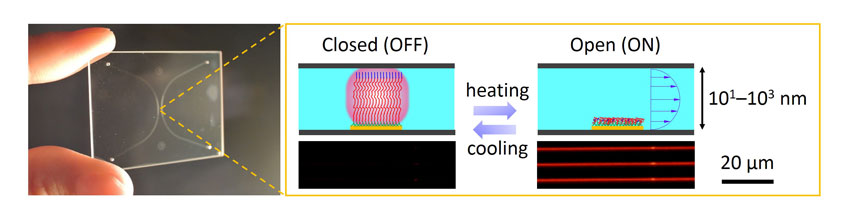
Recently a collaborative team led by Prof. Yan Xu and Prof. Atsushi Harada at Osaka Prefecture University has made a breakthrough in assembling functional soft materials in tiny nanofluidic channels. In combination with nanofluidics, they used a nano-in-nano integration technique they developed to assemble nanobrushes of a well-tailored short-chain thermoresponsive polymer in nanofluidic channels. The assembled polymer nanobrushes enable the active regulation of femtoliter-scale fluids inside nanofluidic channels in response to an external temperature change, without clogging.
Such soft matter-regulated active nanovalves within nanofluidic channels could be extended to build well-controlled functional nanofluidic systems, allowing complex fluidic processes to be performed at nanometer scales. In addition, because control of fluids is involved in fields as diverse as chemistry, mechanics, physics, materials science, energy, biology, drug discovery and clinical medicine, this improvement in the ability to actively regulate femtoliter-scale fluids could have a big impact on these fields.

Journal Reference
[expand title=”Show Affiliations”]
- Nanoscience and Nanotechnology Research Center, Research Organization for the 21st Century, Osaka Prefecture University, 1-2, Gakuen-cho, Naka-ku, Sakai, Osaka, 599-8570, Japan.
- Department of Applied Chemistry, Graduate School of Engineering, Osaka Prefecture University, 1-1, Gakuen-cho, Naka-ku, Sakai, Osaka, 599-8531, Japan.
Abstract
Well-tailored thermoresponsive polymer brushes locally self-assembled in tiny nanofluidic channels enable the active regulation of femtoliter-scale fluids. Such soft-matter-regulated active nanovalves within nanofluidic channels can be extended to build well-controlled functional nanofluidic systems, allowing complex fluidic processes to be performed at the nanometer scales.
© 2016 WILEY-VCH Verlag GmbH & Co. KGaA, Weinheim.
Go To Adv Mater.