 Advances in Engineering Advances in Engineering features breaking research judged by Advances in Engineering advisory team to be of key importance in the Engineering field. Papers are selected from over 10,000 published each week from most peer reviewed journals.

Significance Statement
Natural gas is used in applications like manufacturing of plastics and chemicals, generation of electricity, cooking, etc. Similarly, other gases such as oxygen, hydrogen and nitrogen find wide applications in residential, industrial and service sectors. Underground Pipelines are used to transport the natural gases and other fuels from the processing facilities to demand centers. Pipelines are considered to be the safest and the most reliable mode of transportation of gases and fuels. The buried steel structures are affected by factors such as moisture, microbiological activity and pH. When the steel is unprotected, corrosion rate may be very high, thereby leading to catastrophic effects.
It is important to monitor the underground steel pipelines as the metal when in contact with the soil can suffer severe corrosion processes. Hence an organic coating is usually applied to the metal to protect it from degradation. In order to study the behavior of the buried steel pipes, a group of researchers led by Professor Philippe Refait from Université de La Rochelle in France tested carbon steel coupons buried in an artificial silt loam soil which they are kept buried for several months and the corrosion process was monitored.
In the proposed study, the authors performed experiments in an artificial soil made of small particles. Here the oxygen transport is controlled by the moisture content in the soil. The active area of the steel buried in the soil is proportional to the soil moisture. Electrochemical impedance spectroscopy is used to determine the active area of the steel with respect to the resistivity of the soil. An increase in the soil resistivity decreases the active area. The buried steel is subjected to wet and dry conditions and the results were noted.
The authors looked at the surface of the steel coupons using an optical microscopy and the magnitude of the corrosion process was estimated by measuring the residual thickness on various zones of the steel surface. A specifically designed electrochemical cell is used in this study to determine the concentration of oxygen and moisture content. A titanium grid is taken as a counter electrode and for the reference electrode a copper-copper sulfate electrode is used. To achieve constant moisture, the cell is completely sealed. The soil is allowed to dry by exposing it to laboratory atmosphere. By adding de-ionized water, the soil is again in its wet condition.
The instantaneous corrosion rate of the buried carbon steel was obtained from Voltammetry around open circuit potential. This non-destructive technique, when coupled with electrochemical impedance spectroscopy, provided new information about the behavior of the carbon steel.
In the vicinity of coupons, the authors recorded the evolution of soil moisture and the concentration of oxygen. They found that maximum corrosion rate was at 60-70% saturation levels. This was because the oxygen was transported rapidly in the soil pores while it is controlled by diffusion in the liquid phase closer to the saturation level. When the steel was exposed to drier conditions, the corrosion rate apparently decreased. Actually, the decrease of the corrosion rate is only apparent because it is only related to the decrease of the active area of the metal. The corrosion remains active at approximately the same rate but is restricted to the zones of the metal surface still in contact with the electrolyte. Because of differential aeration cells it is suspected that the “true” corrosion rate (i.e. the corrosion rate expressed with respect to the active area) may increase with further drying under 60-70% saturation levels.
The corrosion process of the buried carbon steel is thus successfully studied by determining simultaneously the soil moisture, the oxygen concentration, the corrosion rate and the active area.
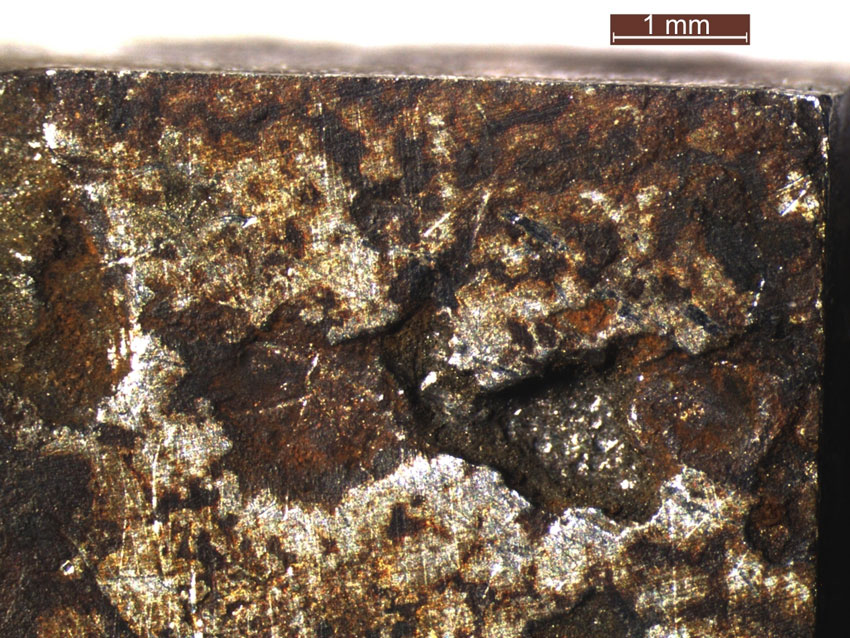
Figure Legend: photograph of a carbon steel surface after 3 months in silt-loam soil showing the localized morphology of the corrosion process.

Journal Reference
Akkouche R.1,2, Rémazeilles C.1, Jeannin M1, Barbalat M2, Sabot R1, Refait Ph.1 . Influence of soil moisture on the corrosion processes of carbon steel in artificial soil: Active area and differential aeration cells, Electrochimica Acta, Volume 213, 2016, Pages 698-708.
[expand title=”Show Affiliations”]- Laboratoire des Sciences de l’Ingénieur pour l’Environnement (LaSIE), UMR 7356 CNRS-Univ. La Rochelle, Bât. Marie Curie, Av. Michel Crépeau, F-17042 La Rochelle cedex 01, France.
- AIR LIQUIDE Research & Development, 1 Chemin de la Porte des Loges, F-78350 Les Loges en Josas, France.
Go To Electrochimica Acta
