 Advances in Engineering Advances in Engineering features breaking research judged by Advances in Engineering advisory team to be of key importance in the Engineering field. Papers are selected from over 10,000 published each week from most peer reviewed journals.

Significance
Recently published studies have revealed that organometal halide perovskites have great potential for photovoltaics applications; mainly due to their high absorption coefficient, robust fabrication process and balanced charge diffusion length – among other excellent attributes. Pleasingly, efficiencies as high as 23.7% for perovskite solar cell have been reported. Unfortunately, the instability of perovskite materials and corresponding devices offers great hinderance when it comes to their practical applications. To this resolve, perovskite solar cell (PSC) employing titanium (II) oxide (TiO2) as the electron transport layer have achieved commendable efficacy levels.
However, the Titania (TiO2) used has been demonstrated to decay in the power conversion efficiency when exposed to UV light illuminations. To counteract such decay, numerous methods have been proposed. To this end, exploring a new type of electron transport layer to replace TiO2 for fabricating stable perovskite solar cell without damaging their performance remains the most suitable approach. Such a realization has motivated much research on various organic semiconductors and metal thin film oxides. Considerable focus has been directed to Nb2O5, particularly due to its high optical transparency. In this context, development of a novel type of Nb2O5 electron transport layer with much better anti-UV ability and higher power conversion efficiency of perovskite solar cells would be critically important and highly valuable.
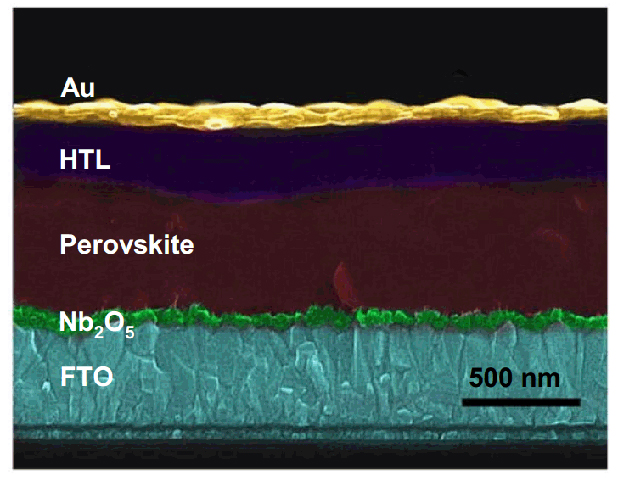
To this effect, Lanzhou University scientists: Dr. Zenghua Wang, Dr. Junjie Lou, Professor Xiaojia Zheng Professor Wen-Hua Zhang and Professor Yong Qin demonstrated a novel type of Nb2O5 nanoparticles electron transport layer for fabricating efficient planar perovskite solar cells with excellent UV stability. They developed a low-temperature solution route to prepare Nb2O5 nanoparticles, and further utilized them as electron transport layer to fabricate perovskite solar cell. Their work is currently published in the research journal, ACS Sustainable Chemistry & Engineering.
The research team used for their study Lead iodide, cesium iodide, 4-tert-butylpyridine, Li-TFSI, N,Ndimethylformamide (DMF) and dimethyl sulfoxide – among others. The approach started by synthesizing Nb2O5 Nanoparticles. Next, perovskite solar cells were fabricated as per the outlined procedure. Finally, the obtained samples were characterized using X-ray diffraction, Scanning electron microscopy, X-ray photoelectron spectroscopy, Transmission electron microscopy and Atomic force microscopy.
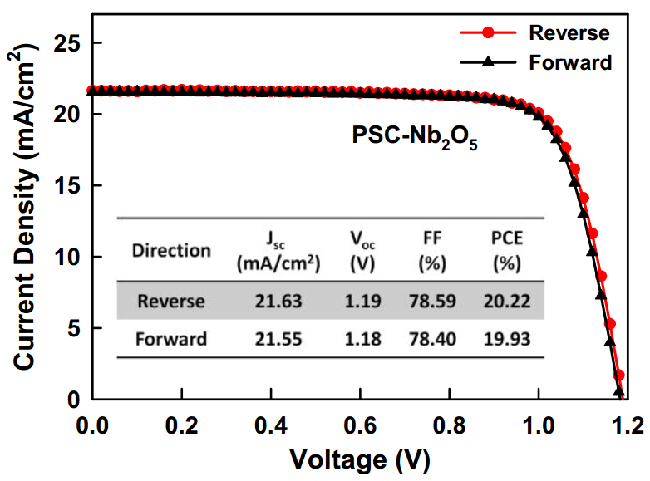
It was reported that the matched band alignment between perovskites and Nb2O5, promoted electron injection at the electron transport layer/perovskite interface and decreased the energy barrier for electron injection. Additionally, decreased energy loss during electron transfer from perovskite to Nb2O5 and lower recombination rates in the devices were also seen to contribute to the improved open-circuit voltage of perovskite solar cells on Nb2O5 compared to devices on TiO2.
In summary, the Lanzhou University researchers reported for the first time a low-temperature solution-processed Nb2O5 nanoparticle-formed film as electron transport layer to fabricate perovskite solar cells, yielding the highest power conversion efficiency of a very high open-circuit voltage. Remarkably, the devise exhibited improved UV stability. In fact, it retained 93% of the initial short-circuit current density under 365nm UV light exposure for 10 hours, whereas the device based on TiO2 retained only 40% of its initial short-circuit current density. Overall, perovskite solar cells with improved UV stability were reported.





Reference
Zenghua Wang, Junjie Lou, Xiaojia Zheng, Wen-Hua Zhang, Yong Qin. Solution Processed Nb2O5 Electrodes for High Efficient Ultraviolet Light Stable Planar Perovskite Solar Cells. ACS Sustainable Chemistry & Engineering 2019, volume 7, page 7421−7429.
Go To ACS Sustainable Chemistry & Engineering 2019