 Advances in Engineering Advances in Engineering features breaking research judged by Advances in Engineering advisory team to be of key importance in the Engineering field. Papers are selected from over 10,000 published each week from most peer reviewed journals.

Significance
Silicone-based coatings are used to reduce friction, prevent unwanted adhesion, and control how liquids interact with solid surfaces. One of the most familiar silicone materials is polydimethylsiloxane (PDMS), which combines low surface energy with flexibility and chemical stability. These properties make silicone coatings useful in lubrication, microfluidic devices, and surfaces designed to repel liquids.
A way to control these properties is to attach polymer chains to a solid surface, forming a structure known as a polymer brush. Each chain is anchored at one end, while the remaining portion can move and interact with the surrounding liquid. The behavior of these brushes depends on factors such as chain length, packing density, and the chemical composition of the polymer. When exposed to different solvents, the chains may expand or collapse, changing how the surface responds to contact and movement.
Preparing silicone polymer brushes with precisely controlled structures remains challenging. A common method, known as grafting-to, involves attaching preformed polymer chains to a surface. However, neighboring chains can restrict access to available attachment sites, limiting the number of chains that can be attached and the resulting film thickness. Other methods grow silicone chains directly from the surface but often produce relatively thin coatings with limited control over their structure.
An alternative is to use silicone-containing methacrylate polymers, which combine flexible silicone side groups with a backbone that can be formed through controlled radical polymerization. This allows polymer chains to grow directly from a surface while offering greater control over the thickness and uniformity of the coating. An important question is whether these materials can retain the desirable surface properties of conventional silicones while allowing their adhesion and friction to be adjusted through changes in the surrounding solvent.
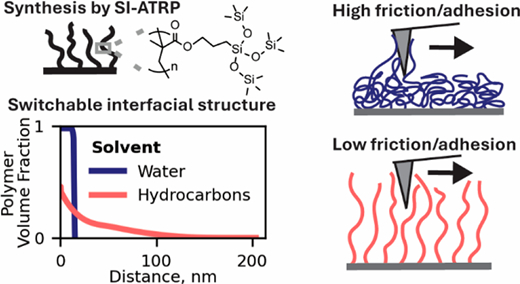
In a recent research paper published in Chemistry of Materials, PhD candidate Zachary Di Pietro, Geran Dunlop, Stuart Prescott, Andrew Nelson, Steven Armes, Professor Grant Webber, Professor Erica Wanless, and Dr. Edwin Johnson, from the University of Newcastle in Australia and collaborating institutions, investigated this possibility. developed ultrasmooth silicone methacrylate polymer brushes using surface-initiated atom transfer radical polymerization, with controllable dry thicknesses of up to approximately 75 nanometers. They demonstrated that changes in the surrounding solvent regulate the structure of these coatings and can reduce nanoscale friction by approximately fourfold while weakening adhesion, even when the polymer chains are only partially swollen.
The team prepared polymer brushes made from poly(3-[tris(trimethylsiloxy)silyl]propyl methacrylate), known as PSiMA. Using SI-ATRP, polymer chains were grown directly from chemically modified silicon surfaces. By adjusting the polymerization conditions and reaction time, they produced coatings with dry thicknesses ranging from approximately 5 to 75 nanometers.
The addition of a soluble initiator to the reaction mixture provided better control over polymer growth, producing highly uniform coatings with surface roughness of only about 0.35 nanometers. Without this initiator, the chains could grow longer and form thicker films, although thickness variations became more pronounced as polymerization continued. These observations established how the preparation conditions could be adjusted to balance coating thickness and uniformity.
The researchers also developed a low-volume reaction cell that allowed polymer brushes to grow on larger silicon substrates while reducing the amount of reaction solution by approximately 98%. This provided a practical way to prepare uniform coatings for detailed structural measurements.
To understand how the brushes respond to liquids, the team used spectroscopic ellipsometry and neutron reflectometry. Ellipsometry measured changes in coating thickness, while neutron reflectometry provided information about how polymer chains and solvent molecules were distributed within the layer.
The authors found the differences between solvents were pronounced. For example, in water, methanol, and ethanol, the PSiMA chains remained tightly packed, forming a compact layer with little solvent penetration. Isopropanol produced a partially collapsed structure, while chloroform and hydrocarbon solvents caused the chains to expand and form a more diffuse interface.
Toluene produced the greatest swelling, increasing the coating thickness to approximately 3.5 times its dry value. The researchers attributed this behavior to the ability of toluene to interact favorably with both the methacrylate backbone and the silicone-containing side chains. This differs from conventional PDMS brushes, which typically swell most strongly in n-hexane.
Neutron reflectometry confirmed that swelling involved more than a simple increase in film thickness. As solvent penetration increased, the polymer concentration became more gradually distributed away from the surface. Instead of forming a compact layer with a clearly defined boundary, the chains extended into the surrounding liquid.
The team then investigated how these structural changes affected surface interactions using atomic force microscopy (AFM). A microscopic probe was brought into contact with the brushes in water, isopropanol, n-hexane, and toluene to measure adhesion and friction under different solvent conditions.
In water, the collapsed polymer layer behaved as a relatively firm surface and showed strong adhesion to the probe. As the solvent environment became more favorable for the polymer, the probe encountered a softer, more extended layer. Adhesion was much weaker in the organic solvents, consistent with increased solvent interactions reducing direct contact between the probe and polymer chains.
Friction measurements showed an equally clear difference. The relative friction coefficient in water was approximately four times higher than in isopropanol, n-hexane, or toluene. The researchers associated the higher friction in water with stronger adhesion and energy dissipation as the probe moved through the densely packed polymer chains. In better solvents, interactions between the polymer and surrounding liquid reduced resistance to sliding.
One particularly interesting observation involved isopropanol. Although the brushes were only partially swollen in this solvent, their adhesion remained weak and their friction was comparable to that measured in the more strongly swollen states.
This indicated that the overall degree of swelling was not sufficient to explain the frictional behavior. The researchers proposed that flexible silicone side chains might rearrange near the outer surface, allowing solvent molecules to reduce direct contact with the probe even when much of the brush remained relatively compact.
They also considered how differences in the contact area between the probe and polymer layer could influence friction. In highly swollen brushes, a larger contact area may partly offset the weaker individual interactions, while the smaller contact area in isopropanol may compensate for somewhat stronger attractive forces. These explanations remain proposed interpretations of the observed behavior.
The new study by Newcastle University scientists establishes a useful relationship between the molecular structure of silicone-containing polymer brushes and their mechanical interactions with contacting surfaces. By controlling how the polymer chains interact with a surrounding solvent, it becomes possible to adjust adhesion and friction without changing the chemical composition of the coating.
The behavior in isopropanol is relevant to understanding polymer brush lubrication. A strongly swollen structure is not always necessary to achieve low friction. Local interactions near the outer surface, including the possible rearrangement of silicone side chains and changes in contact area, may be just as important as the average swelling of the polymer layer.
This distinction helps explain why coatings with different internal structures can display similar frictional behavior. It also shows the value of combining structural measurements with direct force measurements, since neither swelling nor friction data alone can fully describe the interaction between a polymer brush and a contacting surface.
From a materials design perspective, the controlled synthesis provides another advantage. The ability to adjust coating thickness while maintaining smooth surfaces makes PSiMA brushes a useful platform for studying how polymer architecture affects interfacial properties. It is also worthy to mention, the authors’ demonstrated solvent sensitivity may also be valuable for developing silicone-based coatings whose friction and adhesion change with their operating environment, particularly in hydrocarbon-rich liquids relevant to lubrication. The results establish this behavior at the nanoscale and provide a basis for designing coatings with more precisely controlled surface interactions.


Reference
Zachary Di Pietro, Geran S. Dunlop, Stuart W. Prescott, Andrew R. J. Nelson, Steven P. Armes, Grant B. Webber, Erica J. Wanless, Edwin C. Johnson; Silicone Methacrylate Brushes Prepared by Atom Transfer Radical Polymerization Exhibit Solvent-Regulated Adhesion and Friction. Chem. Mater. 2026; 38 (18): 9481–9492. https://doi.org/10.1021/acs.chemmater.6c01842