 Advances in Engineering Advances in Engineering features breaking research judged by Advances in Engineering advisory team to be of key importance in the Engineering field. Papers are selected from over 10,000 published each week from most peer reviewed journals.

Significance
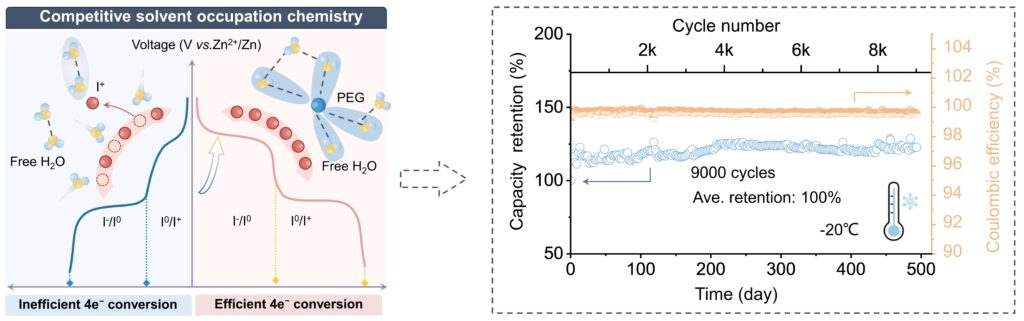
Aqueous zinc–iodine batteries can provide safer energy storage and at lower cost. These batteries use zinc as the negative electrode and iodine-based materials as the positive electrode, with a water-based electrolyte which allows ions to move between them. Iodine can undergo several electrochemical reactions, including a four-electron process that could nearly double the capacity of conventional two-electron iodine batteries. However, achieving higher capacity requires careful control of the reactions inside the battery. During charging and discharging, iodine changes between different chemical forms, including iodide (I–), elemental iodine (I0), and positively charged iodine (I+). The positively charged form is difficult to maintain because it reacts readily with water. Iodine can also form compounds called polyiodides, which dissolve in the electrolyte and move between the electrodes and can lead to the loss of active material and unwanted chemical reactions which reduce the amount of energy the battery can store and its ability to maintain performance over time.
Low temperatures are another challenge for these batteries and when the electrolyte cools, hydrogen bonding between water molecules reduce fluidity and slow the movement of ions which lower the efficiency of the electrochemical reactions and increases resistance inside the battery. If we add more salt, it can help lower the freezing point, but high salt concentrations can also make ion transport more difficult. Therefore, an effective electrolyte must maintain good ion movement at low temperatures and provide a stable chemical environment for iodine reactions. In a recent research paper published in Energy & Environmental Science, Dr. Wenyu Xu, Dr. Zelin Chang, Dr. Hongwei Wang, Dr. Binfen Wang, Dr. Hongbo Ding, and Professor Xinliang Li from Zhengzhou University, working together with Professor Jijian Xu from City University of Hong Kong, developed a new strategy to control the chemical environment inside aqueous zinc–iodine batteries by changing how solvent molecules interact with water and dissolved ions which enables more complete and reversible iodine conversion, even at freezing temperatures.
The researchers started their experiments by studying how the cathode material behaved in different electrolytes. They used tin tetraiodide (SnI4, which contains 81.1% iodine by mass. The strong bonds between tin and iodine help keep the material stable. They conducted thermal tests and showed that SnI4 was more stable than elemental iodine, and further measurements demonstrated that adding polyethylene glycol (PEG) reduced the formation of soluble iodine compounds that can cause problems during battery operation.
Molecular calculations and electrochemical tests revealed how PEG interacts with the cathode material. Its oxygen groups interact strongly with water and change how water molecules are arranged. The calculations also showed that PEG binds more strongly to SnI₄ than water does, making the cathode less likely to break down through reactions with water. The amount of PEG in the electrolyte also affected battery performance. Adding more PEG improved cathode stability and iodine conversion. However, higher concentrations made the electrolyte thicker and slowed ion movement. The researchers selected an optimized composition, called CN7, that balanced these effects.
The team used Raman spectroscopy to investigate how PEG changed the electrolyte. They found that the proportion of strongly hydrogen-bonded water decreased from 50% in the original electrolyte to just 3% in CN7. Molecular simulations also showed that PEG replaced much of the water surrounding zinc ions and that the bonds between PEG and water were stronger than those between water molecules. The microscopic and structural studies showed that the modified electrolyte promoted more even and compact zinc deposition during charging. In separate tests, zinc electrodes using the optimized electrolyte operated for more than 2,200 hours. They noticed the battery also achieved a high level of iodine conversion, reaching 97.2% of its theoretical four-electron capacity and both stages of the iodine reaction contributed substantially to the battery’s capacity, including the higher-voltage stage that is usually more difficult to maintain in aqueous batteries.
The authors studied the chemical changes during charging and discharging to better understand the iodine conversion process. Spectroscopic measurements confirmed reversible changes between the different iodine oxidation states and the analysis also indicated that chloride ions stabilized high-valent iodine, allowing the battery to maintain its higher-voltage reaction. The researchers also found that iodinated coordination complexes ICl2– were distributed more evenly throughout the cathode. As a result, electrochemical reactions could take place deeper inside the electrode instead of being limited to its surface. That improved reaction conditions also supported faster charge transfer and stable performance during repeated charging and discharging. After 4,000 cycles at room temperature, the battery continued to maintain both stages of the iodine reaction with very little capacity loss (0.0031% per cycle). The researchers then studied the battery under freezing conditions. The modified electrolyte remained fluid at −20 °C, allowing ions to continue moving between the electrodes. Although cooling increased internal resistance and reduced the available capacity, both iodine conversion stages remained active, with the higher-voltage reaction continuing to contribute substantially to energy storage.
The battery also performed well during long-term testing at low temperatures. At −20 °C, it completed 9,000 charging and discharging cycles over 495 days without any detectable loss of capacity. The higher-voltage iodine reaction remained active throughout this period. The Zhengzhou University scientists also examined how the battery continued to work in the cold. Although low temperatures slow the movement of ions through the electrolyte, chemical interactions near the electrode can still support the higher-voltage iodine reaction and explains why the reaction remained active even after prolonged operation at −20 °C.



Reference
Xu, Wenyu & Chang, Zelin & Wang, Hongwei & Wang, Binfen & Ding, Hongbo & Xu, Jijian & Li, Xinliang. (2026). Competitive solvent occupation chemistry enabling robust four-electron conversion for anti-freezing aqueous zinc-iodine batteries. Energy & Environmental Science. 19. 10.1039/D6EE00755D.