 Advances in Engineering Advances in Engineering features breaking research judged by Advances in Engineering advisory team to be of key importance in the Engineering field. Papers are selected from over 10,000 published each week from most peer reviewed journals.

Significance statement
Removal of trace heavy metal from water has received extensive attention due to its signicance in the protection of human health and maintenance of biological environments. Utilization of nanosized functional materials will be a substantial route to achieve toxic metal purification. Recently, a new work publshed in Environmental Science & Technology by Qingrui Zhang and his co-workers from Yanshan Univeristy and Nanjing University, described the development of the charged-polystynere supported zirconium oxide composites for trace lead sequstration. the obtained nanocomposite exhibits excellent sorption selectivity, fast kinetics and recycled properties. More attactively, the effluents by charged-composite treatment can approach to near 1 ug/L, Which is far below the WHO recommended drinking water standards.
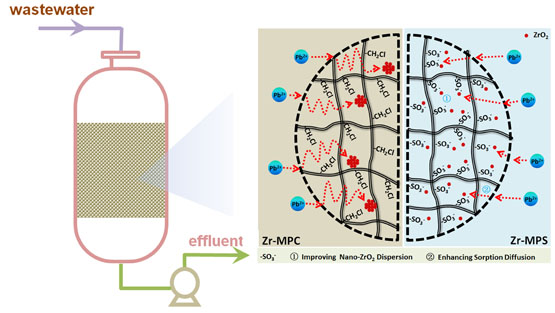
Nowadays, more attentions of advanced functional materials were paid to the well-defied morphology and superior capacities. Unfortunately, large capacities don’t always suggest efficient applied performance for environmrntal remediation. Herein, Zhang et al. offers a new criterion and idea to guide nanocomposite fabrication and application. i.e. surface modification of host materials by charged groups is an important choice for fabrication of efficient nanocomposite adsorbents, because the charged groups could enhance the dispersion of the encapsulated nanoparticles. In addition, selection of suitable surface groups is also a key factor related to the sorption kinetic enhancement and sorption performance for application. such guideline gains a new insight into the novel nanomaterials fabrication and industrial applicability.
Environ. Sci. Technol., 2013, 47 (12), pp 6536–6544.
Qingrui Zhang †‡, Qing Du †, Ming Hua ‡, Tifeng Jiao †, Faming Gao †, and Bingcai Pan *‡
† Hebei Key Laboratory of Applied Chemistry, School of Environmental and Chemical Engineering, Yanshan University, Qinhuangdao 066004, PR China and
‡ State Key Laboratory of Pollution Control and Resources Reuse, School of the Environment, Nanjing University, Nanjing 210023, PR China.
Abstract
A novel hybrid nanomaterial was fabricated by encapsulating ZrO2 nanoparticles into spherical polystyrene beads (MPS) covalently bound with charged sulfonate groups (−SO3–). The resultant adsorbent, Zr–MPS, exhibited more preferential sorption toward Pb(II) than the simple equivalent mixture of MPS and ZrO2. Such observation might be ascribed to the presence of sulfonate groups of the polymeric host, which could enhance nano-ZrO2dispersion and Pb(II) diffusion kinetics. To further elucidate the role of surface functional groups, we encapsulated nano-ZrO2 onto another two macroporous polystyrene with different surface groups (i.e., −N(CH3)3+/–CH2Cl, respectively) and a conventional activated carbon. The three obtained nanocomposites were denoted as Zr–MPN, Zr–MPC, and Zr–GAC. The presence of −SO3– and −N(CH3)3+ was more favorable for nano-ZrO2 dispersion than the neutral −CH2Cl, resulting in the sequence of sorption capacities as Zr–MPS > Zr–MPN > Zr–GAC > Zr–MPC. Column Pb(II) sorption by the four nanocomposites further demonstrated the excellent Pb(II) retention by Zr–MPS. Comparatively, Zr–MPN of well-dispersed nano-ZrO2and high sorption capacities showed much faster breakthrough for Pb(II) sequestration than Zr–MPS, because the electrostatic repulsion of surface quaternary ammonium group of MPN and Pb(II) ion would result in a poor sorption kinetics. This study suggests that charged groups in the host resins improve the dispersion of embedded nanoparticles and enhance the reactivity and capacity for sorption of metal ions. Suitably charged functional groups in the hosts are crucial in the fabrication of efficient nanocomposites for the decontamination of water from toxic metals and other charged pollutants.
Copyright © 2013 American Chemical Society
