Advances in Engineering Advances in Engineering features breaking research judged by Advances in Engineering advisory team to be of key importance in the Engineering field. Papers are selected from over 10,000 published each week from most peer reviewed journals.

Significance
Coulomb interactions are independent of the electrons’ magnetic moment. However, the imposition of antisymmetric wave functions is responsible for electrostatic potential acting like spin-dependent. It is thought that the magnetic features of compounds are hinged on the exchange energy considering that it has the same order of magnitude as the electronic repulsions. The energy difference between the triplet oxygen molecules and the next singlet excited state is about 1eV. Exchange interactions make the triplet oxygen molecule configuration stable, and dioxygen is a strong oxidizing agent but relatively unreactive.
Transition metals with a perovskite structure are unique oxygen electro-catalysis when associated with background ferromagnetic charge delocalization. Counting on the interplay between the degrees of freedom in a crystal, it is possible to describe magnetic and electronic structures of perovskite oxides considering their spin-orbital physics.
In fact magnetism can be viewed as a cooperative phenomenon that is influenced by inter-atomic exchange interactions. The interactions are decisive for electro-catalysis considering that they set the collective e-spin transport. Sufficient empty d orbitals at the Femi Level settle that the exchange of electrons will be ferromagnetic, therefore favoring fast and coherent e-spin transport with a reduced band gap for a majority of spin. In case the orbitals are magnetically filled, the inter-atomic interactions will be anti-ferromagnetic and will generate a band gap.
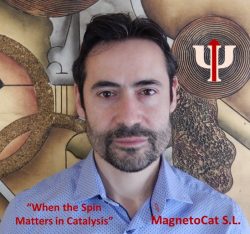
The growing interest in oxygen evolution and reduction reactions for clean use and storage of energy has led to the development of a number of catalysts. However, the catalytic and physical features of a majority of active compositions can only be understood in view of magnetic interactions. Dr. Jose Gracia from Magnetocat in Spain quantified charge transfer rates reference to spin dependent interactions in optimum oxygen evolution and oxygen reduction reactions catalysts with a perovskite structure. This was in light of the fact that ferromagnetic fingertips drive to an extra delocalized character of the electronic states. In order to evaluate the reaction kinetics, the author focused on the electronic configuration of the transition state in the course of the electron transport. His research work is published in journal, Physical Chemistry Chemical Physics.
Oxygen electro-catalysts initiate at the transition state, an exchange coupled mixed-valence e-spin acceptor (oxygen evolution reaction) or donor (oxygen reduction reaction). The principle role of magnetic interactions in optimum catalysts is to help in the e-spin delocalization. For the reaction to have occurred, it was necessary that the electrons travelled through the conduction band of the catalyst, and spin dependent potential decreased the activation energy.
In his study, Dr. Jose Gracia observed that the overlapping of semi-occupied antibonding d-shells with the oxygen orbitals formed the conducting channels. The reduced value of the Coulomb integrals by ferromagnetic spin-potential indicated a facile e-spin transport.
The magnetic features of the molecules as well as materials were individually well-defined, but the function of the spin-dependent potentials in the catalysts at the interface between a molecule with unpaired electrons and a magnetic material was not. Therefore, these interactions will be of importance to several aspects of oxygen technology.

Reference
J. Gracia. Spin dependent interactions catalyze the oxygen electrochemistry. Physical Chemistry Chemical Physics, volume 19 (2017), pages 20451-20456.
Go To Physical Chemistry Chemical Physics