 Advances in Engineering Advances in Engineering features breaking research judged by Advances in Engineering advisory team to be of key importance in the Engineering field. Papers are selected from over 10,000 published each week from most peer reviewed journals.

Significance Statement
Presently, studies are being undertaken to explore renewable, economical and promising ways to match up to the cooling and thermal management requirements during heat transfer processes. Commercial heat transfer fluids are deficient when it comes to the proper dissipation of heat from systems. As a resolve, thermal oils are the most popular cooling media adopted for works such as in nuclear cooling, distributor transformers, solar collectors among other high heat flux cooling appliances. Nevertheless, conventional thermal oils have various setbacks such as weak thermal properties. In so being, the introduction of nanoparticles in heat transfer oils so as to improve their thermal properties has been brought forward. So far, remarkable outcomes have been achieved from the application of nanofluids in pharmaceuticals, refrigeration, fuel cells and hybrid power engines among others. For that reason, empirical investigations on oil-based nanofluids are getting considerable attention and the application of nanoparticles in oil is becoming even more promising. Nonetheless, little has been done on the stability and rheological behavior of nanofluids despite the immense literature already published on the numerical and empirical investigations on the improved heat transfer behavior in nanofluids.
Rajashekhar Pendyala, Marneni Narahari and Suhaib Umer Ilyas at Universiti Teknologi PETRONAS in collaboration with Lim Susin at Vantage Oilfield Solutions in Malaysia, investigated the dispersion behavior and thermal analysis of functionalized alumina nanoparticles in thermal oil. The team aimed at preparing oil-based nanofluids and utilize alumina nanoparticles to investigate its properties. They also hoped to unearth extensive applications of thermal oils by eliminating their inhibitive low thermal properties. Their research work is currently published in the journal, Energy Conversion and Management.
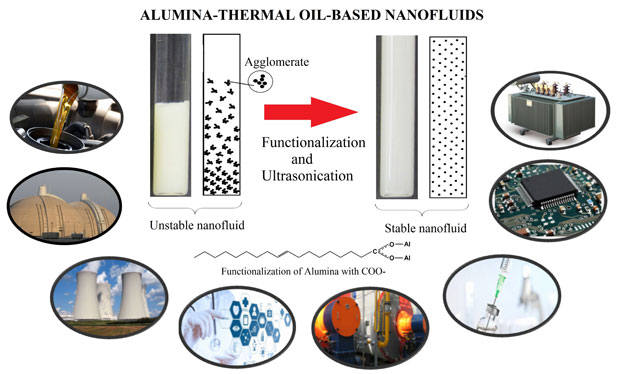
The researchers commenced their empirical procedure by functionalizing alumina using oleic acid. They then undertook complete nanoparticle characterizations of the same. The team then performed rheology and thermal analysis procedures so as to fully understand the potential capabilities of the functionalized alumina/oil-based nanofluids. From this, correlations of thermal physical properties as a function of temperature and nanoparticle concentration were developed. Eventually, thermogravimetric analysis was done so as to investigate the effects of nanoparticles on the degradation and life-cycle of oil.
The authors of this paper observed that surface modification does not disturb the crystallinity of nanoparticles. Also, the stability of the nanofluids was observed to increase from a few hours to at least one month when the functionalization process was used. The particles size distribution curves developed was noted to illustrate that the surface modification leads to breaking of the agglomerates into the primary size of the nanoparticles. From the rheological properties investigated, it was found that viscosity increased with the increase in particle concentrations.
Herein, thermal oil-based nanofluids have been prepared using functionalized alumina nanoparticles for advanced cooling applications. Different characterizations and analysis have been performed. The effective thermal conductivity of nanofluids has been seen to improve as compared to pure oil. A slight increase in effective density of nanofluids has also been observed. Correlations have been developed for thermophysical properties. Thermogravimetric analysis has proved the possibility of improved life and degradation temperature of the nanofluids. In totality, the preparation of the novel nanofluids with high stability is therefore expected to gain great attraction for advanced industrial cooling applications.




Reference
Suhaib Umer Ilyas, Rajashekhar Pendyala, Marneni Narahari, Lim Susin. Stability, rheology and thermal analysis of functionalized alumina- thermal oil-based nanofluids for advanced cooling systems. Energy Conversion and Management volume 142 (2017) pages 215–229
Go To Energy Conversion and Management
