Advances in Engineering Advances in Engineering features breaking research judged by Advances in Engineering advisory team to be of key importance in the Engineering field. Papers are selected from over 10,000 published each week from most peer reviewed journals.

Significance
The design of smart materials demands a complete command of the fundamentals of molecular interactions at the nanoscale level. Over the years, scientists observed that stimuli-responsive materials possess macroscopic attributes that can be tuned over a large range on demand basis in a controlled manner. The application of these knowledge on foams in quest to control their stability has attracted much interest in the scientific world of late. Foam has various applications that include: fire-fighting, food, cosmetics, detergency and flotation of minerals. Most of these fields demand high foam stability during the first part of the process followed by fast and easy foam destabilization at the end. Conversely, stable foam is generally difficult to destabilize at whatever stage. Chemical defoaming agents are normally applied to breakdown the end-use foam, however, they have adverse harmful environmental impacts. Therefore, with the current stringent environmental regulations, it is imperative that new responsive foams be developed.
Recently French scientists: Arnaud Saint-Jalmes and Romain Derrien at Institut de Physique de Rennes (CNRS) in collaboration with Anne-Laure Fameau at Biopolymères Interactions Assemblages (INRA), and Fabrice Cousin at Laboratoire Léon Brillouin (CEA) demonstrated that the 12-hydroxystearic acid (12- HSA), associated with alkanolamines or amino acids, could successfully serve as a renewable and non-toxic low-molecular-weight surfactant, having high foamability, and long foam lifetime in stable state. Specifically, they focused on overcoming the inherent drawback with temperature responsive foams so as to enable the threshold temperature of destabilization be precisely chosen at will, within a wide range of temperature, and without having to use completely different chemical systems. Their work is currently published in the research journal, Soft Matter.
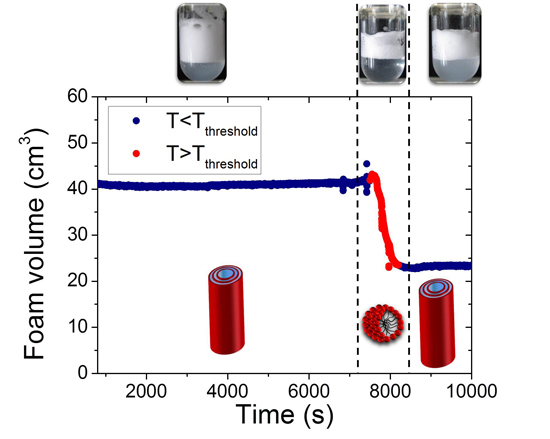
In brief, the research method used by the scientists is based on the mixture between 12-HSA with alkanolamine or amino-acids as counter-ion known to self-assemble into multilamellar micron-size tubes in water. These tubes transit into nanometric micelles at a precise temperature threshold. This temperature depends on both the molar ratio between the 12-HSA and the counter-ion and the alkyl chain length of the counter-ion. Consequently, the temperature threshold can be precisely tuned from 20°C to 75°C. Ultrastable foams have been obtained with the 12-HSA tubes of micron size that are adsorbed at the air/water interface and jammed within the foam liquid channels. Upon heating the foam above the temperature threshold, the tubes transform into nanometric micelles inside the foam liquid channels between the bubbles leading to complete destruction of the foam. The micelles with a nanometric size cannot efficiently stabilize the foam by blocking the gravitational drainage of liquid from the foam, or the occurrence of coalescence and coarsening between bubbles. Therefore, the authors demonstrated that thermoresponsive foams can be obtained from 20°C to 75°C due to the change of 12-HSA self-assemblies from micron-size tubes to nanometric micelles inside the foam. By combining the correct amount of the counterion and the optimum counterion chain length enable to set precisely the temperature threshold over a range that almost covered the one for which water is liquid. These features make it interesting for a wide range of applications where stabilization and controlled destabilization of foam is desired from low to relatively high temperatures, such as: textile, petrochemical, washing, environmental cleanup and material recovery processes.


Reference
Anne-Laure Fameau, Fabrice Cousin, Romain Derrien, Arnaud Saint-Jalmes. Design of responsive foams with an adjustable temperature threshold of destabilization. . Soft Matter, 2018, volume 14, page 2578.
Go To Soft Matter