 Advances in Engineering Advances in Engineering features breaking research judged by Advances in Engineering advisory team to be of key importance in the Engineering field. Papers are selected from over 10,000 published each week from most peer reviewed journals.

Significance
It is important to understand the equilibrium states of mixtures and how colloidal mixtures with varying particle shapes and sizes attain equilibrium. This is stemming from the fact that these mixtures are naturally available and have been widely implemented in industrial applications.
Several researchers have studied previously the kinetics of phase separation using experiments, theory, and simulation. Unfortunately, studying phase transition kinetics is limited by the inherent theoretical challenges in characterizing the phase ordering process and obtaining an adequate experimental system.
The experimental incorporation of a second component in a colloidal suspension has indicated a number of new phenomena, which include dependence of demixing on size ratio, phase transitions, and reentrant phase boundary caused by the depletion interaction. A good number of colloidal mixtures tend to gel, therefore, this presents a difficulty in studying phase transitions in mixtures. Also, the high polydispersity of colloidal particles affects significantly phase transitions.
Researchers at Guangdong University of Technology in China, Mingfeng Chen, Min He, Pengcheng Lin, and Professor Ying Chen in collaboration with Professor Zhengdong Cheng from Texas A&M University presented a staged phase transition study where several pathways exist to realize a tri-phase equilibrium. They used highly anisotropic zirconium phosphate platelets to make an I-N transition at a low volume fraction due to their small aspect ratio. Their research work is published in peer-reviewed journal, Soft matter.
The authors prepared a series of samples with volume fractions of Zirconium Phosphate nanolayers ranging from 0.0054 to 0.0150 while the silica sphere ranged from 0 to 0.0041. In the phase transition processes, the authors found the samples first separated into two metastable phases, which would further develop to attain a tri-phase coexistence. The authors categorized the pathways of the samples into three main categories by implementing the method that was used for colloidal-polymer mixtures.
Experimental results indicated that experimental phase fractions were consistent with the calculated phase fractions qualitatively. However, deviations were expected mainly because of gravitational compression, while the error in computation of the experimental phase fractions and the computation due to the error in the proposed sample positions in the tri-phase coexistence also played a role.
The research team observed staged phase transitions inside the tri-phase triangle in the sphere-plate mixtures. These observations indicated that the initial homogenized specimens originally formed one or two metastable phases. Subsequently, these metastable phases separated into stable phases. The samples finally attained, gas, liquid, and nematic phase coexistence. Even though the specimens inside the tri-phase triangle finally attained equilibrium among the same gas, liquid, and nematic phases, these specimens exhibited distinct pathways.
The authors illustrated this feature by correlating with the free-energy landscape, extending the already developed method for sphere-polymer mixtures. More pathways awaits to be explored experimentally in the proposed platelet-sphere mixtures according to the pathway categories that has been discussed for tri-phase transitions.
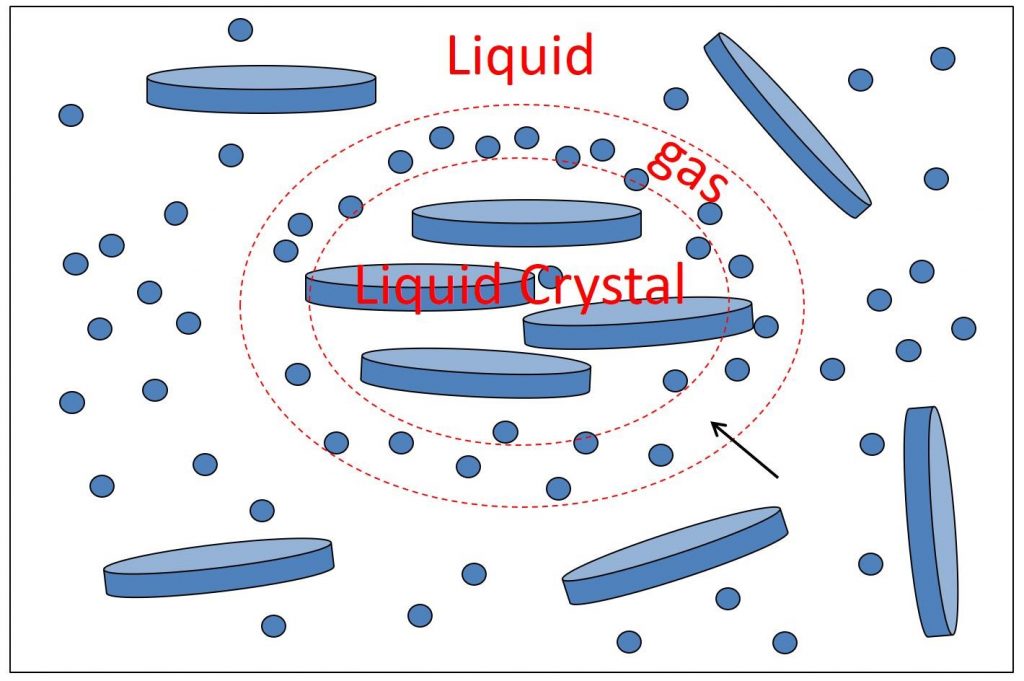
Schematic of liquid crystal droplet with a protective gas layer, which is formed in the first step of the phase transition when the nematic phase can’t coexist with the liquid phase.



Reference
Mingfeng Chen, Min He, Pengcheng Lin, Ying Chena and Zhengdong Cheng. Staged phase separation in the I–I–N tri-phase region of platelet–sphere mixtures. Soft Matter, issue 13 (2017), pages 4457—4463.
Go To Soft Matter
