Advances in Engineering Advances in Engineering features breaking research judged by Advances in Engineering advisory team to be of key importance in the Engineering field. Papers are selected from over 10,000 published each week from most peer reviewed journals.

Significance Statement
In a recent paper published by Prof. Roberto Brighenti (Univ. of Parma, Italy) and by Prof. Franck Vernerey (Colorado Univ. at Boulder, USA) in the Journal Composites Part B: Engineering, “A simple statistical-based approach to model the time-dependent response of polymers with reversible cross-links”, 2016, has been proposed.
Viscoelasticity in soft polymers involves complex molecular mechanisms such as temporary chain entanglements and diffusion; the dynamics of chain entanglements and diffusion have been extensively studied in the past few decades, however, the theoretical models established in the polymer literature have not brought to the corresponding continuum models of viscoelasticity.
Recently, the concept of chain detachment and reattachment was proposed for a new class of polymers with dynamic bonds, either through reversible bonds or bond exchange reactions; macroscopically the network exhibits time-dependent mechanical behaviors, which was found to be well modeled by the approach with multiple natural configurations.
Polymers with bond exchange reactions, which have been recently developed (such as epoxy-acid network, polybutadiene polymers, vitrimers, …) can rearrange their network topology while maintaining the network integrity. Such polymeric materials, characterized by complex entangled polymeric chain network (Fig. 1a) have the capacity to reset their internal microstructure in time (microscopic remodeling mechanism), display a viscoelastic mechanical behavior similar to that of an elastic fluid and have potentiality to be used in advanced applications such as in biomechanics, development of smart materials, morphing materials, thermoforming or materials with improved recyclability to cite only a few.
Mechanical modeling of these materials present a significant challenge because no single reference state exists. The existing models, ranging from the simple linear Maxwell or Kevin-Voigt models to the more advanced nonlinear viscoelastic models, are characterized by a phenomenological basis; a difficulty with molecular physics-based viscoelasticity approaches is the lack of a common natural reference configuration for all polymeric chains, due to the relaxation processes enabled by disentanglement and chain diffusion.
In this work, we propose to fix the above mentioned drawbacks of existing approaches by introducing a theoretical framework for time-dependent responses of soft polymers that is rooted in the statistical description of the underlying polymer network. This framework accounts for the physical state of the polymer through a description of the statistical distribution of the length and direction of chain end-to-end vectors. This distribution can be altered through both the macroscopic deformation and molecular-level events causing chain detachment and re-attachment.
We developed a simple and effective thermodynamically consistent model (framed within the Lagrangian approach) for the mechanical description of polymers that can rearrange their internal cross-links in time (Fig. 1b), leading to a material with multiple reference states at the microscopic level. The model assumes a polymeric chains network consisting of long chains with uniform length and reversible cross-links
The developed model is based on the evolution of the molecular chains’ end-to-end distance distribution function evaluated by taking into account for the acting stretch and for the activation (quantified by the Kon rate parameter) / deactivation (quantified by the Koff rate parameter) kinetics mechanism of the polymer’s cross-links (Fig. 2). Upon stretching the distribution function modifies its shape (Fig. 2a) and, according to the time-dependent cross-links kinetics, the distribution function goes back to its initial state even by keeping a constant stretch of the material (Fig. 2b).
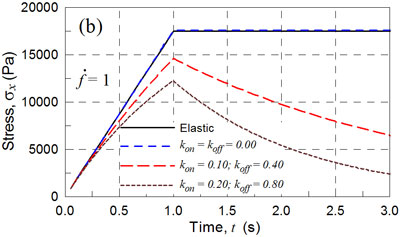
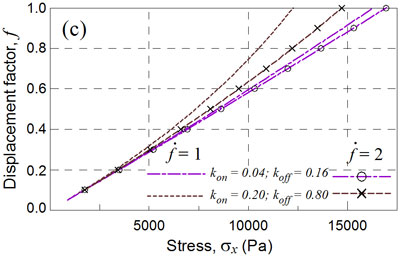
The stress state in the material can then be obtained through the knowledge of its internal energy – that depends on the current end-to-end distance distribution function and on the energy in a single polymeric chain (Fig. 1) – at the desired time instant along the applied deformation history. By changing the activation and deactivation rates different stress-time responses can be obtained and the viscoelastic response can be recognized as much as the activation-deactivation rates assume greater values (Fig. 3a), indicating a more pronounced ability of the material to rearrange its internal microstructure. Furthermore, the loading rate is naturally accounted for by the present model; slower loading rates enhance the recovery of the initial stress-free state, and the stress state in the material – for the same stretch level – is lower than in the case of faster loading rates (Fig. 3b).
It is shown that the proposed approach enables a simple and effective description of the mechanical behavior of polymeric materials with an evolving microstructure, without needing to keep track of their deformation history. The developed theoretical model enables to deal with the mechanical simulations of polymeric materials (such as transient network polymers or self-healing gels) in a simple and effective way. The micromechanical model can be easily implemented in finite element (FE) computational codes, enabling to get the macroscopic mechanical response of active materials under generic stress or strain histories.
The proposed theory is very general and, by adopting specific assumptions of the chain kinetics (such as constant values of the activation-deactivation rates, kinetic rates faster than the loading rate, …..), degenerates to the neo-Hookean elastic model, the Maxwell-type viscoelastic model, and the Newtonian viscous fluid model. Furthermore the micromechanics-based approach allows to account for the existence of multiple networks in the polymer.
Figure Legend 1: 3-D molecular network microstructure of a polymeric material (a). Scheme of the attachment-detachment mechanism in a polymer with dynamic cross-links.
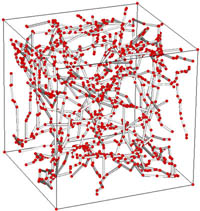
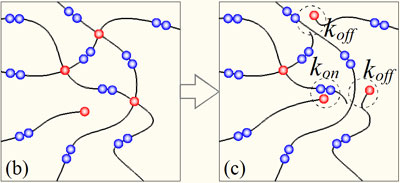
Figure Legend 2. Evolution of the end-to-end (r) probability distribution function for a polymeric material under an increasing stretch (a). The Piola stress P can be evaluated through the derivation of the energy function (depending of the end-to-end probability distribution function itself and on the energy of a single chain ) with respect to the deformation gradient tensor F. In (b) the evolution of the end-to-end probability distribution function by reducing (i.e. relaxing) the applied stretch: the distribution function tends to return back to its initial free-stress state.
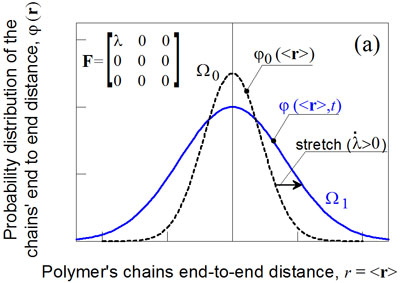
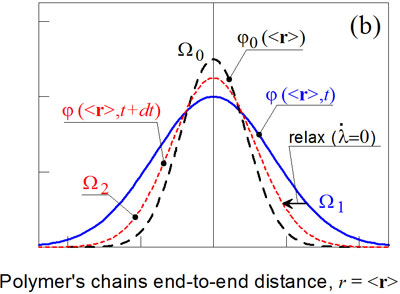

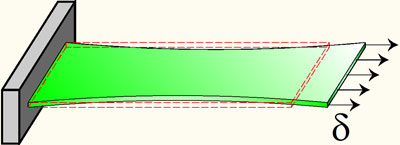
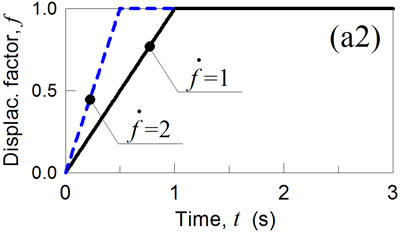
Figure Legend 3: Numerical simulation of a relaxation test on a polymeric material with dynamic cross-links: scheme of the test and time history of the applied displacement, (a1, a2); stress vs time obtained for a given loading rate and different attachment-detachment rates (Fig. 3b). Stress vs stretch factor response obtained by using the proposed approach by changing the loading rate and the attachment-detachment rates of the network (c).


Journal Reference
- Dept. of Civil-Environmental Engng & Architecture, Univ. of Parma, V. delle Scienze 181A, 43124 Parma, Italy
- Department of Mechanical Engineering, University of Colorado at Boulder, USA
Go To Composites Part B: Engineering