 Advances in Engineering Advances in Engineering features breaking research judged by Advances in Engineering advisory team to be of key importance in the Engineering field. Papers are selected from over 10,000 published each week from most peer reviewed journals.

Significance Statement
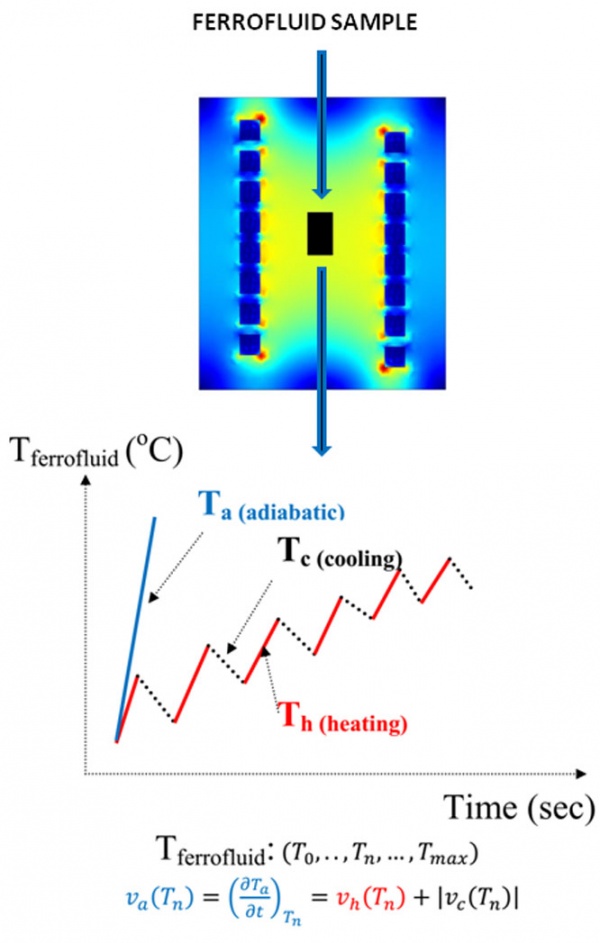
Magnetic fluid hyperthermia (MFH) is a relatively well established procedure in cancer therapy which unfortunately has not enough practical impact due to challenging methodological items having still not reasonable solutions. The procedure involves the injection of a small quantity of ferrofluids in the tumor, followed by application of an AC magnetic field. The nanoparticles dissipate heat in the tumor tissue via different possible mechanisms (depending on particle type and size), leading to a local increase of temperature of a few Celsius degree over the physiologically threshold, process which must be precisely controlled in order to avoid the overheating of adjacent healthy cells. For enough fine non-metallic nanoparticles the main mechanism for heat dissipation is the superparamagnetic relaxation which depends on the particle size distribution and interparticle interactions. The distribution of the temperature in the tissue might be obtained via a numerical solution of the bio-heat transfer equation (BHTE) which has as a main source term (in case of the superparamagnetic relaxation mechanism) the volumetric power generated by nanoparticles. This term is directly related to the specific absorption rate (SAR). Even if the administration of nanoparticles in MFH is made under low concentrations, agglomeration of nanoparticles could appear in some internal parts of the tissue (as possible to be estimated by imagistic techniques). Therefore, SAR (as an input local parameter in BHTE), should be precisely estimated as function of the volume fraction and temperature. This parameter can be theoretically evaluated knowing the physical properties of the nanoparticles and the parameters of the AC magnetic field, and experimentally by calorimetric and magnetic measurements on ferrofluid samples of different volume fractions. A suitable way of SAR evaluation is proposed in this paper as based on calorimetric measurements. The compensation of the experimental temporal dependence of the temperature by taking into account the heat losses which are unavoidable in experimental measurements is performed.
Journal Reference
Eur Phys J E Soft Matter. 2015; 38(6):57.
Iacob N, Schinteie G, Palade P, Ticos CM, Kuncser V.
National Institute for Lasers, Plasma and Radiation Physics, PO Box MG-36, 077125, Bucharest-Magurele, Romania.
Abstract
The aim of this paper is to present a reliable procedure for the experimental determination of the specific absorption rate (SAR) in case of superparamagnetic Fe oxide nanoparticles dispersed in liquid environments. It is based on the acquisition of consecutive steps of time-temperature dependences along of both heating and cooling processes. Linear fitting of these recorded steps provides the heating and cooling speeds at different temperatures, which finally allow the determination of the heating profile in adiabatic-like conditions over a broad temperature range. The presented methodology represents on one hand, a useful alternative tool for the experimental evaluation of the heating capability of nanoparticulate systems for magnetic hyperthermia applications and on the other hand, gives support for a more accurate modeling of bio-heat transfer phenomena.
Go To Eur Phys J E Soft Matter.