Advances in Engineering Advances in Engineering features breaking research judged by Advances in Engineering advisory team to be of key importance in the Engineering field. Papers are selected from over 10,000 published each week from most peer reviewed journals.

Significance Statement
Owing to the rising global concerns of energy problems, efficient harvesting of renewable energy resources is being pursued with much zeal. Dye sensitized solar cells are environmentally friendly, have a subsidized cost of production and have been observed to be one of the most promising energy harvesting devises. Unfortunately, most of the sensitizers used are chemical metal dyes which are rather expensive, environmentally non-friendly and tedious to fabricate. Therefore, with such realization of the higher photovoltaic performance and durability in dye sensitized solar cells, the development of the sensitizing dyes is one of the most important approaches. In a bid to enhance the photovoltaic performance in dye sensitized solar cells, considerable efforts have been devoted to optimize the structure of the organic dyes, such as by increasing the amount of anchoring groups and extending π-conjugation to increase the molar extinction coefficient of the absorption band, which can improve the light harvesting ability of the dyes.
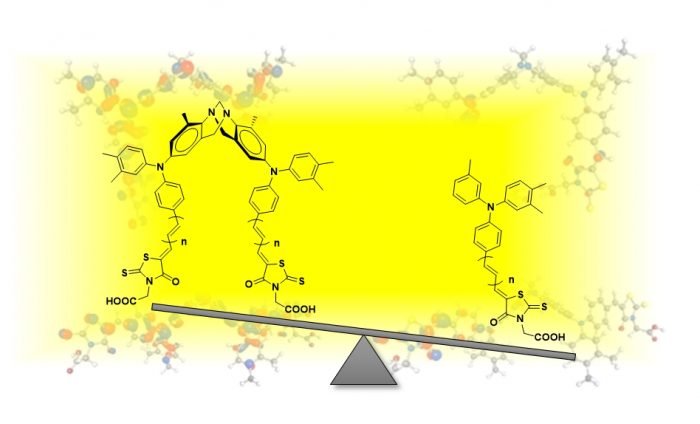
Researchers led by professor Vytautas Getautis at Kaunas University of Technology in Lithuania, proposed a structural study of Troger’s base scaffold-based dyes for dye sensitized solar cells applications. They hoped to investigate the influence of the polymethine chain length and number of the anchoring groups on the photo-physical, electrochemical, and photovoltaic properties of the V-shape sensitizers. Their work is now published in the research journal, Dyes and Pigments.
The study was conducted in initially by carrying out cyclic-voltammetry measurements on the acquired solvents and reagents to be used in their study. The team then measured the ionization potentials of the layers of the synthesized compounds by electron photoemission in air technique. Sensitizer series were then designed so as to investigate the influence of the poly[n]enic (from n=0 to 2) backbones and their anchoring effect in dye sensitized solar cells. Optical, electrochemical and photovoltaic properties were compared with analogues dyes D1-D3 possessing one anchoring group.
The research team observed that the extended polymethine chains displayed excellent flexibility of the V-shape sensitizers units and inspired the interaction between two chromophores promoting aggregate formation in the Troger’s base-based dyes. In return, the best result of dye sensitized solar cells, showed an overall conversion efficiency of 2.36%, and was obtained using dye D1, which possessed the shortest polymethine chain length and one anchoring group.
Vytautas Getautis and colleagues successfully presented the design and synthesis of a series of novel metal-free di-anchoring organic dyes based on a Troger’s base scaffold. The Troger’s base used possessed triphenylamine donor and rhodanine-3-acetic acid as the anchoring group being linked by the polymethine chain. Their work will help prove that the extended polymethine chains ensure flexibility of the units and inspire the interaction between two chromophores thereby promoting aggregate formation in the Troger’s base-based dyes.






Reference
Simona Urnikaite, Titas Braukyla, Artiom Magomedov, Egidijus Kamarauskas, Tadas Malinauskas, Vytautas Getautis. A structural study of Troger’s base scaffold-based dyes for DSSC applications. Dyes and Pigments volume 143 (2017) pages 48-61.
Go To Dyes and Pigments