Advances in Engineering Advances in Engineering features breaking research judged by Advances in Engineering advisory team to be of key importance in the Engineering field. Papers are selected from over 10,000 published each week from most peer reviewed journals.

By TD-NMR and AFM – Zinc Stearate System
Significance
Over the past few years, rubber materials have been increasingly applied in different fields such as automobiles and aerospace industries. To date, cross-linking raw rubbers have been widely used to produce rubber networks with desirable properties. Unfortunately, the heterogeneous nature of conventional cross-linking reactions, such as vulcanization induced by various factors such as fillers, makes it hard to control the formation of rubber networks. To this end, the production of sturdier and stable rubber materials is of great importance and requires a thorough understanding of the rubber network structures.
Previous studies have revealed some of the factors affecting the formation of isoprene rubber networks. The combination of zinc oxide (ZnO) with other reagents was found to be crucial for controlling the structural network inhomogeneity consisting of network domains and mesh network of the matrix in the N-(1,3-benzothiazol-2-ylsulfanyl)cyclohexanamine (CBS)-accelerated vulcanization system. Nevertheless, despite the extensive studies on the preparation of rubber materials, there is no clear understanding of the underlying mechanisms by which the combination of ZnO and stearic acid (StH) enables the control of mesh size in the CBS-accelerated vulcanization. Consequently, the speculations that the reaction between ZnO and StH results in activator zinc stearate (ZnSt2) that plays a significant role in the cross-linking reactions needs to be verified.
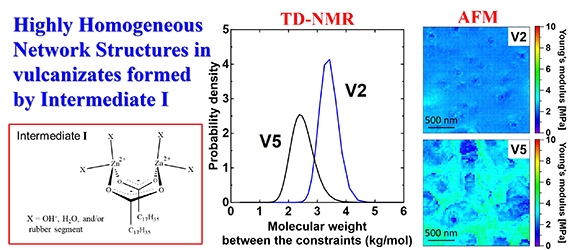
The authors found out that the intermediate I was well dispersed in the rubber matrix and was the main reason for forming highly homogenous network structures when CBS was reacted with sulfur. This was attributed to its high solubility and fast diffusion properties. Increasing the concentration of ZnSt2 led to an increase in the amount of intermediate I generated and a corresponding decrease in the molecular weight between the constraints of the network structures. In contrast, a decrease in the network uniformity and a widened distribution of the molecular weight between cross-links were observed when large amounts of ZnSt2 were used. Additionally, it was worth noting that controlling the formation of the network structures was highly influenced by the amount of intermediate I. A unique feature of this work is that, for the first time, the mesh size distributions in the networks were characterized by two entirely different techniques, the results of which were found to be in near quantitative agreement.
In summary, the authors, for the first time, reported the significant role of ZnSt2 activator in sulfur cross-linking reactions of isoprene rubber using a combination of TD-NMR and AFM. The high homogeneity of the network structures uncovered unreported insights governing the vulcanization mechanisms during rubber processing. Based on this information, it was noted that the mesh network structure of the matrix could be controlled by controlling the amount of ZnSt2, which further influences the amount of intermediate I generated. Altogether, this approach provided quantitative structural information applicable in studying complicated network structures in rubber vulcanizates. In a statement to Advances in Engineering, the authors emphasized that the ideas provided in the study would advance rubber science and technology by providing a breakthrough in understanding the vulcanization mechanism.





Reference
Miyaji, K., Sugiyama, T., Ohashi, T., Saalwächter, K., & Ikeda, Y. (2020). Study on Homogeneity in Sulfur Cross-Linked Network Structures of Isoprene Rubber by TD-NMR and AFM – Zinc Stearate System. Macromolecules, 53(19), 8438-8449.