Advances in Engineering Advances in Engineering features breaking research judged by Advances in Engineering advisory team to be of key importance in the Engineering field. Papers are selected from over 10,000 published each week from most peer reviewed journals.

Significance
A typical emulsion system consists of a mixture of two or more immiscible liquids and is considered a more general class of two-phase systems of colloids and matter. Such systems have found a wide range of applications in numerous industrial fields like medicine and engineering. In many fields, significant research efforts have been devoted to isolating specific materials with hydrophobic properties from the surrounding environments through encapsulation in hydrophilic phase. In most cases, these studies were successful since they employed various amphiphilic materials as emulsifying agents.
It is of great importance for emulsion templates to have long-term stability. Previous studies that have attempted to endow emulsion templates with desirable stability properties have mainly relied on applying high voltages of mechanical energy to the system instead of chemical methods capable of stabilizing emulsification agents. However, these methods result in phase separation over time as they only endow stability after the process. Additionally, applying inappropriate voltages may cause system demulsification and degraded performance. Thus, finding more robust alternative approaches to enhance emulsion stability is imperative.
Recently, nanoparticles with core-shell structures have emerged as a promising alternative. These particles are generally prepared by modifying their as-synthesized surface with other specialized materials. While this approach has recorded some progress in improving adsorption energy at the interface by changing the structure and shape of the surfactants, there is still room for improvement. In particular, using oil-in-water emulsion system has drawn significant attention as a promising approach to overcome these challenges. However, there is no experimental work to verify their feasibility.
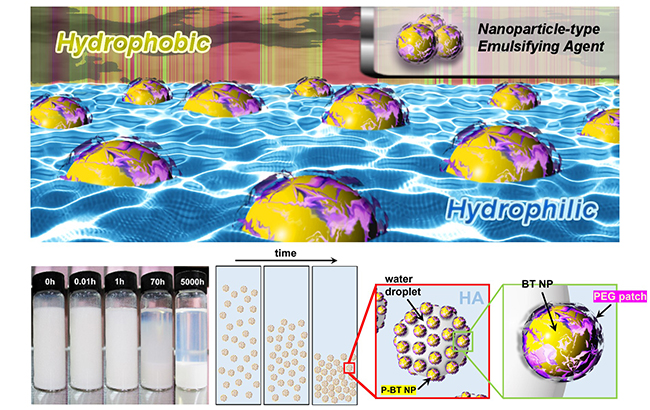
On this account, Dr. Taegyun Kwon and his colleague from Corporate R&D Institute at Samsung Electro-Mechanics Co. Ltd investigated the use of nanoparticle-type emulsifying agents to stabilize conductive colloidal dispersions using oil-in-water Pickering emulsion technique. Specifically, BaTiO3 nanoparticles (BT NPs) with core-shell structures were used as emulsifying agents. They were designed to have hydrophobic and hydrophilic surface properties for easy location at the water-oil interface. Their work is currently published in the peer-reviewed journal, Chemical Engineering and Processing – Process Intensification.
The authors managed to replace the solvent phases of conductive Nickel paste with water through oil-in-water emulsification. Thus, additional hydrophilic properties were successfully assigned to the original paste consisting of only hydrophobic phases due to the strong adsorption of the nanoparticle agents to form a stable emulsion paste. Additionally, a selective location of Ni nanoparticles capped with hydrophobic polymer binders and hydrophobic surface ligands only in the oil droplets was reported.
The applications of nanoparticles with an amphiphilic surface as emulsifying agents have several benefits, including increased compatibility between the two phases in the immiscible liquid. For the region with well-balanced hydrophobic and hydrophilic properties on the surface, P-BT nanoparticles exhibited very high adsorption energy at the water-HA phase interface. This further resulted in the production of Ni emulsion paste with excellent efficiency never reported before. The results confirmed that the emulsion paste maintained its initial stability of 5000 h with significantly higher stability at elevated temperatures of up to 150 ℃.
In summary, this is the first contribution in this industry to use the oil-in-water emulsion system to the metal paste used as an internal electrode material of multilayer ceramic capacitors. By redesigning the emulsifying agents, the stability limitations reported in the previous studies were addressed. The presented approach guaranteed more excellent emulsion stability than the previously used methods due to the use of amphiphilic BT nanoparticles as emulsifying agents. In a statement to Advances in Engineering, Dr. Kwon’s research team explained their study provided valuable insights that would contribute to the development of water-dispersible paste systems for applications in different industries.

Reference
Kwon, T., & Lee, E. (2023). Super-stable conductive colloidal dispersions stabilized by nanoparticle-type emulsifying agents. Chemical Engineering and Processing – Process Intensification, 184, 109288.
Go To Chemical Engineering and Processing – Process Intensification