Advances in Engineering Advances in Engineering features breaking research judged by Advances in Engineering advisory team to be of key importance in the Engineering field. Papers are selected from over 10,000 published each week from most peer reviewed journals.

Significance
Electrodeposition has long been recognized as a practical tool for material synthesis, but when it comes to producing conducting polymers with finely tuned properties, the method often feels like working with blunt instruments. Among these polymers, polypyrrole (PPy) continues to stand out for its versatility in applications ranging from supercapacitors to biomedical devices. Yet, despite years of research we still don’t know how to precisely control the micro- and nanoscale architecture of these films during synthesis. This is important because the morphology of PPy films directly governs their electrochemical performance—affecting conductivity, charge storage capacity, and long-term stability and without control over structure, we remain limited in how far we can push the material’s performance. Aqueous electrodeposition systems, which dominate the field, impose rigid boundaries on what’s possible. The inherent properties of water as a solvent restrict the fine-tuning of mass transport and nucleation dynamics—two critical factors that dictate how polymer chains organize at the electrode interface. The use of surfactants has provided some relief, but even this approach reaches its limits when the solvent environment itself remains static and poorly suited for guiding complex structural evolution. This limitation has driven a search for alternative environments capable of offering better control, and supercritical carbon dioxide (scCO₂) emerges as a remarkably underutilized candidate. What makes scCO₂ so compelling is its low environmental footprint—although that certainly makes it attractive in an era demanding greener processes—as well as its unique physical characteristics. It behaves as both a gas and a liquid, combining high diffusivity with solvent power in a way that fundamentally changes interfacial behavior. These properties aren’t just academic curiosities; they provide a real pathway to influence polymer growth at the molecular level, allowing for the kind of precision that conventional aqueous systems simply cannot deliver. And yet, for all its promise, scCO₂ has remained largely absent from anodic polymer electrodeposition research. While it has found a comfortable role in the cathodic deposition of metals, its capacity to unlock new morphologies and functionalities in conducting polymers like PPy has barely been explored. This gap isn’t due to a lack of interest, but perhaps a hesitation to venture beyond well-trodden ground. It’s precisely this hesitation that this study challenges—by asking whether scCO₂ can not only match but surpass traditional systems in delivering both structural control and enhanced electrochemical performance. Seeing a clear gap in the control of conducting polymer morphologies, new research paper published in Journal of The Electrochemical Society and conducted by PhD student Punvinai Vinaisuratern, Dr. Tomoyuki Kurioka, Professor Chun-Yi Chen, Professor Tso-Fu Mark Chang and Professor Masato Sone from the Institute of Integrated Research at Institute of Science Tokyo investigated whether scCO₂ emulsified electrolytes could offer a fundamentally new approach for tuning the structure of electrodeposited PPy films. Their hypothesis was both straightforward and ambitious: by introducing sodium dodecyl sulfate (SDS), an anionic surfactant, into the scCO₂-aqueous system, it might be possible to not only stabilize the emulsion but also directly influence the nucleation and growth kinetics during polymer deposition. The goal wasn’t simply to refine morphology for the sake of aesthetics—it was to engineer films with superior electrochemical behavior, overcoming the well-known limitations of conventional aqueous systems.
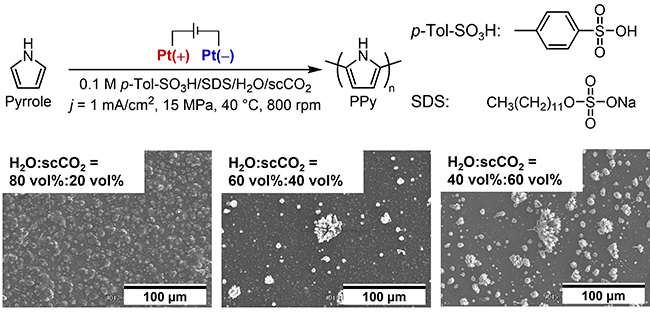
The research team employed a custom-designed electrochemical cell capable of sustaining the high pressures and temperatures necessary to maintain CO₂ in its supercritical state. Electrodepositions were carried out at a constant current density of 1 mA/cm², and by systematically varying both the CO₂-to-water volume ratios and SDS concentrations, they constructed an experimental matrix specifically designed to isolate and understand the influence of each variable on film growth. Their initial investigations centered on the effect of SDS concentration. In the absence of surfactant, the PPy films barely adhered to the platinum electrode, forming uneven, poorly defined structures that left significant areas exposed. This clearly reflected inefficient monomer transport and an uncontrolled nucleation process. However, once SDS was introduced above its critical micelle concentration (CMC), the change was immediate and dramatic. At 10 mM SDS, the films became more uniform, developing conical surface features. When the concentration was increased to 40 mM, these structures became even denser and highly nodular, suggesting that micelle formation was facilitating more effective monomer delivery and accelerating nucleation rates at the electrode interface. SEM imaging captured these changes with remarkable clarity, revealing how such seemingly modest adjustments to the electrolyte composition profoundly influenced the final film architecture. The next phase, the authors focused on manipulating the CO₂-to-water ratio. With SDS fixed at 40 mM, increasing the CO₂ content produced a striking transition in film morphology. At lower CO₂ levels (20/80), the nodular structures remained. But as the ratio shifted to 40/60 and eventually 60/40, the researchers found that films evolved into highly intricate, flower-like architectures—complex structures that had not previously been observed in supercritical fluid electrodeposition. The team hypothesized that higher CO₂ concentrations modified interfacial dynamics and local electrochemical environments, effectively driving the system toward these unexpected structural outcomes. Finally, to connect these morphological differences with functional performance, cyclic voltammetry analyses were conducted. The authors found that films produced under higher CO₂ content and optimized SDS concentrations showed significantly enhanced redox activity, delivering higher current densities and excellent stability across repeated cycling.
In conclusion, Institute of Science Tokyo scientists successfully developed a novel and environmentally friendly method to precisely control the morphology of electrodeposited PPy films using scCO₂ emulsified electrolytes combined with SDS as a surfactant. One result that really stands out is the emergence of flower-like PPy structures which was achieved without turning to toxic solvents or complicated processing steps, which is a welcome change in a field often dominated by environmentally questionable practices. We believe also what makes this approach even more compelling is how accessible it is. Adjusting the CO₂-to-water ratio and the concentration of a common surfactant like SDS isn’t exactly cutting-edge from a technical standpoint—but that’s the point. Sometimes, meaningful breakthroughs come from revisiting basic parameters with fresh eyes rather than inventing entirely new methodologies. And with industries increasingly under pressure to adopt greener manufacturing processes, a method that aligns so naturally with sustainability goals is bound to attract serious attention beyond academic labs.





Reference
Vinaisuratern, Punvinai & Kurioka, Tomoyuki & Chen, Chun-Yi & Chang, Tso-Fu Mark & Sone, Masato. (2024). Communication—Influence of Supercritical CO2 Emulsified Electrolyte on the Morphology of Electrodeposited Polypyrrole Films. Journal of The Electrochemical Society. 171. 10.1149/1945-7111/ad77f7.