Advances in Engineering Advances in Engineering features breaking research judged by Advances in Engineering advisory team to be of key importance in the Engineering field. Papers are selected from over 10,000 published each week from most peer reviewed journals.

Significance
Studying hydrophobicity of water to various surfaces is a hot research area owing to the many potential fields of application it can be employed in, including: anti-icing, corrosion resistance, self-cleaning and water-oil separation – among others. Of interest, are the superhydrophobic surfaces; which have a water contact angle that is >150°. Adept knowledge of any material and how it interacts with other materials is the key to its successful utilization. In this context, steel is the most common metal alloy in use globally owing to its low cost and excellent mechanical properties. Therefore, the fabrication of superhydrophobic coatings on mold steel has considerable industrial significance. Presently, numerous techniques have been devised for fabricating superhydrophobic surfaces. However, the metal substrates used are limited to copper, titanium, aluminium and the research on other metal materials especially steel substrates is still insufficient. It is therefore imperative that a facile, highly efficient, low cost and environmental-friendly method to fabricate superhydrophobic surfaces on steel substrates be developed.
Recently, Dalian University of Technology scientists led by Dr. Jinlong Song in collaboration with Dr. Yao Lu at University College London used Electrochemical Machining (ECM) technology, based on passivation property of steel, to prepare superhydrophobic surfaces on mold steel substrates. Particularly, they use the technique to create surface structures with roughness on Zinc and Magnesium alloy surfaces to achieve superhydrophobicity. Their work is currently published in the research journal, Surface & Coatings Technology.
In brief, the research method employed entailed the fabrication of superhydrophobic surfaces on mold steel substrates via simple and environment-friendly electrochemical technology followed by fluoroalkylsilane modification. The researchers then investigated the microstructure, crystal structure, chemical composition, and wettability of the sample surfaces using scanning electron microscopy, X-ray photoelectron spectroscopy, X-ray diffraction, Fourier transform infrared spectroscopy and optical contact angle measuring instrument. Lastly, they studied the influences of current density and electrochemical machining time on wettability.
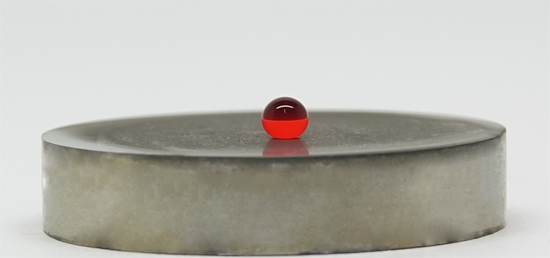
The authors observed that after the electrochemical processing, the mold steel substrates were covered with a layer of passive films, which had micro/nano binary rough structures composed of rugged plateau structures and rupture-like shapes. In addition, before the fluorination procedure, the obtained sample surfaces showed superhydrophilicity, while after fluorination the sample surfaces became superhydrophobic. To be exact, the water contact angles of the obtained sample surfaces were 167.2°, while the water rolling angles were only 4.4°.
In summary, the study presented and demonstrated a novel simple, economical and eco-friendly technique for fabricating superhydrophobic surfaces on mold steel substrate. In general, they noted that processing time had little effect on surface wettability under proper current density, thereby making it possible to prepare superhydrophobic surfaces within just a few seconds. More so, after reduction of surface energy of the passive films, superhydrophobic surfaces were obtained. Altogether, the proposed novel technique is simple, economical and environmentally friendly, and has great potential for large-scale industrial applications.


Reference
Jinlong Song, Wenbo Huang, Jiyu Liu, Liu Huang, Yao Lu. Electrochemical machining of superhydrophobic surfaces on mold steel substrates. Surface & Coatings Technology, volume 344 (2018) page 499-506.
Go To Surface & Coatings Technology