Advances in Engineering Advances in Engineering features breaking research judged by Advances in Engineering advisory team to be of key importance in the Engineering field. Papers are selected from over 10,000 published each week from most peer reviewed journals.

Significance
Gas hydrates forming under cold, pressurized conditions has long been a major challenge for pipeline engineers and these crystalline solids—essentially ice cages trapping gases like methane—can grow unexpectedly fast, restricting or even sealing off flow within natural gas lines. While chemical inhibitors have been the standard defense, their use comes with familiar compromises: high cost, environmental concerns, and, paradoxically, the tendency of some additives to make hydrates adhere even more tightly once they form. Over time, researchers started to think differently and to look beyond chemistry and toward the physics of the pipe surface itself. For instance, the lotus leaf, with its extraordinary ability to shed water, inspired scientists to engineer surfaces that resist wetting altogether. If the liquid never truly settles, hydrate nuclei have nowhere to grow. Experiments have shown a consistent trend—surfaces with larger contact angles tend to show dramatically lower adhesion. However, the real-world application of such coatings has proven stubbornly difficult. Under high pressure, vibration, and continuous water exposure, many coatings lose their hydrophobicity or peel away from the metal substrate, reminding us that ideal behavior in the lab rarely translates directly to the field. One promising direction has emerged in the use of ZSM-5 zeolite. Its rigid, porous framework and high Si/Al ratio make it unusually compatible with steel, while its resistance to corrosion and capacity for surface modification provide a stable foundation for hydrophobic coatings designed to withstand the harsh realities of natural gas transport. To this account, new research paper published in Colloids and Surfaces A: Physicochemical and Engineering Aspects and led by Professor Wenjuan Zhang and Professor Shuanshi Fan from the South China University of Technology, the researchers developed two complementary models: an experimental ZSM-5/PES superhydrophobic coating with a hierarchical micro-nano structure, and a theoretical thermodynamic model linking contact angle to the critical nucleation energy of cyclopentane hydrates.
The research team synthesized ZSM-5 nanoparticles hydrothermally using tetraethyl orthosilicate, tetrapropylammonium hydroxide, and sodium aluminate precursors, followed by calcination and ion exchange to yield NH₄- and H-type forms. Surface fluorination with FAS-17 imparted strong hydrophobicity. They dispersed these particles with PES in dimethylformamide, and then applied the mixture onto pre-treated X80 pipeline steel before curing at 240 °C to form adherent coatings about 65 µm thick. They found the composite to display a hierarchical micro/nanostructure with rough asperities that trap air cushions, as confirmed by SEM and energy-dispersive spectroscopy.
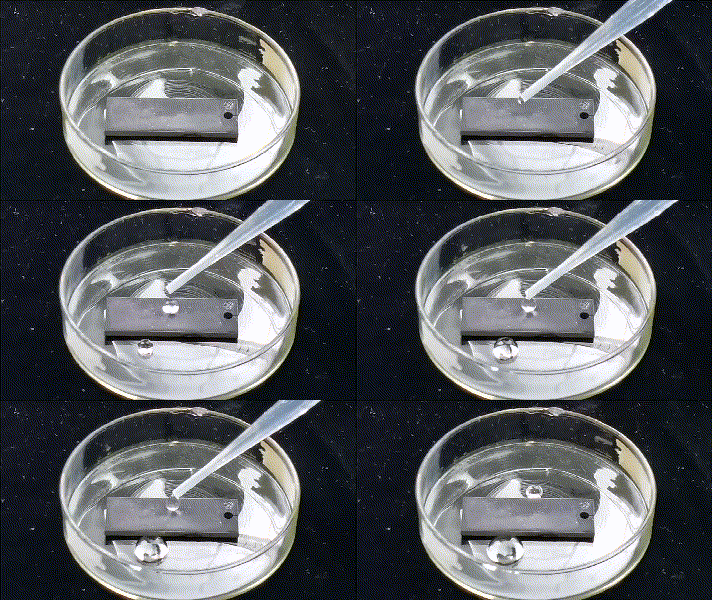
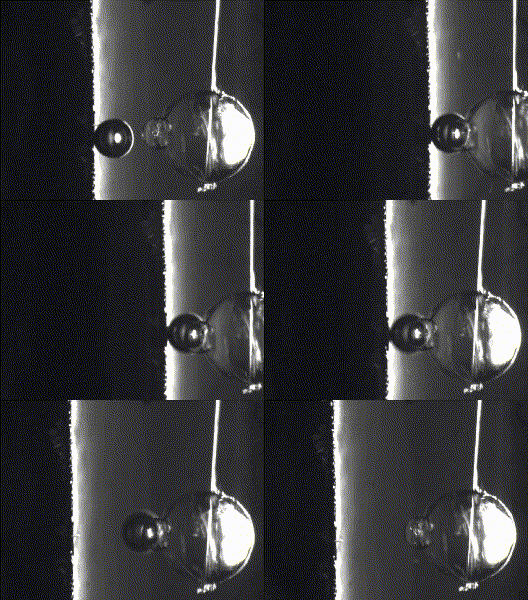
The authors showed using wettability analysis, synthesis time and crystal form important to determine hydrophobicity. NH₄-ZSM-5 synthesized for 12 hours achieved optimal oil- and water-repellent behavior, whereas excessive synthesis led to aggregation and reduced liquid repellency. Adjusting the ZSM-5 : PES ratio further tuned performance: increasing ZSM-5 content enhanced the water contact angle from 91.9° to 162°, but too much zeolite weakened adhesion to the substrate. The 5 : 1 ratio offered the best compromise—Grade 0 adhesion and superhydrophobicity. On the other hand, when the team conducted condensation tests at 1 °C and 85 % relative humidity showed dramatic differences between bare steel and the coated surface. On X80, the authors found water condensed continuously into large droplets forming a film after several hours, while on the ZSM-5 coating, droplets stayed spherical and repeatedly coalesced and bounced off and even after ten hours, droplet diameters remained below 0.5 mm, roughly one-eighth those on bare steel which confirm suppressed condensation due to the Cassie-Baxter wetting state. To probe hydrate behavior, cyclopentane hydrate nucleation was monitored microscopically. Hydrate crystals appeared on X80 after 321 minutes and thickened within minutes, but no nucleation occurred on the ZSM-5 coating throughout the experiment. Theoretical modeling quantified this observation: the critical nucleation energy of CyC₅ hydrate rose monotonically with increasing contact angle which makes formation energetically unfavorable on hydrophobic surfaces. Moreover, the team showed similar trends in their adhesion measurements and reported On X80, CyC₅ hydrates adhered strongly (> 6.6 mN/m) and resisted detachment, whereas on the optimized coating, adhesion dropped to undetectable levels. Indeed, across samples with contact angles from 92° to 162°, the adhesion force declined linearly, demonstrating that surface wettability governs mechanical detachment strength.
In conclusion, the study by Dr. Wenjuan Zhang and her tutor Professor Shuanshi Fan successfully designed new models that elucidated how surface hydrophobicity suppresses condensation, nucleation, and adhesion simultaneously. The resulting coating achieved a water contact angle of 162° and reduces hydrate adhesion to undetectable levels, providing a practical, durable, and environmentally safe strategy for hydrate prevention in natural-gas pipelines. Fan’s group created successfully a coating that unites three key protections: delayed condensation, inhibited hydrate nucleation, and negligible adhesion by integrating the porosity and adhesion strength of ZSM-5 with the flexibility of PES and the ultralow surface energy of fluorinated silanes. Moreover, this coating offers a transformative pathway for natural-gas pipeline safety. This is different from conventional inhibitors that require continuous chemical dosing, the ZSM-5/PES layer is passive, durable, and environmentally benign. Its superhydrophobicity remains stable after repeated condensation cycles, and its strong interfacial bonding ensures endurance in turbulent multiphase flows. By reducing the adhesion force of hydrates to near-zero, maintenance intervals can be extended and the risk of catastrophic plugging nearly eliminated. Beyond pipeline transport, we believe the new findings have wider implications for other cryogenic and sub-sea applications where water–solid interactions govern icing, fouling, or hydrate formation—such as LNG storage, cold-energy systems, and heat exchangers. The mechanistic insight into nucleation barriers also enriches fundamental surface-science theory which suggest that the design of next-generation coatings should consider not only static contact angles but also dynamic behaviors such as droplet bouncing and air-cushion persistence. The researchers’ approach demonstrates that durable anti-hydrate performance can be achieved through rational structural hierarchy rather than relying on exotic materials. By revealing the near-linear dependence between adhesion force and contact angle, the study provides a quantitative design rule that can guide industrial optimization. It also highlights the promise of zeolite-based frameworks for multifunctional coatings combining corrosion resistance, hydrophobicity, and mechanical integrity. Professor Fan is an internationally renowned hydrate expert, he established a dedicated gas hydrate research center (https://www2.scut.edu.cn/hydratech/main.htm) composed of 45 people (included Prof. Yanhong Wang, Prof. Xuemei Lang, Prof. Gang Li) at South China University of Technology. The kinetic hydrate inhibitors they developed have already been used in China oil and gas fields.Future developments may involve scaling this coating for long pipelines, adapting the deposition process to curved surfaces, and testing under pressurized methane flow.
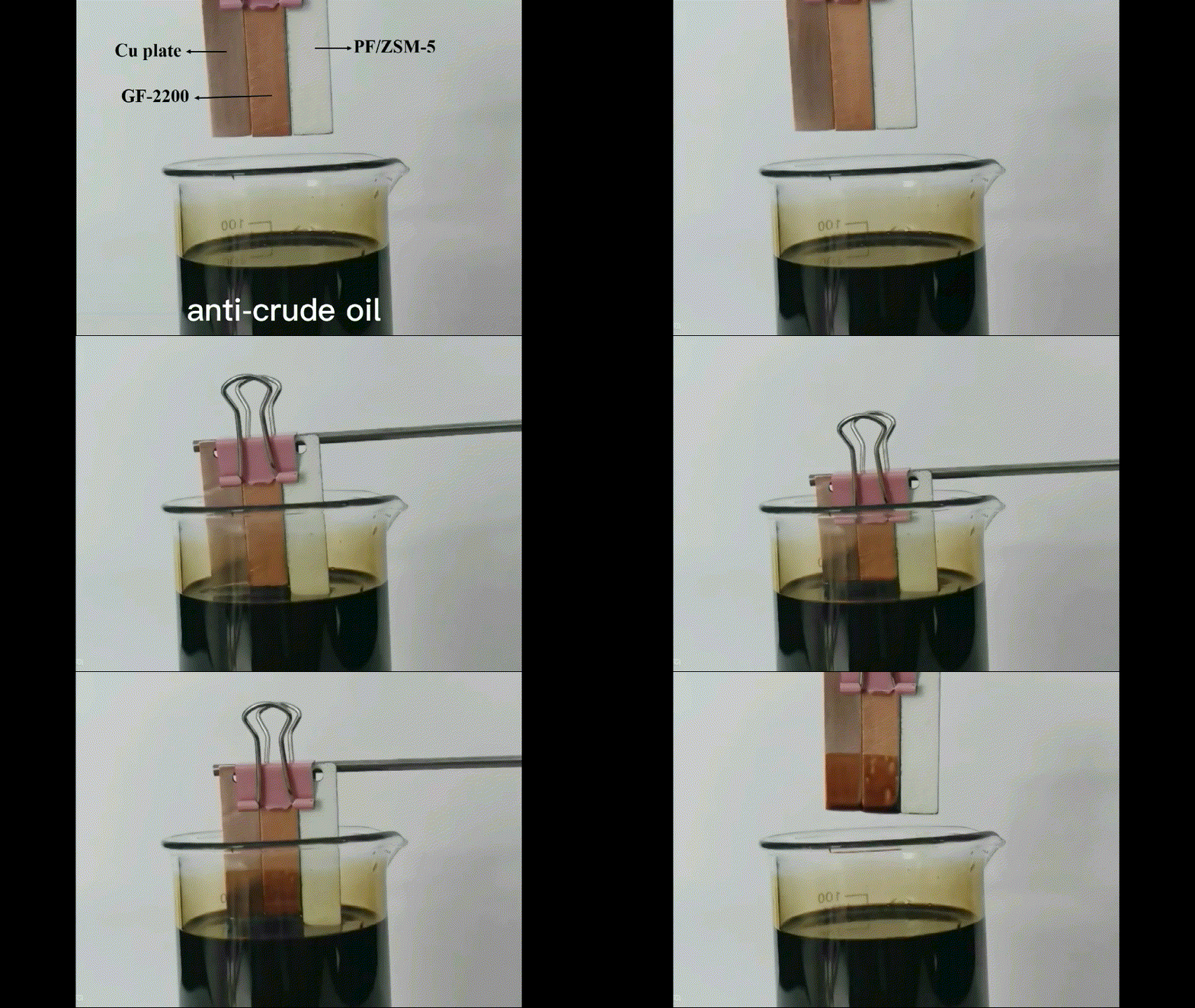
is metal sheet with GF-2200, right sheet is metal sheet with PF/ZSM-5 coating




References
Wenjuan Zhang, Shuanshi Fan, Preparation of anti-hydrate coating on natural gas pipeline and the inhibition performance of hydrate nucleation and adhesion, Colloids and Surfaces A: Physicochemical and Engineering Aspects, Volume 715, 2025, 136620
Go to Colloids and Surfaces A: Physicochemical and Engineering Aspects
Wenjuan Zhang, Shuanshi Fan, Yanhong Wang, Xuemei Lang, Gang Li, Preparation and performance of biomimetic superhydrophobic coating on X80 pipeline steel for inhibition of hydrate adhesion, Chemical Engineering Journal, Volume 419, 1 September 2021, 129651